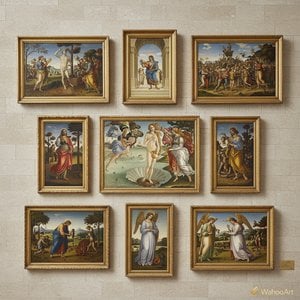
The Rebirth of Perspective: Understanding the Foundations of Early Renaissance Composition
To step into the world of the Early Renaissance is to witness a profound awakening, a moment where the flat, symbolic language of the Middle Ages began to dissolve into a breathtakingly three-dimensional reality. This era, often referred to as the Quattrocento, was characterized by an obsessive pursuit of depth and spatial logic. Artists were no longer content with placing figures against a gold-leaf void; they sought to puncture the surface of the canvas and invite the viewer into a measurable, breathable world. The mastery of linear perspective—the mathematical orchestration of vanishing points and receding lines—transformed the painted plane into a window through which we glimpse an organized universe.
This revolution in composition was not merely a technical feat but a philosophical shift. By applying geometric rigor to the depiction of space, painters like those of the Florentine school began to ground sacred narratives within a human-centric reality. The architecture within these paintings—the marble columns, tiled floors, and distant cityscapes—served as a structural framework that anchored the divine within the terrestrial. As the eye travels through these meticulously constructed vistas, one feels the weight of the atmosphere and the true distance between the foreground figures and the horizon, creating a sense of presence that had been absent for centuries.
Ultimately, this mastery of perspective laid the groundwork for all subsequent Western art. It provided the vocabulary necessary to depict the drama of human interaction within a believable environment, ensuring that the viewer was not just an observer of a holy icon, but a participant in a living scene. This structural evolution remains one of the most enduring legacies of the dawn of modernity.
Anatomical Precision and Humanism: The Scientific Evolution of Artistic Detail
As the mathematical foundations of space were being solidified, a parallel revolution was occurring within the human form itself. The rise of Humanism—a movement celebrating human agency, intellect, and the beauty of the natural world—demanded a new level of anatomical accuracy. Artists began to look beyond mere silhouettes, seeking to understand the underlying mechanics of bone, muscle, and sinew. This period saw the artist’s studio transform into a laboratory of observation, where the boundaries between art and science became beautifully blurred.
Nowhere is this scientific curiosity more evident than in the preparatory studies that preceded the final masterpieces. Consider the profound anatomical investigations found in works such as Leonardo da Vinci’s Studies of Human Skull. These drawings were not merely exercises in sketching but rigorous inquiries into the very architecture of life. By dissecting the complexities of the cranium and the musculature of the face, artists could imbict their figures with a sense of weight, tension, and psychological depth. When a figure moves, we see the subtle shift of muscle beneath the skin; when they grieve, we witness the anatomical reality of sorrow etched into the brow.
This dedication to precision allowed for a more profound emotional resonance. The human body became a vessel for the soul's expression, capable of conveying complex narratives through posture and gesture alone. This marriage of scientific inquiry and artistic grace ensured that the figures of the Early Renaissance possessed a palpable vitality, bridging the gap between the eternal and the mortal.
Sacred Landscapes and Devotional Light: Exploring Symbolism in Quattrocento Masterpieces
While the era was defined by a move toward realism, it never abandoned the profound spiritual symbolism that had long been the heartbeat of European art. In the Early Renaissance, the landscape was rarely just a backdrop; it was a sacred text written in earth and sky. The natural world became a canvas for divine allegory, where every rolling hill, tranquil river, and distant mountain held a deeper, theological significance.
In masterpieces such as Perugino’s The Adoration of the Magi, we see this beautifully realized through the use of serene, expansive landscapes. The soft light that bathes the figures is not merely atmospheric; it acts as a metaphor for divine grace, illuminating the holy scene with a clarity that suggests the presence of the Creator. The harmony between the human subjects and the undulating terrain reflects a cosmic order, where the peace of the landscape mirrors the sanctity of the event being depicted. Light, in this context, becomes a tool of devotion, guiding the viewer's eye toward the focal point of worship.
Furthermore, the subtle placement of flora and fauna often served as coded messages for the faithful. A specific flower might represent purity, while a certain bird could symbolize the Holy Spirit. Through this delicate layering of naturalism and symbolism, Renaissance artists created works that were simultaneously accessible to the eye and profound to the spirit, inviting a meditative engagement with the divine through the beauty of the physical world.
The Masters of the Florentine School: Analyzing the Legacy of Perugino and Agnolo di Domenico
The brilliance of the Early Renaissance was driven by individual masters whose distinct styles contributed to a collective movement of excellence. In Florence and its surrounding territories, painters developed a unique language of harmony and grace. Artists such as Agnolo di Domenico, often known as the Master of Santo Spirito, exemplified this Florentine elegance. His work is characterized by a delicate attention to detail and a rhythmic, harmonious composition that captures the quiet dignity of religious themes.
_Contemporaneously, Pietro Vannucci, better known as Perugino, emerged as a titan of the era. His ability to blend vast, atmospheric landscapes with clearly defined, graceful figures created a sense of "sweetness" and serenity that became highly influential. Perugino’s compositions often feature a balanced, almost musical arrangement of elements, where the eye is led through a rhythmic progression of light and shadow. His influence was so pervasive that it provided the essential foundation upon which his most famous pupil, Raphael, would later build the High Renaissance.
The legacy of these Florentine masters lies in their ability to balance the monumental with the intimate. They taught subsequent generations how to command large-scale compositions without losing the delicate, human touch. Their works remain enduring testaments to a period when artistic skill was inseparable from a profound respect for the harmony of the natural and divine realms.
From Fresco to Oil: Technical Innovations that Defined a New Era of Artistry
The evolution of Renaissance art was as much a triumph of chemistry and technique as it was of vision. The transition between different mediums—from the rapid, matte finish of fresco to the luminous, translucent depths of oil painting—fundamentally altered what was possible on the canvas. Early Renaissance artists primarily worked with tempera and fresco, techniques that required immense speed and precision, as the artist had to work while the plaster was still wet or before the pigment dried.
While fresco allowed for magnificent, large-scale decorations in churches and palazzos, it lacked the ability to blend colors seamlessly or capture the subtle gradations of light. The gradual introduction and refinement of oil painting changed everything. By using slow-drying oils, artists could apply multiple, thin glazes of pigment, building up layers that allowed light to pass through the surface and reflect back from the depths of the paint. This technique, known as glazing, created a "living" quality in the artwork, imbuing skin tones with warmth and fabrics with a rich, tactile luster.
This technical progression enabled the creation of textures that felt almost tangible to the touch—the heavy weight of velvet, the cold sheen of armor, and the soft glow of candlelight. These innovations provided the physical medium necessary to support the era's burgeoning interest in realism and humanism, ensuring that the artistic triumphs of the Renaissance would be preserved with a brilliance that continues to captivate collectors and scholars alike.
At WahooArt.com, we are dedicated to preserving this magnificent heritage. Our studio specializes in creating museum-quality, hand-painted oil reproductions that capture the very soul of the Old Masters. From the meticulous anatomical studies of Da Vinci to the serene landscapes of Perugino, our artists use traditional techniques—applying multiple layers of premium pigments on heavy-duty cotton canvas—to ensure every brushstroke retains the tactile depth and historical spirit of the original. Whether you seek a breathtaking Giclée print or a bespoke, textured oil masterpiece, WahooArt brings the timeless beauty of the Renaissance into the modern home.