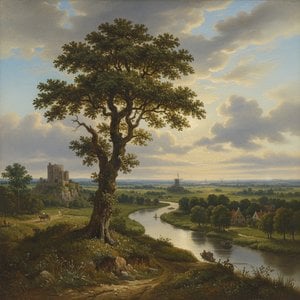
Winter Scene, Oil on Canvas, Staatlische Gem The Winter Landscape painting, created by Rembrandt Van Rijn in 1646, is a stunning example of Dutch Golden Age art. This beautiful oil on canvas piece, housed in the Staatlische Gem museum, showcases Remb...
To observe a canvas from the seventeenth-century Netherlands is to witness a deliberate negotiation between what is revealed and what is withheld. The technique of chiaroscuro, far from being a mere theatrical flourish, functioned as the primary language for articulating the human condition. In the hands of masters like Rembrandt van Rijn, light does not simply illuminate; it car and sculpts. When we look upon his Portrait of Philips Lucasz, we see how the sudden intrusion of brightness against an encroaching darkness directs the eye toward the weight of character rather than the superficiality of costume.
This manipulation of contrast finds a profound echo in the works of later eras, where shadow serves to define the boundaries of thought. Consider the way Rembrandt used deep, enveloping darkness to suggest depths of emotion that remained unsaid. This same tension is present in his Winter Scene, where the starkness of light on snow-covered figures creates a palpable sense of volume and presence. The shadow is not an absence of information, but a reservoir of mystery, inviting the viewer to contemplate the unseen.
The Secular Gaze: Finding the Divine in the Everyday
Dutch Golden Age painting is the painting of the Dutch Golden Age, a period in Dutch history roughly spanning the 17th century, during and after the later part of the Eighty Years' War (1568–1648) for Dutch independence. The new Dutch Republic was th...
As the Dutch Republic moved away from the heavy religious iconography of the South, a new kind of reverence emerged—one directed toward the mundane. The shift from grand, Catholic altarpieces to the quietude of domestic interiors represented a revolution of the gaze. In this era, the sacred was no longer found in celestial visions but in the way a single sunbeam might catch the rim of a pewter goblet or the texture of a silk gown. This transition allowed for a profound psychological depth within genres that were previously considered lowly.
Gerard ter Borch’s Le Duo: chanteuse et joueur de luth théorbé exemplifies this shift perfectly. Within a modest, dark-toned interior, there is no overt religious drama, yet the meticulous rendering of the musicians creates a moment of profound intimacy. This ability to elevate the ordinary to the extraordinary was the hallmark of the age. It mirrors the way we might find significance in the stillness of a modern room, recognizing that beauty often resides in the quietest, most unadorned corners of our existence.
The Windmill at Wijk bij Duurstede: A Dutch Masterpiece of Light and Atmosphere Jacob Isaackszoon van Ruysdael’s “The Windmill at Wijk bij Duurstede” isn't merely a depiction of a rural scene; it’s a profound meditation on light, space, and the endur...
The Dutch landscape is rarely just a depiction of earth; it is an exploration of the air that sits between the viewer and the horizon. The mastery of aerial perspective—making distant elements appear paler and less distinct—allowed painters to create an illusion of vast, breathing space. In the works of Jacob Isaackszoon van Ruisdael, such as The Windmill at Wijk bij Duurstede, the sky is a primary protagonist. The heavy, layered clouds and the diffused glow of daylight provide a sense of scale that anchors the terrestrial elements of the composition.
This preoccupation with the atmosphere finds a striking parallel in the American landscape tradition. Rembrandt Peale’s The Stone Bridge demonstrates how these principles of light and atmospheric weight can transcend borders. By utilizing thick impasto brushstrokes to capture the texture of an overcast sky, Peale evokes a sense of contemplative weight that directly inherits the Dutch tradition. The bridge becomes more than stone; it is a symbol of transition, much like the shifting clouds in a Ruisdael landscape.
Texture and Light: The Materiality of the Dutch Surface
Nicolaes Keyser: The Golden Weaver of Delft Nicolaes Keyser, a name often whispered in the halls of Dutch art history, remains an enigmatic figure despite his undeniable brilliance. Active primarily during the mid-17th century, he stands as one of De...
The tactile quality of a Golden Age painting is found in its very substance. Whether working on wooden panels or copper plates, these artists possessed an intimate understanding of how light interacts with different surfaces. The use of oil glazes allowed for a luminosity that seemed to emanate from within the canvas itself. In the portraits of Nicolaes Keyser, one can almost feel the weight of the opulent fabrics and the metallic sheen of gold leaf, a technique likely informed by his background as a goldsmith.
This reverence for materiality is something we still seek in the finest reproductions today. A true oil painting on cotton canvas possesses a depth of tone and a visible brushstroke that a flat print simply cannot replicate. The way light catches the ridges of impasto paint creates a physical dimension, much like the way the Dutch masters used texture to breathe life into a sitter's sleeve or a landscape's foliage. It is the difference between seeing an image and experiencing a presence.
A Legacy of Observation: From 17th-Century Realism to Modern Interpretation
The Aelbert Jacobsz Cuyp painting, The Maas at Dordrecht , is a stunning representation of the Dutch Golden Age. Created in 1660, this oil on canvas piece measures 114 x 170 cm and is housed in the National Gallery of Art in Washington, United States...
The enduring strength of the Dutch Golden Age lies in its refusal to idealize. Unlike the polished, often artificial splendor of the French Baroque, the Dutch masters embraced the character and individuality of their subjects. Whether it was the candid, energetic portraits of Frans Hals or the maritime precision of Aelbert Jacobsz Cuyp in The Maas at Dordrecht, the focus remained on truthful observation. They captured the fleeting expressions and the honest textures of a nation finding its identity.
Today, this legacy continues through the careful preservation and recreation of these works. At WahooArt.com, we honor this tradition of craftsmanship by providing hand-painted oil reproductions that respect the technical rigor of the original masters. Our artists, trained in the finest academies, utilize the same principles of light, shadow, and texture to ensure that every commission—whether a custom portrait or a landscape—carries the weight and soul of the seventeenth century into the modern home.
Explore the profound mastery of light and shadow in Dutch Golden Age painting. From chiaroscuro to atmospheric landscapes, discover the techniques that defined an era and learn how to bring these timeless masterpieces into your home through museum-quality oil reproductions.
Explore the life & work of Jacob van Ruisdael, the preeminent Dutch landscape painter. Discover his technical brilliance, symbolic depth, and lasting influence on art history. Learn about collecting Ruisdael's masterpieces.
Embark on a journey through the Dutch Golden Age. From Rembrandt's drama to Vermeer's light, explore 25 iconic Rijksmuseum masterpieces and find museum-quality art reproductions for your decor. Discover all masterpieces on WahooArt.com.



 Winter scene, Oil on canvas, Staatlische Gem
 Dutch Golden Age painting
 The Windmill at Wijk bij Duurstede (detail)
 Nicolaes Keyser
 The Maas at Dordrecht