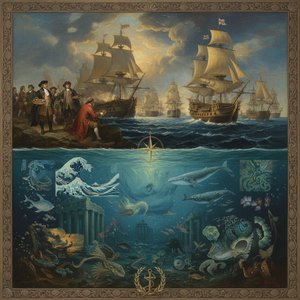
Marine art or maritime art is a form of figurative art (i.e. painting, drawing, printmaking, and sculpture) that portrays or draws its main inspiration from the sea. Maritime painting is a genre that depicts ships and the sea, being particularly stro...
To stand before a maritime work is to engage with a dialogue between the terrestrial and the infinite. This genre, often distinguished from pure seascape by its focus on human seafaring, offers more than mere topography; it provides a window into the mechanics of exploration and the weight of history. While marine art may present the ocean as an untamed, solitary force, maritime painting traditionally anchors the viewer in the reality of the vessel and the crew. It is a study of movement, where the tension of a sail or the steadying of a hull against a swell tells a story of survival and ambition.
The distinction between these two modes—the pure seascape and the human-centric maritime scene—is often subtle, yet vital for the collector. One seeks the sublime isolation of the waves, while the other documents the technical and social intricacies of life upon the water. Whether through the depiction of a single ship portrait or a bustling harbor, the genre captures the intersection of human ingenuity and the unpredictable rhythms of the tide.
The Luminous Legacy of Pieter Cornelis Dommersen In the grand tapestry of nineteenth-century maritime art, few threads shine with as much atmospheric brilliance as those woven by Pieter Cornelis Dommersen . Born as Pieter Dommershuisen on December 6,...
The true lineage of maritime excellence finds its roots in the Dutch Golden Age of the 17th century. During this era, the sea was not merely a backdrop but the very engine of the Dutch Republic's prosperity. As overseas trade and naval power expanded, so too did the demand for works that reflected this maritime dominance. This period saw the emergence of specialized artists who moved away from historical narratives to focus on the atmospheric reality of the North Sea and the intricate details of merchant vessels.
This tradition of precision and tonal harmony remains a cornerstone of the genre. The Dutch masters understood how to manipulate light to suggest the weight of water and the vastness of the horizon, establishing a standard of technical excellence that would influence generations. This legacy persists in the way we perceive the sea today—not as a static image, but as a living, breathing entity shaped by wind, salt, and commerce.
Dissolving Boundaries: Light and Water in Impressionist Works
Introduction Close your eyes for a moment and imagine the world not as a collection of fixed lines and rigid shapes, but as a shimmering dance of light and atmosphere. Imagine the way a morning mist clings to the reeds of a pond, or how the setting s...
As the 19th century progressed, the rigid structures of academic painting began to yield to a more sensory approach. The Impressionists, seeking to capture the ephemeral nature of a single moment, turned their attention to the fluid boundaries between sky and sea. Artists like Claude Monet moved beyond the documentation of vessels to explore how light breathes upon the water's surface. In works such as his reflections on the water-lily ponds, the horizon often dissolves, leaving the viewer suspended in a world of shimmering color and shifting atmosphere.
This movement replaced heavy, dark pigments with a broken palette, using visible brushstrokes to mimic the flickering movement of light. The goal was no longer to paint the water itself, than to paint the sensation of seeing it. This era introduced a new level of luminosity to maritime subjects, where the interplay of shadow and radiance could transform a simple coastal scene into a profound meditation on time and perception.
Thomas Henry Roskell: A Chronicle of the Coastal Soul The canvases of Thomas Henry Roskell aren’t merely depictions of seascapes; they are profound meditations on humanity's relationship with the relentless, beautiful, and often unforgiving power of ...
Beyond the ethereal light of Impressionism lies a more visceral connection to the sea, found in works that embrace the ruggedness of coastal existence. Artists such as Thomas Henry Roskell and Pieter Cornelis Dommersen brought a different perspective to the genre, focusing on the tactile reality of maritime life. For these painters, the sea was not just a subject of beauty but a force of labor and endurance. Their canvases often feature the weathered faces of fishermen, the worn textures of nets, and the salt-sprayed hulls of working boats.
This approach avoids romanticized heroism in favor of an honest portrayal of the struggle against the elements. The use of impasto and layered textures allows the viewer to feel the grit of the sand and the weight of a storm-tossed sea. It is a style that honors the craftsmanship of those who live by the tides, finding profound beauty in the unpolished, the aged, and the resilient.
Preserved Currents: Navigating Global Maritime Museums
A Legacy Forged on Waves: The Soul of Maine's Maritime Heritage Nestled along the scenic, mist-shrouded banks of the Kennebec River in Bath, Maine , the Maine Maritime Museum stands as a profound testament to the enduring, rhythmic relationship betwe...
The history of our relationship with the ocean is preserved within the halls of institutions that act as repositories for both artifact and memory. From the Maine Maritime Museum in Bath, which showcases the engineering marvels of the Percy & Small Shipyard, to the National Maritime Museum of Korea in Busan, these spaces allow us to trace the evolution of seafaring technology. To walk through such a museum is to witness the transition from the delicate curves of birch bark canoes to the colossal wooden structures like the Wyoming.
These collections extend far beyond ship models; they encompass the tools of navigation—celestial globes and intricate maps—that allowed early explorers to traverse unknown horizons. Similarly, the Australian National Maritime Museum in Sydney provides a dialogue between ancient indigenous waterways and the era of European exploration. These institutions remind us that maritime history is a continuous thread, connecting the technological leaps of the past with our contemporary identity.
The Collector's Anchor: Integrating Nautical Art into Modern Interiors
The 30-second answer Here's the whole guide in one breath, and then I'll make you sit through the rest of it anyway. At €150 you're buying a print, not a painting, and you should buy it big — enormous, in fact, bigger than the sofa. At €500 you're bu...
For the modern collector or interior designer, incorporating maritime themes requires a balance of historical reverence and contemporary aesthetic. A large-scale oil reproduction of a harbor scene can serve as a powerful anchor for a room, providing a sense of depth and openness. The choice between a structured, detailed maritime painting and a more abstract, light-drenched seascape depends entirely on the desired atmosphere.
When selecting pieces, consider the interplay of texture and light. A high-quality oil painting, with its visible brushstrokes and deep tonal range, offers a tactile presence that prints cannot replicate. For larger architectural projects, such as hotel lobbies or expansive living areas, multi-panel compositions can extend the horizon across a wall, creating an immersive experience. By selecting works that share a cohesive palette—perhaps through subtle blues, ochres, or muted greys—one can create a curated collection that feels both historically grounded and effortlessly modern.
At WahooArt.com, we specialize in bringing these historical moments into the contemporary home through meticulous hand-painted reproductions and museum-quality prints. Whether you are seeking to commission a custom portrait in the style of a master or looking for a large-format mural to transform a space, our expertise ensures that every piece meets the highest standards of academic excellence and archival longevity.
Pieter Janssens Elinga (1623-1682): Dutch Golden Age painter of intimate interiors, geometric perspective & still lifes. Influenced by De Hooch & Kalf, famed for his unique 'perspective box'.
Explore the rich history of marine painting with WahooArt. Discover Dutch Masters, Romantic seascapes & renowned artists like Wyllie and Harris. Expert guidance for collectors & custom reproductions.



 Marine art
 Pieter Cornelis Dommersen
 10 Iconic Impressionist Landscapes That Changed Art Forever
 Thomas Henry Roskell
 Maine Maritime Museum
 The Impressionism Buyer's Guide: What €150, €500 and €1,500 Actually Buy