![The Courtship Of Paris And Helen [detail 1] — Jacques-louis David](/media/artworks/images-thumb/cb/6c/cb6cd2fb48353357d2ab2a0324aa75a5.jpg)


The Enlightenment Catalyst: Escaping Rococo Excess for Rational Restraint
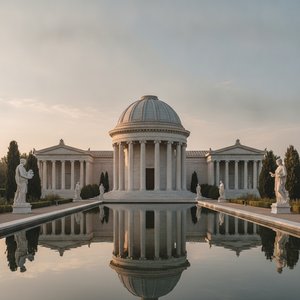 Neoclassicism Unveiled: The Timeless Elegance of Order, Reason, and Classical Antiquity
The Enlightenment Catalyst: From Rococo Excess to Rational Restraint The Revival of Antiquity: Exploring Neoclassical Art's Ideals & Enduring Legacy The Seeds of Revival: Enlightenment Ideals & Rediscovering Classical Antiquity The latter half of the...
To truly appreciate the profound shift brought about by Neoclassicism, one must first envision the sensory overload of the mid-18th century. Before the era of rational restraint took hold, European artistic sensibilities were dominated by the Rococo—a style characterized by its exuberant ornamentation, pastel frivolity, and a certain whimsical instability. It was an age of lace, shells, and asymmetrical flourishes that sought to dazz precisely through superficial charm and emotional lightness. However, as the intellectual currents of the Enlightenment began to surge across the continent, a profound fatigue set in regarding this perceived decadence.
The movement toward Neoclassicism was, at its core, a great aesthetic reset. It represented a deliberate turning away from the ornate excesses of the Rococo and a move toward a more disciplined, cerebral approach to beauty. This transition was not merely a change in fashion but a philosophical imperative; it sought to replace the chaotic whims of emotion with the clarity of reason. Artists began to seek a visual language that could mirror the scientific and philosophical advancements of their time, favoring stability over spontaneity and logic over luxury. In this new era, the pursuit of truth through art became as vital as the pursuit of knowledge through science.
The Revival of Antiquity: Reclaiming the Grandeur of Greece and Rome
 pierre antoine de machy
Gavin Hamilton: The Antiquarian Painter of Rome Gavin Hamilton (1723, Lanarkshire – 4 January 1798, Rome) stands as a singular figure in the history of art, a man inextricably linked to both the burgeoning neoclassical movement and the passionate pur...
As the intellectual landscape shifted, the eyes of Europe turned backward, toward the sun-drenched ruins of the Mediterranean. The rediscovery of classical antiquity provided the essential blueprint for this new aesthetic era. This was not a mere imitation of the past, but a passionate reclamation of the values embodied by the Greco-Roman world. Figures such as Gavin Hamilton, the quintessential antiquarian painter, played a pivotal role in this movement. His life, deeply intertwined with the exploration of Roman ruins, allowed him to translate the silent majesty of ancient relics into monumental paintings that breathed life into Greek and Roman mythology.
This fascination was fueled by an unprecedented archaeological awakening. The ability to study accurate records of surviving classical buildings allowed artists and architects alike to move beyond vague inspirations toward a more authentic engagement with antiquity. Whether it was the meticulous rendering of a classical bust, as seen in the works of Vincenzo Camuccini, or the profound reverence for sculptural forms found in the studies of Johann Gottfried Schadow, the goal remained consistent: to establish a tangible connection to the enduring traditions of the ancient world. This revival sought to capture the eternal—the immutable laws of geometry and the stoic dignity that defined the classical age.
Mastering the Classical Ideal: Precision, Symmetry, and Moral Virtue in Painting
 Mastering the Classics: The 25 Greatest Paintings by Nicolas Poussin
Introduction To step into the world of Nicolas Poussin is to leave the chaotic whims of emotion behind and enter a realm of profound intellectual clarity. As you wander through this curated selection of his top twenty-five masterpieces, you are not m...
In the hands of a master, Neoclassical painting became a stage for philosophical contemplation. The movement rejected the fleeting light and superficial drama of its predecessors in favor of disegno—the primacy of line, structure, and anatomical accuracy. To step into the world of a painter like Nicolas Poussin is to enter a realm of profound intellectual clarity. His works, though bridging the gap between the Baroque and the Neoclassical, established the foundational principles of French Classicism: the use of structured, almost sculptural arrangements of figures and landscapes that serve as orderly backdrops to human drama.
The technical execution of these masterpieces required an unparalleled level of discipline. Artists employed precise hatching and cross-hatching to build tonal values, creating a sense of depth and texture that honored the weight of the subject matter. Every gesture was deliberate; every composition was balanced. This precision was intended to convey more than just physical beauty; it was meant to embody moral virtue and the strength of character. In works like those of Paolo Borroni, we see this commitment to realism and classical motifs, where religious themes are treated with a sense of gravity and dignity that reflects the broader cultural aspiration for elevated, virtuous expression.
Architectural Echoes: The Neoclassical Legacy in Structure and Form
 Neoclassical architecture
Neoclassical architecture, sometimes referred to as Classical Revival architecture, is an architectural style produced by the Neoclassical movement that began in the mid-18th century in Italy, France and Germany. It became one of the most prominent a...
The principles of Neoclassicism were not confined to the canvas; they etched themselves into the very skyline of the Western world. Neoclassical architecture, often referred to as Classical Revival, emerged as a powerful articulation of Enlightenment ideals rendered in stone. Unlike the preceding Renaissance or Baroque styles, which often relied on partial revivals and complex ornamentation, the Neoclassical movement aimed to strip away the unnecessary. It sought a purer, more complete, and more authentic classical style, emphasizing symmetry, simple geometry, and the strength of the wall itself.
This architectural language is defined by its monumental presence and its use of classical vocabulary—columns, pediments, and domes—to create spaces that feel both permanent and authoritative. From the grand museum complexes like the Altes Museum in Berlin to the refined elegance of the Petit Trianon, these structures were designed to inspire awe through their order and proportion. This style was not merely about aesthetics; it was a social statement, suggesting that the stability of classical forms could provide a foundation for modern civilization. Even today, the legacy of this movement persists in the way we perceive strength and permanence in our most significant civic institutions.
Neoclassicism in Modern Interiors: Integrating Timeless Order into Contemporary Design
The Great Reset: Escaping Rococo Excess for Neoclassical Order Neoclassical Art: The Ultimate Guide to Timeless Power, Precision, and the Classical Ideal The Great Reset: Moving from Rococo Excess to Neoclassical Order Neoclassicism Unveiled: The Tim...
For the discerning collector and the sophisticated interior designer, Neoclassicism offers a sanctuary of order in an increasingly fragmented and fast-paced world. The movement’s emphasis on harmony, clarity, and restraint provides a timeless framework that can breathe life into even the most modern spaces. Integrating classical elements—be it a high-quality oil reproduction of a mythological scene or a sculptural bust—allows for a curated conversation between eras, where the weight of history meets the brilliance of contemporary vision.
Modern design thrives on the tension between the ancient and the avant-garde. By utilizing the principles of Neoclassical symmetry and balance, one can create interiors that feel both grounded and luxurious. Whether through large-format murals that recreate historical grandeur or the strategic placement of multi-panel group paintings to accentuate architectural lines, the goal is to achieve a sense of enduring elegance. In an age of rapid change, the return to classical order is not a retreat into the past, but an invitation to embrace a beauty that is truly universal and everlasting.
At WahooArt.com, we celebrate this enduring legacy through our commitment to museum-grade craftsmanship. We specialize in the creation of exquisite, hand-painted oil reproductions that capture the very soul of Neoclassical mastery. From bespoke commissions that transform personal memories into historical masterpieces to large-scale architectural murals for luxury hospitality projects, our artists—each a specialist in their genre—ensure that every brushstroke honors the traditions of the Old Masters. We invite you to explore our curated collection and experience the profound elegance of art that transcends time.