The history of childhood has been a topic of interest in social history since the highly influential book Centuries of Childhood, published by French historian Philippe Ariès in 1960. He argued "childhood" as a concept was created by modern society. ...
To look upon a portrait of a child is to encounter one of the most profound mirrors of the human condition. However, the way we perceive these young subjects has undergone a radical transformation over the centuries. In much of Western history, particularly before the 17th century, the very concept of childhood as a protected or distinct stage of life was not established. Historians such as Philippe Ariès have noted that children were often represented as miniature adults—stiff, formal, and draped in heavy, symbolic garments that denoted lineage rather than youth. They were depicted with a gravity that reflected their perceived role in family legacy, their small forms mirroring the proportions and postures of the grown men and women around them.
This rigid representation began to soften as social structures shifted. During the Renaissance, a more tender, humanized version of the Christ child emerged, signaling a move toward seeing children as individual beings. By the seventeenth century, particularly in Northern European genre painting, we see a shift toward realism. The works of artists like Velázquez introduced a fresh level of observation, where the subject was no longer just a symbol of status but a living, breathing person. This transition from the formal to the personal allowed art to capture the actual experience of being young—a period defined by learning and development rather than mere preparation for adulthood.
Romanticism and the Pastoral Ideal: Nature as a Sanctuary for Youth
A Moment Frozen in Time: Karl Bryullov’s “Child in a Swimming Pool” Karl Pavlovich Bryullov's "Child in a Swimming Pool," painted in 1829, is more than just a charming pastoral scene; it’s a poignant meditation on innocence, fleeting beauty, and the ...
As the nineteenth century progressed, the concept of childhood became inextricably linked to the natural world. The Romantic movement, peaking between 1800 and 1850, advocated for the importance of subjectivity, imagination, and an appreciation of nature in response to the industrial era. For the Romantics, childhood was a time of blissful detachment from the complexities of the modern world. This is beautifully realized in Karl Pavlovich Bryullov's 1829 watercolor, Child in a Swimming Pool (Portrait of Prince A.G. Gagarin in Childhood). Currently held in the Tretyakov Gallery in Moscow, this work depicts a young boy immersed in a tranquil pool surrounded by lush greenery. Bryullov uses subtle gradations of color and light filtering through leaves to create an atmosphere of hazy warmth, evoking a profound sense of serenity and vulnerability.
This romanticized view of youth finds a historical echo in the works of Antoine-Jean Gros. His Portrait de Paulin des Hours, painted around the early 19 andth century, depicts a young boy kneeling amidst wildflowers while gently holding a small bird. Much like Bryullov’s work, Gros utilizes diffused, natural lighting to highlight the textures of the surroundings, creating a bridge between Neoclassical clarity and Romantic emotion. These paintings do not merely record a likeness; they celebrate a state of being where the child exists in perfect harmony with the organic world, untouched by the mechanical progress of society.
Sacred Symbols: The Spiritual Language of Purity in Art
Songs of Innocence (Title page) – A Visionary Echo Through Time William Blake’s “Songs of Innocence,” published in 1789, stands as a cornerstone of Romantic art and literature—a testament to the artist's singular ability to fuse poetic imagination wi...
The visual language used to communicate innocence often relies on a shared vocabulary of symbols that transcend individual paintings. In Christian iconography, the lamb is perhaps the most enduring symbol of purity, specifically through the figure of Jesus as the "Lamb of God," emphasizing a sinless nature. Similarly, the color white and the presence of songbirds frequently serve as visual shorthand for an uncorrupted soul. These symbols were not merely decorative; they were intended to convey deep theological truths about the state of the human spirit before it is touched by experience or sin.
We see this symbolic depth in the works of William Blake, particularly in his 1789 collection, Songs of Innocence. Blake used a revolutionary technique of hand-painting relief-etched copper plates with watercolors to intensify his poetic visions. In his title page illustrations, he depicts women seated beneath blossoming trees surrounded by birds, which symbolize freedom and spiritual aspiration. While Blake’s work explores the "contrary states" of the human soul, his Songs of Innocence remains a cornerstone of Romantic idealism, using the imagery of the pastoral to represent a state of protected, happy perception.
The Impressionist Gaze: Capturing the Fleeting Light of Play
The Construction of Purity: Historical Shifts in the Perception of Childhood The invention of childhood innocence --- title: The invention of childhood innocence — Harvard Gazette author: Krysten A Keches ' url: https://news.harvard.edu/gazette/story...
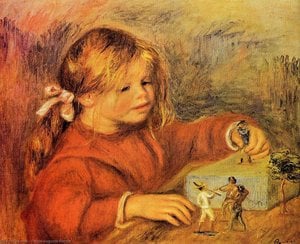
By the late 19th century, the focus shifted from symbolic purity to the sensory experience of childhood. Artists of the Impressionist and Post-Impressionist movements moved away from rigid academic compositions to capture the spontaneous pulse of life. They saw children not as posed figures in fine clothing, but as subjects of pure sensation—their skin bathed in dappled sunlight and their small hands lost in the colors of a summer afternoon. This era celebrated the intimate, domestic joys of the everyday, finding profound meaning in the ephemeral.
Pierre-Auguste Renoir was a master of this luminous gaze. In The Little Fishergirl (Marthe Berard), he uses thin washes of paint and loose brushstrokes to create an atmospheric haze that breathes with the figure. There is no rigid line to define the subject; instead, there is only the softness of youth. This pursuit of light and movement is also evident in Max Liebermann's Free hour at Amsterdam orphanage (1876), where children and women are gathered in a rhythmic dance of everyday life. Through these works, the artist captures the very breath of youth, inviting the viewer to reconnect with their own capacity for wonder through the medium of light and color.
Textures of Memory: Reimagining Childhood through Contemporary Eyes
Tseng Shu-fen: Capturing Childhood’s Echoes in Textured Landscapes Tseng Shu-fen, born in Taipei, Taiwan in 1973, is a Taiwanese artist whose distinctive style centers on meticulously rendered depictions of playgrounds and scenes reflecting the essen...
The exploration of childhood innocence continues into the modern and contemporary eras, often through a lens of nostalgia and the reconstruction of memory. Modern artists frequently revisit the textures and colors of their own formative years to evoke a universal sense of longing. The Indonesian artist Ronald Apriyan, for example, uses a rich palette and tactile layers of color to explore the quiet beauty found within everyday experiences. His work does not simply represent a scene; it seeks to reimagine the world as seen through the eyes of a child, emphasizing the inherent magic of discovery.
Similarly, the Taiwanese artist Tseng Shu-fen utilizes mixed media and oil on canvas to recreate the tactile reality of playgrounds. Her works, such as Playground – Seesaw / Playground – Swing, are characterized by a painstaking attention to detail, particularly in the grain of wood and the texture of metal. By focusing on these sensory elements, she invites viewers to revisit cherished memories and recapture the feeling of carefree play. Whether through the expressive lines of Egon Schiele or the textured landscapes of Tseng, art remains a vital tool for preserving the fleeting magic of our most tender beginnings.
For those looking to bring these historical perspectives into their own homes, WahooArt.com offers a curated selection of high-quality reproductions and custom commissions. Whether you seek a hand-painted oil reproduction that captures the visible brushstrokes of the masters or a personalized portrait that transforms your own memories into a classical work, our collection provides a window into the enduring power of art.
Journey through history with 10 iconic artworks capturing the innocence of childhood. From Impressionist portraits to classical masterpieces, explore the stories behind these timeless pieces and find museum-quality reproductions for your decor. Discover all masterpieces on WahooArt.com.
Explore the life & art of Karl Bryullov, a pivotal figure in Russian Romanticism. Discover his iconic paintings like 'The Last Day of Pompeii' and delve into his lasting influence on 19th-century art history.



 History of childhood
 Child in a Swimming Pool (Portrait of Prince A.G. Gagarin in Childhood)
 Songs of Innocence (Title page)
 Fleeting Grace: The Impressionist Pursuit of Childhood Innocence
 Tseng Shu-Fen


