Romanticism (also known as the Romantic movement or Romantic era) was an artistic and intellectual movement that originated in Europe towards the end of the 18th century. The purpose of the movement was to advocate for the importance of subjectivity,...
At the close of the eighteenth century, a profound shift occurred in the European consciousness, moving away from the rigid rationalism of the Enlightenment toward a reverence for the untamed and the unknown. This was the era of Romanticism, a period where the landscape ceased to be merely a backdrop for human drama and became a vessel for the sublime. To the Romantic mind, nature was not a machine to be understood through science, but a powerful, often terrifying force capable of evoking deep spiritual awe.
This preoccupation with the emotional weight of the natural world finds a striking parallel in the German Romantic tradition. In the works of the Jena circle, thinkers and artists sought a synthesis of art and philosophy, viewing the landscape as a mirror to the soul's internal struggles. Just as the German Romantics explored the tension between the daily world and the irrational projections of genius, British painters utilized the vastness of the sky and the turbulence of water to communicate truths that words often failed to capture.
The movement reached its zenith between 1800 and 1850, leaving behind a legacy of works that prioritize intuition over intellect. It was a period that celebrated the heroic and the mysterious, finding beauty in the shadows of ancient ruins and the mist of distant mountains.
The Rise of the Landscape: Capturing the British Spirit
Market Day is an 1807 landscape painting by the British artist Augustus Wall Callcott. It depicts a country road where various rural figures are bringing their goods to town for market day. It is part of the tradition of Romantic landscapes and scene...
As Britain underwent the immense transformations of the Industrial Revolution, the landscape painting emerged as a vital medium for documenting a changing nation. This was a golden age of British art, fueled by unprecedented industrial wealth and a sophisticated culture of patronage. Artists began to look closely at the English countryside, not merely to record topography, and certainly not to idealize it into something unrecognizable, but to find a sense of identity within the rolling hills and river estuaries.
One might look to the work of Augustus Wall Callcott to understand this era's fascination with light and atmosphere. His 1807 painting, Market Day, presented a scene of everyday rural life that resonated deeply with contemporary audiences at the Royal Academy. While John Constable famously held a critical view of such works, Callcott’s ability to layer oil paints to achieve a subtle atmospheric haze captured the very essence of the British climate. This tradition of observing the local—the way light hits a Thames estuary or settles upon a country road—became a cornerstone of the national aesthetic.
This era also saw the development of specialized techniques, such as the "white ground" method explored by William James Blacklock, which allowed for an extraordinary sense of luminosity. Through these methods, the British landscape became more than just scenery; it became a profound meditation on permanence in an age of rapid change.
A Rebellion Against 'Slosh': The Pre-Raphaelite Manifesto
The Rebellion of 1848: Challenging the Royal Academy's 'Slosh' The Pre-Raphaelite Brotherhood: Rediscovering Romanticism, Mythological Depth, and Vivid Detail in Victorian Art The Rebellion Against Tradition: The Birth of the Pre-Raphaelite Brotherho...
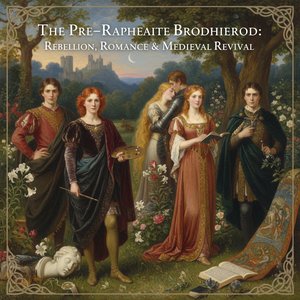
By 1848, the air in London felt heavy with the scent of revolution, not only in the political streets of Europe but within the studios of the Royal Academy. A group of young, fervent visionaries—including William Holman Hunt, John Everett Millais, and Dante Gabriel Rossetti—found themselves stifled by the academic standards of their time. They grew weary of what they disparagingly termed "slosh": those heavy-handed, formulaic, and overly dark compositions that prioritized artificial elegance over genuine vitality.
The formation of the Pre-Raphaelite Brotherhood was a deliberate act of defiance against the mechanistic approach of the Mannerist tradition. These artists rejected the influence of Sir Joshua Reynolds—whom they mockingly called "Sir Sloshua"—and instead looked backward to the era before Raphael. They sought to reclaim the spiritual purity and complex compositions found in Quattrocento Italian art. This was not a movement of nostalgia, but a radical attempt to strip away layers of academic pretension to reveal a more profound, unadulterated truth.
This rebellion was deeply rooted in a desire for sincerity. By looking to an earlier period of art, the Brotherhood aimed to reconnect the viewer with a sense of moral and aesthetic integrity that they believed had been lost to the shadows of convention.
Meticulous Truth: The Pursuit of Naturalism and Detail
A Life Immersed in Landscape: The Evocative World of William James Blacklock William James Blacklock, born in the bustling heart of Shoreditch, London, in 1816, was an artist whose life became inextricably linked with the serene beauty of the British...
If the Romantics sought the sublime through grand gestures, the Pre-Ralphaites found it through the microscopic. Theirs was a commitment to mimesis—the intense, almost obsessive imitation of nature. To a member of the Brotherhood, no detail was too small to be ignored; every petal, every blade of grass, and every ripple in a pool required rigorous, attentive study.
This dedication to truth is perhaps best exemplified by the work of John Keates, whose landscapes bridged the gap between Romanticism and Pre-Raphaelite precision. His paintings, often focused on the serene beauty of Italian vistas, utilized luminous color palettes and precise draughtsmanship to capture fleeting moments with remarkable clarity. Similarly, the influence of John Ruskin provided a theoretical backbone for this movement, encouraging artists to study nature so closely that the world might disclose a surfeit of detail, turning the natural landscape into an intricate ornament of truth.
This period of intense observation demanded a different kind of technical mastery. It required a patience that rejected the "scamped" or lazy brushwork of the Academy in favor of a high level of finish. The result was an art form that felt tactile and alive, inviting the viewer to linger upon every meticulously rendered element of the composition.
From English Fields to American Vistas: The Movement's Expansion
The American Pre-Raphaelites was a movement of landscape painters in the United States during the mid-19th century. It was named for its connection to the Pre-Raphaelite Brotherhood and for the influence of John Ruskin on its members. Painter Thomas ...
The ideals of the Pre-Raphaelite Brotherhood did not remain confined to the shores of Britain; they crossed the Atlantic, finding fertile ground in the United States. The American Pre-Raphaelites, led by figures such as Thomas Charles Farrer, adopted the movement’s emphasis on vivid realism and naturalistic detail, though they adapted it to a different context.
Unlike their English counterparts, who often leaned into medievalism and mythological subjects, the American practitioners tended to avoid figurative painting altogether. Instead, they focused their energies on landscapes and still lifes, applying a scientific gaze to the American wilderness. This movement was characterized by a profound devotion to the landscape, where artists like William Stillman might spend months meticulously painting a single violet in the foreground of a larger composition.
This expansion demonstrated the universal appeal of the pursuit of truth in art. Whether depicting the rugged terrain of the Hudson River Valley or the quiet corners of an English garden, the core principle remained the same: a belief that through the disciplined observation of the natural world, one could uncover a deeper, more spiritual reality.
Legacy of the Brotherhood: Influence on Modern Aesthetic Values
Introduction To step into the world of Dante Gabriel Rossetti is to surrender oneself to a realm where poetry and pigment become indistinguishable. His work does not merely sit upon a canvas; it breathes with a rhythmic, soulful intensity that seeks ...
The ripples of the Pre-Raphaelite rebellion continue to be felt in the way we perceive the relationship between art and the natural world. While the movement eventually divided—with Realists like Hunt and Millais moving in one direction, and Medievalists like Rossetti and Burne-Jones following another—the fundamental shift they achieved was permanent. They had successfully challenged the idea that art must be a polished, idealized imitation of life, proving instead that truth could be found in the raw, the detailed, and the unadorned.
Today, we see their influence in any art form that values authenticity over artifice. The movement’s emphasis on the sanctity of nature also laid the groundwork for modern conservation efforts, as it fostered a widespread appreciation for the intrinsic value of the environment. The Brotherhood taught us to look closer, to find the extraordinary within the ordinary, and to respect the complexity of the world around us.
In an age often characterized by digital fleetingness, the enduring strength of these works lies in their permanence and depth. They offer a sanctuary of detail and a reminder that true beauty does not require the mask of convention, but rather the courage to see the world exactly as it is.
At WahooArt.com, we hold this reverence for tradition and craftsmanship in the highest regard. Our collection of hand-painted oil reproductions allows you to bring the profound depth and tactile texture of these historical movements into your own space. Whether you seek a meticulous landscape or a custom portrait reimagined in a classical style, our artists utilize time-honored techniques on 100% cotton canvas to ensure that every brushstroke serves as a lasting connection to the masters of the past.
Explore the revolutionary Pre-Raphaelite Brotherhood. Discover how visionaries like Rossetti and Millais reclaimed truth and beauty through luminous detail and naturalism in Victorian art history. Expert insights for art lovers and collectors.
Explore the profound emotional power of Romanticism. From the sublime landscapes of Paul Huet to Goya's dramatic mastery, discover how this era revolutionized art through passion, intuition, and nature. Expert insights for classic art enthusiasts and collectors.
Explore the captivating world of the Pre-Raphaelite Brotherhood! Discover their rebellious spirit, iconic masterpieces & lasting influence on art history. Learn about Rossetti, Millais & more.
Discover the profound emotional depth of Victorian Romanticism. Explore how 19th-century masters captured the sublime through untamed landscapes and atmospheric beauty, bridging the gap between classical order and the soulful light of Impressionism.



 Romanticism
 Market Day (painting)
 The Pre-Raphaelite Brotherhood: Reclaiming Beauty, Truth, and Naturalism in Victorian Art
 William James Blacklock
 American Pre-Raphaelites
 25 Masterpieces by Dante Gabriel Rossetti: The Soul of Pre-Raphaelite Art