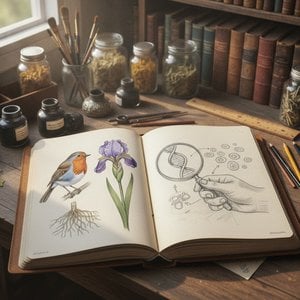
The Genesis of Botanical Illustration: From Scientific Herbals to the Age of Discovery
Long before the canvas became a stage for purely aesthetic expression, the depiction of flora served a vital, almost sacred, purpose in the preservation of human knowledge. In the early centuries, the herbals emerged not as mere ornaments, but as essential scientific manuscripts. These foundational works were the precursors to modern botany, where the primary objective was the meticulous documentation of medicinal plants. Each stroke of the quill and each wash of pigment was driven by a necessity for accuracy; an error in depicting a leaf's serration or a petal's hue could mean the difference between a healing remedy and a lethal mistake.
As the Age of Discovery unfolded, the scope of these illustrations expanded alongside the horizons of the known world. Explorers returned from distant lands with specimens that defied European classification, prompting a surge in demand for illustrators who possessed both the eye of an artist and the discipline of a scientist. This era transformed the botanical manuscript into a window onto the exotic, blending the rigor of empirical observation with a burgeoning sense of wonder. The transition from the utilitarian herbals to more expansive florilegia marked the beginning of a profound shift, where the sheer beauty of the specimen began to rival its medicinal utility in the eyes of the collector.
The Precision of the Lens: The Intersection of Botany and Academic Realism
As botanical studies matured, the movement toward botanical realism became an exercise in academic excellence. This period saw the convergence of scientific inquiry and the highest standards of fine art training. The artist was no longer merely a recorder but a master of light, texture, and anatomical precision. To capture the delicate translucency of a petal or the rugged architecture of a stem required a profound understanding of organic structure and the subtle interplay of shadows.
This intersection demanded a technique that could withstand the scrutiny of the botanist while satisfying the aesthetic cravings of the connoisseur. The use of fine brushes and layered glazes allowed for a depth of field that mimicked the three-dimensional reality of the living plant. It was during this era that the discipline achieved its most sophisticated form, where every vein and stamen was rendered with such fidelity that the artwork functioned as both a masterpiece of composition and a definitive biological record. This marriage of empirical truth and artistic virtuosity remains the hallmark of the genre's most revered period.
From Documentation to Decoration: The Evolution into Fine Art Mastery
The metamorphosis of botanical illustration from scientific tool to fine art is a testament to the enduring power of nature's inherent geometry. As the strict requirements of scientific documentation became increasingly handled by photography, the artistic community was liberated to explore the more emotive and decorative potential of the subject matter. The focus shifted from the purely diagnostic to the aesthetic sublime, allowing for greater experimentation with color, scale, and composition.
In this evolution, the botanical subject began to inhabit the realms of still life and landscape painting, infused with a new sense of drama and atmosphere. Artists began to play with the impasto techniques of the masters or the light-drenched softness of Impressionism, treating a single rose or a sprawling vine not just as a specimen, but as a vessel for light and emotion. This transition ensured that botanical art would not fade into the archives of history but would instead ascend to the status of high art, capable of commanding attention in the most prestigious galleries and private estates.
Botanical Elegance in Modern Interiors: Curating Nature's Timeless Detail
For the discerning collector and the sophisticated interior designer, botanical realism offers a unique opportunity to introduce a sense of organic tranquility into the built environment. Unlike more abstract forms of modern art, botanical works possess an immediate, recognizable elegance that bridges the gap between the natural world and architectural grandeur. A large-scale, hand-painted oil reproduction of a lush, verdant scene can serve as a commanding focal point in a formal dining room, while delicate, multi-panel botanical prints can add rhythmic texture to a contemporary hallway or staircase.
The versatility of this genre allows for profound customization within a space. One might choose a multi-panel layout to span a wide architectural feature, creating a sense of movement and continuity that mimics a garden wall. Alternatively, the integration of botanical themes through custom commissions—perhaps reimagining a personal garden in the style of an Old Master—can imbue a home with a deeply personal narrative. The key to successful curation lies in respecting the tactile depth of the medium; the visible brushstrokes and rich tonal ranges found in authentic oil paintings provide a sensory richness that digital prints simply cannot replicate.
Preserving the Bloom: The Enduring Value of Botanical Art in Private Collections
Investing in botanical art is an act of preserving beauty against the ephemeral nature of time. A well-chosen piece, whether it be a meticulously rendered 17th-century style reproduction or a bespoke contemporary commission, serves as a lasting legacy. These works possess an inherent stability; they do not follow the fleeting whims of trends but rather tap into a perennial appreciation for the natural order. For the serious collector, the value lies in the authenticity and craftsmanship—the weight of the canvas, the richness of the pigments, and the historical lineage the subject matter evokes.
As we look toward the future, the intersection of traditional techniques and modern accessibility ensures that this legacy will continue to flourish. Whether through the acquisition of museum-quality reproductions or the commissioning of a personalized masterpiece, the pursuit of botanical realism remains a profound way to connect with the eternal rhythms of the earth. At WahooArt.com, we celebrate this enduring passion by providing a gateway to extraordinary botanical works, offering everything from hand-painted oil masterpieces to exquisite fine art prints, all designed to bring the timeless majesty of nature into your most cherished spaces.