The Grammar of Light: Distinguishing Chiaroscuro from Tenebrism Tenebrism Tenebrism, from Italian tenebroso ('dark, gloomy, mysterious'), also occasionally called dramatic illumination, is a style of painting using especially pronounced chiaroscuro, ...
To observe a Baroque canvas is to witness a deliberate struggle between presence and absence. While we often speak of light as the primary actor in these works, the true strength of the era lies in how the darkness is structured. We must distinguish between two fundamental methods that define this period: chiaroscuro and tenebrism. Chiarosc and scuro, meaning light and dark, refers to a technical gradation of tones. It is an architectural tool used by painters to suggest three-dimensional volume, allowing a limb or a cheekbone to emerge from the flat surface with palpable weight. Through the careful management of value, the artist builds depth, making figures appear solid and tangible.
Tenebrism operates on a different emotional frequency. Derived from the Italian tenebroso, meaning dark or gloomy, this style does not merely use shadow to define shape; it allows darkness to dominate the composition entirely. In a tenebrist work, the shadows are not mere absences of light but active, heavy presences that swallow the background, leaving only specific figures caught in a sudden, theatrical spotlight. If chiaroscuro is the soft glow of a morning sun through a window, tenebrism is the sharp, unforgiving beam of a lantern in a midnight alley. This distinction allows us to see how artists moved from simple modeling to profound psychological drama.
Ancient Foundations: From Greek Skiagraphia to Renaissance Technique
The Genesis of Shadow: Ancient Skiagraphia and the Foundations of Chiaroscuro Chiaroscuro In art, chiaroscuro (English: kee-AR-ə-SKOOR-oh, -SKURE-, Italian: [ˌkjaroˈskuːro]; lit. 'light-dark') is the use of strong contrasts between light and dark, u...
The impulse to use shadow to create reality is not a modern invention of the seventeenth century. Long before the dramatic canvases of the Baroque occupied European palaces, the fundamental concept of shadow-painting existed as a technical necessity in antiquity. The Greeks understood that to represent a three-dimensional form on a flat surface, one must account for the way light falls across an object. This practice, known as skiagraphia, is attributed to Athenian painters such as Apollodoros. While much of this ancient work has been lost, its influence remains visible in the surviving mosaics of Pella, where the interplay of light and dark begins to suggest volume and weight.
This ancient observation was refined through the centuries, moving from the crude standardized forms of Byzantine art into the sophisticated traditions of Renaissance manuscript illumination. By the time we reach the High Renaissance, masters like Leonardo da Vinci had perfected sfumato, a technique involving incredibly thin glazes to create a smoky, soft-edged effect. This era sought atmospheric unity and serenity. The Baroque period did not discard these lessons; rather, it took the technical foundation of light modeling and pushed it toward extreme tension. We see the evolution from the subtle transitions of the Renaissance to the violent contrasts that would eventually define the age of Caravaggio.
The Spotlight of Devotion: Caravaggio and the Birth of Tenebrism
Tenebrism, from Italian tenebroso ('dark, gloomy, mysterious'), also occasionally called dramatic illumination, is a style of painting using especially pronounced chiaroscuro, where there are violent contrasts of light and dark, and where darkness be...
The history of Western painting shifted irrevocably when Caravaggio began manipulating light as a narrative force. He moved away from the balanced, often airy compositions of his predecessors to embrace a style that felt visceral and immediate. By utilizing tenebrism, he could direct the viewer's eye with surgical precision. In works such as The Calling of Saint Matthew, a single, directional light source thrusts figures into the foreground, stripping away Renaissance idealism to reveal the raw truth of human experience. This technique created a spiritual spotlight, where the darkness was not just a background but a stage for divine intervention.
This radical approach spread through Europe via the Caravaggisti, a group of dedicated followers who adopted his intense lighting. In Italy, artists like Artemisia Gentileschi used these sharp contrasts to heighten the emotional impact of her scenes. In Spain, Jusepe de Ribera employed similar methods in works such as St. Jerome penitente, where the light highlights the saint's weathered face and torso while enveloping the rest of the composition in deep, impenetrable shadows. Even in the Netherlands, artists like Gerard van Honthorst utilized a "candlelight tradition," using a single, obscured flame to create intimate, high-contrast scenes that felt both private and profoundly dramatic.
Sculpting with Shadow: The Physicality of Baroque Figures
Václav Vavřinec Reiner: A Baroque Visionary Václav Vavřinec Reiner (Wenzel Lorenz Reiner), born Prague, Czech Republic around 1686 or 1689 and died Prague in 1743, stands as a pivotal figure within the baroque painting movement—a period characterized...
Beyond the emotional impact, the use of light in the Baroque era served a vital technical purpose: the sculpting of human anatomy. Through the analytical division of light and shadow shapes, artists could achieve a sense of three-dimensional volume that made the figures appear to occupy real space. This is particularly evident in the works of painters like Václav Vavřanc Reiner, whose use of intense chiaroscuro allowed him to capture movement and emotion with remarkable precision. The light does not just illuminate; it defines the musculature, the heavy folds of drapery, and the texture of skin.
This physical realism is a hallmark of the era's commitment to truth. In the works of Jusepe de Ribera, one can see the meticulous rendering of every wrinkle on a saint's face or the rough texture of a coarse robe. The light catches the edge of a limb or the curve of a bone, providing a sense of weight and substance. This technique was not limited to religious figures; even in more secular or mythological works, such as those by Rubens or the Dutch masters, the interplay of light and dark provided a structural integrity that prevented the compositions from appearing flat or decorative. The shadow becomes a tool for anatomical accuracy.
Introduction Imagine stepping into a quiet, sun-drenched monastery in 17th-century Spain, where the air is thick with incense and the only sound is the soft rustle of a monk’s habit. In this stillness, light does not merely illuminate; it reveals the...
In the hands of a Baroque master, the black background is never merely empty space; it is a vessel for meaning. In many religious paintings, the darkness represents the spiritual void, the state of sin, or the unknown mysteries of the divine. When an artist like Caravaggio or Ribera allows the background to dissolve into shadow, they are creating a space for contemplation. The darkness becomes a heavy presence that symbolizes the weight of human suffering or the obscurity of the world before the arrival of grace.
This symbolism is often paired with specific objects to deepen the narrative. In St. Jerome penitente, the light illuminates a skull—a potent symbol of mortality and human vanity—emerging from the gloom. Similarly, in the works of Francisco de Zurbarán, deep, velvety shadows transform simple subjects like white linen or a solitary saint into monumental experiences of spiritual weight. The darkness provides the necessary silence for the light to speak. By stripping away unnecessary detail, the artist forces the viewer to confront the essential truth of the subject, making the void an active participant in the theological message.
The Legacy of Contrast: From the Dutch Masters to Modern Photography
The Mocking of Christ: A Baroque Masterpiece by Gerard van Honthorst Gerard van Honthorst’s “The Mocking of Christ,” painted in 1616, is more than just a depiction of a biblical scene; it's a visceral exploration of human suffering and religious dram...
The techniques developed during the seventeenth century did not vanish with the end of the Baroque era; they evolved into the foundational language of much of Western visual culture. The extreme lighting used by Northern painters to achieve stillness and tranquility can be seen in the later works of the Romantic movement, such as those by Joseph Wright of Derby. These artists continued to use light to create a sense of awe and drama, proving that the tension between light and dark remains a powerful tool for storytelling.
Even in our modern age, the echoes of chiaroscuro are everywhere. The principles of high-contrast lighting are fundamental to black and white photography and the "low-key" lighting styles used in cinema to create suspense or intimacy. When we watch a film noir or view a dramatic portrait captured with a single light source, we are participating in a visual tradition that began with the Greek skiagraphia and reached its zenith in the Baroque studio. The ability to use shadow to direct attention, define form, and evoke emotion remains one of the most enduring legacies of art history.
At WahooArt.com, we celebrate this enduring power of light and shadow. Whether through our hand-painted oil reproductions that capture the thick, tactile brushstrokes of the masters or our custom commissions that allow you to reimagine history, we aim to bring the drama of the Baroque into the modern home. Our artists, trained in the highest academic traditions, work meticulously to ensure that every highlight and every deep shadow reflects the true soul of the original masterpiece.
Explore the profound mastery of Caravaggio's tenebrism. Discover how his dramatic use of chiaroscuro revolutionized Baroque art through intense emotion and realism. An expert guide for classic art enthusiasts seeking to understand the power of shadow in historical masterpieces.
Immerse yourself in the dramatic world of Francisco de Zurbarán. Explore 25 iconic Spanish Baroque masterpieces defined by intense tenebrism and spiritual realism. Find inspiration for museum-quality art reproductions and decor. Discover all masterpieces on WahooArt.com.
Explore the captivating world of tenebrism! Discover Caravaggio's revolutionary techniques, its spread across Europe, & lasting influence on Baroque art. A comprehensive guide for art enthusiasts.



 Shadow and Substance: The Technical Precision of Chiaroscuro and Tenebrism in Baroque Painting
 The Mechanics of Contrast: Chiaroscuro and Tenebrism in Baroque Painting
 Tenebrism
 Václav Vavřinec Reiner
 25 Masterpieces by Francisco de Zurbarán: The King of Spanish Baroque Tenebrism
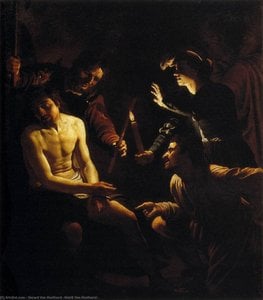 The Mocking of Christ


