


The Dawn of Urban Realism: Breaking from Gilded Age Idealism
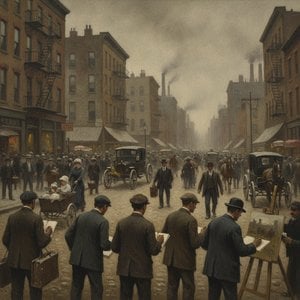 The Ashcan School: Capturing the Raw, Unfiltered Soul of Urban Life through American Realism
Beyond the Gilded Age: The Emergence of a New American Vision To understand the profound shift brought about by the Ashcan School, one must first recall the gilded splendor that preceded it. At the turn of the 20th century, the American art scene was...
To truly comprehend the seismic shift brought about by the Ashcan School, one must first recall the gilded splendor that preceded it. At the turn of the twentieth century, the American artistic landscape was draped in the soft, romanticized veils of the Hudson River School and the refined, aristocratic elegance of society portraits. There was a certain comfort in those idealized landscapes—a sense of a nation looking backward toward a pristine, untouched wilderness or upward toward an untouchable European tradition. This era favored polished idealism, where beauty was synonymous with grace, light, and a sanitized view of existence that often ignored the burgeoning complexities of a modernizing world.
However, as the gears of industrialization began to turn with relentless momentum at the dawn of the twentieth century, this polished veneer started to feel increasingly disconnected from the lived experience of a rapidly changing people. A quiet insurgency was brewing in the bustling streets and crowded tenements of New York City. This movement, later dubbed the Ashcan School, was not born of grand manifestoshi or aristocratic patronage, but of a desire to confront the world as it truly appeared. Much like the French Realists who had rejected Romanticism decades earlier, these American artists sought a truth that was often unvarnished and sometimes uncomfortable, finding profound beauty not in the mythological or the grand, but in the contemporary and the tangible.
The Pulse of the Pavement: Defining the Ashcan Aesthetic
 The Ashcan School: Capturing the Raw Spirit and Urban Realism of New York City Life
The Urban Pulse: Defining the Ashcan School Movement At the dawn of the twentieth century, a transformative energy surged through the streets of Manhattan, a rhythmic, chaotic heartbeat that demanded a new visual language. While the established art a...
The aesthetic of the Ashcan School is characterized by a profound sense of immediacy, achieved through bold, often vigorous brushwork and a tonal range that embraces the shadows. These artists were not interested in the ethereal or the divine; instead, they sought the pulse of the pavement, finding profound beauty in the unvarnably truth of urban existence. There is a palpable weight to their canvases, an impasto texture that mirrors the physical density of the city itself. They embraced the grit—the smoke, the grime, and the heavy atmosphere of an industrializing world—and transformed it into a profound narrative of human endurance.
This was a democratization of subject matter, a deliberate turning away from the refined tastes of the upper classes towards the vibrant, often overlooked realities of modern urban existence. The artists possessed an almost supernatural ability to find cadence within chaos. In their works, one can almost hear the clatter of horse-drawn carriages, the distant cries of street vendors, and the low hum of conversation in a bustling tavern. They did not shy away from the darker corners of urban life; they embraced the murky alleys, the crowded tenements, and the smoke-filled taverns, capturing the fleeting moments of a society transitioning into modernity with an honesty that was both startling and deeply moving.
Masters of the Metropolis: The Visionaries of the Movement
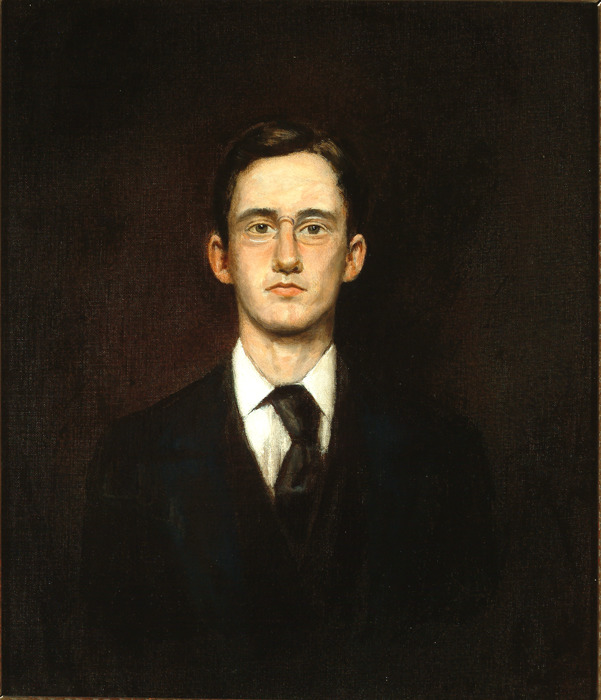 Ashcan School
The Ashcan School, also called the Ash Can School, was an artistic movement in the United States during the late 19th-early 20th century that produced works portraying scenes of daily life in New York, often in the city's poorer neighborhoods. The mo...
The movement was less a formal school and more a shared sensibility, a collective decision to document the grit, the grime, and the glorious vitality of a city in flux. At its heart stood Robert Henri, the spiritual father of this rebellious group. Henri, whose early life was marked by instability, embraced a radical approach that urged his contemporaries to be unafraid of offending contemporary taste. He famously desired art to be akin to journalism, believing that paint should be as real as mud or the snow that froze on Broadway in winter. His vision was deeply influenced by the robust, unfettered spirit of Walt Whitman’s Leaves of Grass, seeking a poetic truth in the everyday.
Alongside Henri, a group of talented painters—including George Luks, William Glackens, John Sloan, and Everett Shinn—formed the core of this artistic rebellion. Some had studied together under the realist Thomas Anshutz, while others found their inspiration in the newspaper offices of Philadelphia, working as illustrators. This shared background in observing the raw details of life provided the foundation for their collective mission. Even artists like Theresa Bernstein contributed to this vibrant tapestry, helping to define a movement that was emblematic of the spirit of political and social rebellion during a period of intense urban expansion.
A Study in Grit and Grace: Analyzing Key Works and Techniques
 Snow in New York
A Winter's Breath in the Heart of Manhattan In the quiet, muffled atmosphere of a New York winter, Robert Henri’s "Snow in New York" (1902) invites the viewer to step into a moment frozen in time. The painting captures a gritty yet poetic urban lands...
Nowhere is the raw distillation of urban life more evident than in Robert Henri’s 1902 masterpiece, Snow in New York. This painting is far removed from the picturesque beauty favored by his contemporaries; it is a study in muted, atmospheric tones—shades of coffee, earth brown, and slate gray that evoke the damp, heavy air of a late nineteenth-century metropolis. The scene is not one of pristine, sparkling white, but rather a gritty yet poetic landscape where the bustling energy of the city is softened by a heavy blanket of snow. Through his masterful use of light and shadow, Henri transforms a common street corner into a profound meditation on urban solitude.
The technique employed in such works is a testament to the commitment to realism. Eschewing the delicate, polished finishes of academic art, these painters utilized a thick, impasto-like application of oil paint that lends a tactile, sculptural quality to the canvas. Visible, expressive brushstrokes dance across the surface, particularly in the facades of buildings and the textured snow beneath carriage wheels. This painterly approach does not merely depict a scene; it recreates the very sensation of looking through a flurry of falling flakes. The palette is intentionally restrained, relying on ivory, cream, and parchment tones, punctuated only by sudden, spirited strokes of black or crimson that suggest the presence of distant pedestrians.
The Legacy of the Ashcan School: Influence on Modern American Art
 American realism
American realism was a movement in art, music and literature that depicted contemporary social realities and the lives and everyday activities of ordinary people. The movement began in literature in the mid-19th century, and became an important tende...
The legacy of the Ashcan School resides in its fundamental alteration of the course of American art. By challenging established norms and rejecting the suffocating influence of the Genteel Tradition, these artists paved the way for a more authentic American visual language. They moved art from the exclusive salons of the elite into the very heart of the public experience, proving that the everyday struggles of immigrant populations, laborers, and bohemians were worthy of the highest artistic consideration. Their work served as a visual chronicle of an era defined by rapid industrialization, capturing the soul of a nation in transition.
Today, we see their influence in the continued importance of American Realism, which seeks to depict contemporary social realities and the lives of ordinary people. The Ashcan School’s ability to find majesty in the unvarnished reality of the modern metropolis remains a cornerstone of artistic inspiration. They taught us that beauty does not require a sanitized view of existence; rather, it can be found in the shadows, the alleys, and the very pulse of the pavement, forever changing how we perceive the art of the streets.
At WahooArt.com, we celebrate this enduring legacy of craftsmanship and realism. We specialize in bringing these historical textures to life through our Handmade Oil Reproductions. Our artists, holding degrees from prestigious Fine Arts academies, utilize the same thick impasto techniques and rich, atmospheric palettes seen in the works of Henri and Sloan. Whether you are looking to adorn a modern space with the gritty elegance of an urban landscape or seeking a Custom Portrait Commission that captures a personal milestone with academic excellence, our 100% hand-painted oils on cotton canvas offer a depth and soul that no print can replicate. Discover the intersection of art history and timeless luxury at WahooArt.com.


