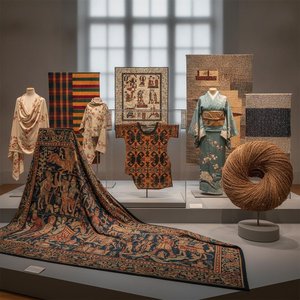
The Rebellion Against Industrialism: The Genesis of a New Aesthetic
 Arts and Crafts movement
The Arts and Crafts movement was an international trend in the decorative and fine arts that developed earliest and most fully in the British Isles and subsequently spread across the British Empire and to the rest of Europe and North America. Broadly...
In the twilight of the nineteenth century, as the soot of the Industrial Revolution began to shroud the once-verdant landscapes of Europe, a profound cultural tremor began to resonate through the halls of design. This was not merely a change in fashion, but a visceral rebellion against the perceived impoverishment of the decorative arts. The rapid ascent of factory production had introduced a certain soullessness into the domestic sphere; objects were being birted from machines with a clinical efficiency that stripped them of their narrative and their dignity. This era of mass-produced uniformity prompted a movement of thinkers, artists, and craftsmen to look backward in order to move forward, seeking to reclaim the sanctity of the human touch.
The movement emerged as a powerful critique of the dehumanization inherent in Victorian industrialism. It was an international trend that found its most fertile ground in the British Isles, yet its echoes were felt across the Atlantic and throughout Europe. The reformers of this era viewed the proliferation of cheap, machine-made goods not just as an aesthetic failure, but as a moral one. They believed that the quality of one's surroundings directly influenced the quality of one's soul. By championing the intrinsic value of craftsmanship and the honest expression of materials, they sought to bridge the widening chasm between the creator and the consumer, fostering a world where every object possessed an inherent, lived-in beauty.
William Morris and the Philosophy of Organic Integrity
 William Morris
William Morris (24 March 1834 – 3 October 1896) was an English textile designer, poet, artist, writer, and socialist activist associated with the British Arts and Crafts movement. He was a major contributor to the revival of traditional British texti...
At the heart of this aesthetic revolution stood the multifaceted figure of William Morris. Before he was recognized as a revolutionary socialist or a seminal poet, Morris was a man deeply captivated by the romanticism of a lost world—a world of medieval chivalry and the untamed English countryside. His vision was never one of mere nostalgia; rather, it was a profound belief that nature and its traditional modes of production held an inherent moral superiority over the burgeoning industrial age. Alongside luminaries such as Dante Gabriel Rosertti and Edward Burne-Jones, Morris sought to revive the prestige of hand-made crafts, imbuing everyday objects with a sense of purpose and meaning.
Morris’s philosophy was rooted in the concept of organic integrity—the idea that design should reflect the natural order and the honest nature of its components. His work, ranging from intricate textile designs to sweeping wallpapers, served as a quiet declaration of rebellion against the prevailing trends of his time. He championed the dignity of labor, believing that the act of creation itself was a transformative power. Through his workshops, he resurrected traditional British textile arts and methods, ensuring that the textures of the past could breathe life into the homes of the present. To touch a Morris design is to feel the pulse of a man who believed that beauty should be accessible through skilled, intentional labor.
Botanical Complexity: The Language of Nature in Decorative Arts
 Rose
RoseWilliam Morris’s Rose: A Floral Emblem of Victorian Romanticism The textile known as “Rose,” created by William Morris between 1862 and 1863, stands as an enduring testament to the Arts and Crafts movement's fascination with natural beauty and its re...
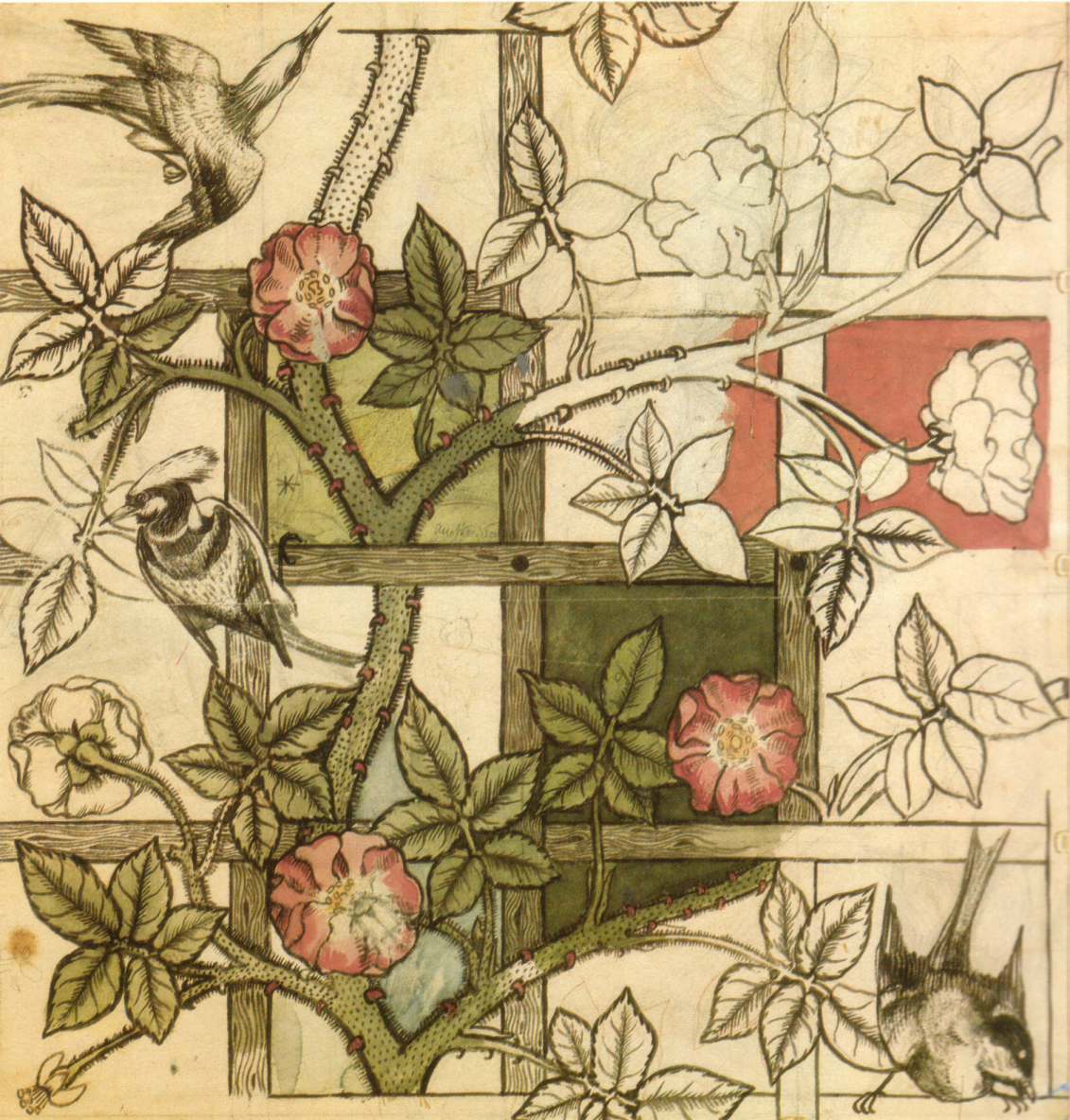
To study the works of the Arts and Crafts movement is to enter a meticulously crafted portal into a world steeped in folklore and botanical accuracy. The visual heartbeat of this era lies in its breathtaking complexity, most notably exemplified by Morris’s legendary floral motifs. Patterns such as his Rose textile or the Hereditary Trellis wallpaper are far more than mere decoration; they are carefully considered visual statements. These designs utilize a symphony of flora and form—winding acanthus leaves, stylized tulips, and pomegranates—to create a sense of rhythmic, living movement across a surface.
Every petal and tendril was rendered with an almost obsessive attention to detail, drawing inspiration from illuminated manuscripts and the rich tapestry of English folklore. In pieces like the Hammersmith Rug, one finds a vision woven in color and myth, where the heavy presence of foliage and earth tones creates a sense of grounded permanence. This fascination with nature was not merely about imitation, but about capturing the essence of growth and connection. By integrating these intricate botanical elements into the domestic environment, the movement sought to invite the wild, restorative power of the natural world indoors, creating sanctuaries of quiet contemplation amidst the chaos of modernity.
From British Isles to American Craftsman: A Global Design Legacy
 American Craftsman
American Craftsman is an American domestic architectural style, inspired by the Arts and Crafts movement, which included interior design, landscape design, applied arts, and decorative arts, beginning in the last years of the 19th century. Its immedi...
While the movement found its most complete expression in Britain, its principles underwent a fascinating evolution as they crossed oceans. In North America, the movement manifested as the American Craftsman style, an architectural and decorative offshoot that embraced simpler, more functional forms. Inspired by the transition away from Victorian ornamentation, this style drew heavily from the Shingle style and the later Prairie style of Frank Lloyd Wright. It emphasized the beauty of heavy timbers, wrought iron, and stone, creating homes that felt deeply rooted in their landscapes.
This global expansion demonstrated the universal appeal of the movement's core tenets: honesty, durability, and the celebration of the artisan. From the California bungalows that defined a generation of American domestic life to the Mingei movement in Japan, the reverence for traditional craftsmanship became a shared language of resistance against industrial uniformity. The legacy of this era is found in the enduring popularity of structures and objects that prioritize structural honesty over superficial ornamentation, proving that true luxury lies in the permanence and integrity of well-made things.
The Modern Revival: Integrating Handcrafted Artistry into Luxury Interiors
 The Arts and Crafts Movement: A Procurement Guide to Timeless Design for Luxury Hotel Interiors
Defining the Aesthetic: The Core Principles of Arts and Crafts for Hospitality Design In the fast-paced world of modern hospitality, where transient guest experiences often lean toward the sterile and the mass-produced, the Arts and Crafts movement o...
In our contemporary, fast-paced world—where digital interfaces and mass-produced furniture often lean toward a sterile, transient experience—the principles of the Arts and Achraf movement offer a profound architectural and decorative antidote. For the modern connoisseur and the luxury interior designer, adopting these principles is not an exercise in mere nostalgia; it is a strategic move toward creating spaces that resonate with warmth, stability, and a sense of permanent luxury. The movement’s philosophy aligns perfectly with the highest standards of high-end hospitality and residential design, where the goal is to provide curated, soulful environments.
Integrating this aesthetic into modern luxury requires an emphasis on natural textures and intentionality. It translates to the use of heavy, tactile materials—richly grained woods, hand-forged metals, and bespoke textiles that tell a story. By incorporating elements that echo the botanical complexity and structural honesty of the Arts and Crafts era, designers can build interiors that possess a timeless authority. Whether through large-format murals that recreate historical grandeur or custom oil reproductions that bring the depth of classical brushwork to a modern wall, the revival of handcrafted artistry ensures that our most cherished spaces remain relevant, prestigious, and deeply connected to the enduring beauty of human creativity.
At WahooArt.com, we celebrate this very spirit of craftsmanship. As a global leader in fine art reproductions, we bridge the gap between historical mastery and modern luxury. Our mission is to preserve the soul of the Old Masters through meticulous, hand-painted oil recreations on 100% cotton canvas. From bespoke commissions that transform personal memories into masterpieces to large-scale architectural murals for luxury hotels, our artists—each a specialist in their genre—ensure that every brushstroke honors the legacy of the great movements. Whether you are an interior designer seeking a cohesive narrative for a project or a collector looking for an authentic piece of history, WahooArt provides the expertise, the quality, and the 100% satisfaction guarantee required to curate a truly timeless collection.