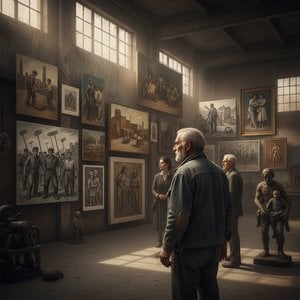
The Rebellion Against Idealism: The Emergence of a New Visual Truth
 The Unvarnished Truth: A Cultural Journey Through the Soul of American Realism
The Rebellion Against Idealism: The Emergence of a New Vision Realism (art movement) Realism was an artistic movement that emerged in France in the 1840s. Realists rejected Romanticism, which had dominated French literature and art since the early 19...
To understand the profound seismic shift that occurred at the dawn of the twentieth century, one must first recall the gilded atmosphere that preceded it. For decades, the American artistic landscape was draped in the soft, romanticized veils of the Hudson River School and the refined, aristocratic elegance of society portraits. There was a certain comfort in those idealized landscapes—a sense of a nation looking backward toward a pristine, untouched wilderness or upward toward an untouchable European tradition. However, as the gears of industrialization began to turn with relentless momentum, this polished veneer started to feel increasingly disconnected from the lived experience of a rapidly changing people.
The emergence of American Realism was not merely a change in brushstroke, but a quiet, profound insurgency. Much like the French Realists of the 1840s, led by the uncompromising Gustave Courbet, American artists began to reject the exoticism and exaggerated emotionalism of Romanticism. They sought a truth that was often unvarnished, sometimes even uncomfortable, finding beauty not in the mythological or the grand, but in the contemporary and the tangible. This movement sought to strip away the artifice and confront the world as it truly appeared, replacing the dreamlike vistas of the past with a commitment to accuracy and the depiction of real, typical contemporary situations.
The Ashcan School: Capturing the Pulse of the Urban Experience
 The Ashcan School: Realism, Urban Life & the Democratization of American Art
Introduction: Challenging Convention – The Rise of Urban Realism The turn of the twentieth century witnessed a seismic shift in artistic sensibilities, a rebellion against the polished idealism that had long dominated the American art scene. This was...
At the turn of the century, a new revolution was brewing within the bustling streets and crowded tenements of New York City. This was not a movement born of grand manifestos or aristocratic patronage, but rather a quiet rebellion emerging from the very grit of urban life. A group of artists, later dubbed the Ashcan School, dared to depict life as it was—raw, unvarnished, and often uncomfortable. They challenged established norms by turning their gaze away from idyllic landscapes and toward the vibrant, often overlooked realities of modern urban existence.
The canvases of this movement pulsed with the energy of immigrant neighborhoods, working-class struggles, and the everyday dramas unfolding on city sidewalks. Artists such as Robert Henri, William James Glackens, and John Sloan became the chroniclers of a new America. In works like Glackens’ Italo-American Celebration, we witness a snapshot of urban joy, where the spirit of early twentieth-century New York is captured through a lens of optimism and civic pride. These artists did not seek to decorate; they sought to document the democratization of American art, finding profound significance in the movement of crowds, the clinking of glass at a soda fountain, and the shared humanity found in the city's most crowded corners.
Mastering the Unvarnished: Technical Brilliance in American Realist Brushwork
 Ernest Lawson
The painting Ernest Lawson by William James Glackens is a captivating oil on canvas artwork that showcases the artist's exceptional skill in capturing the essence of his subject. Created in 1910, this portrait is a testament to Glackens' ability to c...
The power of American Realism lies not only in its subject matter but in the masterful technical execution that brings these scenes to life. The movement was characterized by a departure from the rigid, academic traditions that emphasized meticulous detail and polished finishes. Instead, artists embraced a more visceral approach. Influenced profoundly by Impressionism—particularly the light-drenched works of Renoir—pioneers like Glackens utilized a distinctive visual language. They often employed a wet-on-wet technique, where layers of paint are blended seamlessly to create luminous surfaces and evoke a palpable sense of movement and spontaneity.
In a high-quality oil reproduction, one can truly appreciate the depth of this technique. Unlike the flat appearance of a digital print, a hand-painted work showcases visible brushstrokes and a deeper tonal range that captures the nuances of light reflecting off skin or fabric. Consider the portraiture of Robert Henri; his use of bold brushstrokes and a vibrant color palette creates a sense of texture and dynamism that prevents the subject from appearing static. This tactile quality—the impasto effect where paint stands proud of the canvas—is what allows a piece to transcend mere depiction and become an immersive experience, inviting the viewer to feel the very atmosphere of the era.
Social Resonance and Contemporary Life: Art as a Cultural Witness
 American Realism: Social Commentary & Artistic Representation in Early 20th-Century Painting
The Rise of Realism: Challenging Academic Conventions Wikipedia: American realism American realism was a movement in art, music and literature that depicted contemporary social realities and the lives and everyday activities of ordinary people. The m...
Beyond the aesthetic allure, American Realism served as a vital cultural witness to a nation in flux. The movement flourished during a period of unprecedented immigration, urban expansion, and social class tensions. It was an era where the rhythms of daily life were being redefined by the industrial revolution, and artists felt a burgeoning responsibility to bear witness to these transformations with unflinching honesty. Whether through a cultural portrayal or a scenic view of downtown Manhattan, these works attempted to define what was real in a world that was changing faster than ever before.
This social component is evident in the way artists approached their subjects. They did not shy away from the socio-political conditions of the working class; rather, they found dignity within them. Even in more intimate portraits, such as Henri’s La Madrelenita, there is a sense of profound connection to the contemporary moment. The gaze of the subject often holds both confidence and a touch of melancholy, reflecting the complexities of an era marked by both prosperity and hardship. By focusing on the everyday activities of ordinary people, American Realism provided a gateway into the soul of a nation, creating a legacy of art that is as much about social commentary as it is about visual beauty.
Curating Authenticity: Integrating American Realism into Modern Luxury Interiors
 American Realism's Defining Works: 10 Masterpieces for Your Home
Introduction Imagine stepping back in time to a nation grappling with rapid industrialization, urbanization, and social change. This was America in the late 19th and early 20th centuries – a period of immense upheaval and profound questioning. The pr...
For the discerning collector and the sophisticated interior designer, American Realist works offer an unparalleled opportunity to infuse a space with character, history, and soul. In a modern era often dominated by mass-produced decor, the presence of a hand-painted reproduction brings a sense of permanence and authenticity to a room. These pieces act as anchors, providing a conversation point that connects the contemporary setting to the rich heritage of the twentieth century.
Integrating such works requires an eye for composition and color. The dark-hued, vibrant street scenes of the Ashcan School pair exquisitely with modern, minimalist architecture, where the grit of the painting provides a striking contrast to clean lines. Alternatively, for those seeking a more classical atmosphere, the light-drenched, Impressionistic influences found in Glackens' later works can soften a space, adding warmth and luminosity. Whether through a large-scale multi-panel installation that spans a grand staircase or a single, intimate portrait in a private study, American Realism allows for a curated expression of taste—a way to surround oneself not just with art, but with the very essence of truth.
At WahooArt.com, we specialize in preserving this legacy through our museum-grade, hand-painted oil reproductions. Our artists, all holders of prestigious Fine Arts degrees, meticulously recreate the texture, brushwork, and emotional depth of these masterpieces on 100% cotton canvas. From custom portrait commissions that transform your personal milestones into historical treasures to bespoke architectural murals for luxury hospitality projects, we provide a full-service experience for the global collector. We invite you to explore our collection and discover how the unvarnished beauty of American Realism can redefine your world.