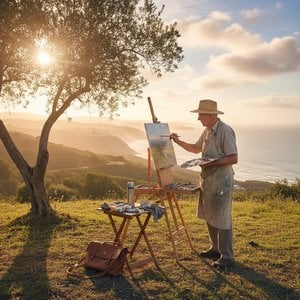
The Dawn of Direct Observation: The Revolutionary Shift to En Plein Air
 Capturing Ephemeral Light: Plein Air Painting from Impressionism to Today
The Genesis of 'En Plein Air': From Studio Tradition to Landscape Portraiture Wikipedia: En plein air En plein air (pronounced [ɑ̃ plɛ.n‿ɛʁ]; French for 'outdoors'), or plein-air painting, is the act of painting outdoors. This method contrasts with s...
For centuries, the sanctity of the artist’s studio reigned supreme as the locus of creation, a controlled sanctuary where light was not experienced but meticulously recreated through memory and academic rigor. Within these walls, landscapes were constructed from sketches and idealized compositions, striving for a predetermined perfection that often lacked the pulse of reality. However, a profound rebellion began to stir in the late 19th century, fueled by a growing Romantic sensibility and an unyielding desire for authenticity. This movement found its theoretical heartbeat in the works of visionaries like Pierre-Henri de Valenciennes, whose treatises championed the concept of landscape portraiture—the radical notion that an artist should engage directly with nature in situ.
The transition to en plein air painting—literally "in the open air"—was more than a mere change in location; it was a revolution of the senses. Before the advent of portable paint tubes, this endeavor required immense logistical fortitude, necessitating the grinding of pigments and the management of unwieldy materials amidst the elements. Yet, the reward was an unprecedented intimacy with the subject. By stepping beyond the studio walls, artists could finally capture the ephemeral nuances of atmosphere, the subtle shifts in temperature, and the fleeting dance of shadows that define a true moment in time. This shift from studio-bound construction to direct observation laid the essential groundwork for the American Impressionist movement, forever altering the relationship between the painter and the natural world.
Luminous Landscapes: Mastering Light and Color in the American Canon
 American Impressionism
American Impressionism was a style of painting related to European Impressionism and practiced by American artists in the United States from the mid-19th century through the beginning of the 20th. The style is characterized by loose brushwork and viv...
As the influence of French Impressionism traveled across the Atlantic, American artists began to interpret this new language through a uniquely domestic lens. The hallmark of this era was an obsession with the ephemeral—the way sunlight filters through a canopy of trees or how the morning mist softens the horizon. Unlike the more structured academic traditions, American Impressionism embraced loose brushwork and a vibrant, luminous palette. Artists sought to capture not just the form of a landscape, but its very soul, using color to evoke the warmth of a summer afternoon or the cool, melancholic hush of twilight.
The mastery of light in this period relied heavily on an understanding of color temperature and the interplay of light absorption and reflection. By utilizing broken brushstrokes, painters could allow colors to blend optically in the viewer's eye, creating a shimmering effect that mimicked the vibration of natural light. This technique allowed for a deeper tonal range and a sense of movement within the canvas. When observing works from this period, one does not merely see a meadow or a coastline; one experiences the weight of the air and the brilliance of the sun, as if standing personally within the scene. It is this pursuit of luminosity that remains the most enduring legacy of the movement.
Beyond the Studio Walls: Exploring Domesticity and Upper-Class Life
 La Marcellerie
Gaines Ruger Donoho was an American artist known for his beautiful landscapes and portraits. One of his notable works is La Marcellerie , an oil on canvas painting created in 1881. This stunning piece is currently housed at the Brooklyn Museum in the...
While the sweeping landscapes of the American West and the rugged coasts provided grand stages, much of the movement's heart resided in the quiet, elegant corners of upper-class domestic life. American Impressionism found a profound resonance in depicting the leisure and grace of the era’s social elite. These paintings often focused on intimate settings—sun-drenched parlors, manicured gardens, and serene porches—where the boundaries between the interior world and the natural landscape began to blur.
These compositions frequently featured figures engaged in quiet contemplation or social ritual, such as the delicate scene in Gaines Ruger Donoho’s La Marcellerie, where a single figure blends into the verdant tonalities of an enclosed meadow. Such works captured the essence of a specific social stratum, celebrating a lifestyle characterized by refinement and tranquility. Through the use of soft light and dappled shadows, artists were able to imbulate even the most mundane domestic moments with a sense of poetic importance, transforming everyday life into a seriesstanding testament to beauty and grace.
Regional Variations: From the Golden Coast of California to the East Coast Tradition
 California Impressionism
The terms California Impressionism and California Plein-Air Painting describe the large art movement of 20th century artists who worked out of doors (en plein air), directly from nature in California, United States. Their work became popular in the S...
The American Impressionist movement was never a monolith; rather, it was a tapestry of regional interpretations shaped by the diverse geographies of the United States. On the Atlantic coast, artists drew inspiration from the historic landscapes of New England and the bustling energy of New York and Boston. This tradition often leaned toward a more structured approach, influenced by the established art associations and the influx of French works during major exhibitions in the 1880s.
Conversely, California Impressionism emerged as a distinct and sun-drenched subset of the movement. Working primarily in the San Francisco Bay Area and Southern California, these artists were deeply moved by the unique light of the Pacific coast. Their work often emphasized the rugged beauty of the California landscape, utilizing a palette that reflected the golden hues of the hills and the brilliant clarity of the coastal atmosphere. This regional variation demonstrates the incredible versatility of the Impressionist technique, proving that whether through the misty mornings of the East or the radiant sun of the West, the movement’s core mission remained the same: to capture the spirit of the land.
The Enduring Legacy: How Impressionist Techniques Shape Modern Aesthetic Values
 Capturing Ephemeral Light: A Comprehensive Exploration of Plein Air Painting's History & Enduring Legacy
The Dawn of Direct Observation: From Studio Tradition to En Plein Air Wikipedia: En plein air En plein air (pronounced [ɑ̃ plɛ.n‿ɛʁ]; French for 'outdoors'), or plein-air painting, is the act of painting outdoors. This method contrasts with studio pa...
The ripples of the American Impressionist movement continue to resonate through the halls of contemporary art and modern interior design. The emphasis on light, texture, and emotional resonance has left an indelible mark on how we perceive beauty in the modern age. The techniques pioneered by these masters—the use of visible, expressive brushstrokes and the prioritization of atmosphere over rigid form—can be seen in everything from modern landscape photography to the textured surfaces of contemporary abstract works.
For the discerning collector and the passionate enthusiast, this movement offers a timeless connection to the natural world. The ability to bring the light-drenched beauty of an Impressionist masterpiece into a modern home allows for a profound sense of tranquility and historical continuity. Whether through the acquisition of a museum-quality reproduction or the commissioning of a custom piece that reimagines a personal memory in a classical style, the spirit of American Impressionism remains a vital, breathing force in the world of fine art, reminding us all to pause and witness the fleeting magic of the light.
At WahooArt.com, we celebrate this enduring legacy by offering exquisite, hand-painted oil reproductions that honor the craftsmanship of the masters. Our artists, trained in the finest academies, meticulously recreate the texture, depth, and luminosity of these historical treasures on 100% cotton canvas. From custom portraits that transform your personal milestones into Impressionist masterpieces to large-scale murals for sophisticated interiors, we provide a bridge between art history and your modern living space. Discover the artistry of the past, reimagined for your present.