


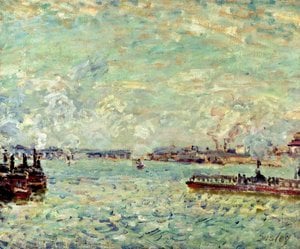


The Quietude of Sisley: A Departure from Impressionist Noise
What Is Impressionism? 4 Things to Know
While the history of the late nineteenth century is often written through the lens of radical disruption, Alfred Sisley offered a different sort of revolution. To look at the works of his contemporaries is to encounter the pulse of a changing era—the bustling energy of Renoir’s La Grenouillère or the industrial shifts captured by Caillebotte. These artists sought the friction of modern life. Sisley, however, found his strength in the stillness. He did not seek to shock the viewer with the frantic pace of Paris; instead, he turned his gaze toward the enduring rhythms of the French countryside.
This preference for the tranquil finds a historical echo in the Barbizon School. Decades before the first Impressionist exhibition in 1874, painters like those active in the Forest of Fontainebleau sought to move away from rigid formalism toward a more naturalistic mode. They established the precedent for observing nature directly, yet they often worked with a heavier, more somber intent. Sisley took this foundation of sincerity and stripped away the weight. Where the Barbizon masters prepared studies for finished studio works, Sisley embraced the immediacy of the moment, finding a way to be modern without being loud.
--- title: What Is Impressionism? 4 Things to Know | National Gallery of Art author: Annie Yi url: https://www.nga.gov/stories/articles/what-impressionism-4-things-know hostname: nga.gov description: Learn the hallmarks of one of the most recognizabl...
Atmospheric Truth: The Sky as a Canvas of Light
For Sisley, the sky was never merely a backdrop; it was the primary protagonist of the landscape. His ability to render the weight of a cloud or the clarity of a summer afternoon relied on an acute sensitivity to atmospheric conditions. In works such as Allée of Chestnut Trees, one perceives a loose brushwork that suggests spontaneity, yet the composition is carefully constructed to direct the eye through layers of light and air. He understood that to paint a tree, one must first paint the light that defines its edges. This focus on the ephemeral mirrors the technical shifts seen in Claude Monet’s early work. In Impression, Sunrise, the harbor of Le Havre is rendered through short, broken brushstrokes that prioritize the sensation of light over the solidity of form. While Monet used this technique to capture the fleeting "impression" of a moment—a term famously used derisively by critic Louis Leroy—Sisley applied similar principles to achieve a sense of permanence within the transient. He utilized the same emphasis on light and color, yet his results felt less like a momentary glance and more like a profound meditation on the sky's enduring presence.Reflections on the Seine: The Weight and Movement of Water
The Seine River serves as a recurring character in the narratives of French landscape painting, acting as both a mirror for the heavens and a conduit for change. Sisley’s relationship with this water was particularly intimate. In Flood at Port-Marly, he depicts a village submerged, using a muted palette of soft grays, blues, and greens to convey the reflective, somber quality of the floodwaters. There is no attempt to dramatize the disaster; there is only the quiet, heavy reality of the water resting against the architecture. This preoccupation with the river’s surface finds its counterpart in the works of Pierre-Auguste Renoir. In his 1869 depiction of La Grenouillère, the water is a site of leisure, shimmering with dappled sunlight and the movement of bathers. While Renoir captures the social vitality of the riverbank, Sisley focuses on its elemental power. Both artists utilized the new technology of portable oil paint tubes to work en plein air, allowing them to catch the light as it hit the ripples, yet Sisley’s water remains a vessel for atmosphere rather than a stage for spectacle.The Language of Color: Breaking the Academic Mold
Impressionism: Art and Modernity
The transition from the sober, dark tones of Academic painting to the luminous palettes of the Impressionists was nothing short of a visual upheaval. The Académie des Beaux-Arts favored precise drawing and smooth, finished surfaces, often utilizing black and gray to define shadows. Sisley, alongside his peers, rejected this convention. He embraced "broken color," placing unblended strokes of contrasting hues side by side to create a visual vibration. By removing black from his palette, he allowed shadows to breathe with reflected blues and purples, bringing a new depth to the mid-tone range.
This technical liberation was made possible by the advent of synthetic pigments, which provided artists with much more vivid shades of blue and green than had been available to previous generations. We see this shift clearly when comparing the meticulous, dark lace of Ingres’s portraits to the luminous, color-driven surfaces of Mary Cassatt. Sisley utilized these new, bright pigments not to create a garish effect, but to achieve a "high key" luminosity that felt true to the natural world. His work proves that innovation does not require the abandonment of grace; it only requires a more honest way of seeing.
--- title: Impressionism: Art and Modernity - The Metropolitan Museum of Art author: Margaret Samu url: https://www.metmuseum.org/essays/impressionism-art-and-modernity hostname: metmuseum.org description: In addition to their radical technique, the ...


