Early Influences & Academic Foundations
American Impressionism was a style of painting related to European Impressionism and practiced by American artists in the United States from the mid-nineteenth century through the beginning of the twentieth. The style is characterized by loose brushw...
William Merritt Chase’s artistic journey began not amidst the blossoming Impressionist circles of Europe, but in the pragmatic world of mid-19th century Indiana. Born in 1849, his early life was marked by a familial shift to Indianapolis and an initial foray into the family business – a practical necessity that nonetheless instilled a sense of discipline. However, even within these constraints, Chase’s innate artistic inclination surfaced, nurtured by local instructors like Barton S. Hays and Jacob Cox. This foundational period, though modest in scope, laid the groundwork for his relentless pursuit of technical mastery. A brief stint in the Navy proved fleeting, quickly superseded by a more compelling calling: formal training at New York's National Academy of Design under Lemuel Wilmarth, himself a student of Jean-Léon Gérôme. This immersion into academic realism would prove crucial, providing Chase with the robust draftsmanship and understanding of form that would later inform his revolutionary Impressionistic explorations.
Financial setbacks forced a temporary return to St. Louis, but even here, Chase’s talent shone, garnering recognition at local exhibitions and attracting patrons willing to sponsor his European studies in 1872. Munich became his chosen center of artistic pilgrimage – a deliberate decision driven by the Academy's reputation for rigorous training and its relative lack of Parisian distractions. For six years, he absorbed the “flashy old-master style” characterized by dark palettes and virtuosic brushwork, honing skills that would initially define his aesthetic. His camaraderie with fellow American artists like Walter Shirlaw, Frank Duveneck, and Joseph Frank Currier further enriched this formative experience, fostering a spirit of artistic ambition and shared exploration.
The Embrace of Impressionism: A New American Palette
Upon returning to New York in 1878, Chase established himself as a respected portraitist, yet a subtle restlessness began to stir within his work. The encounter with Belgian painter Alfred Stevens proved pivotal; Stevens encouraged Chase to abandon the academic bravura he’d cultivated in Munich and embrace a more fluid, light-infused approach. This marked the beginning of Chase's exploration into Impressionism – not as a wholesale adoption of French techniques, but as a carefully considered evolution of his existing skillset. He began experimenting with pastel, captivated by its immediacy and vibrancy, and ventured *en plein air*, seeking to capture the fleeting effects of light and atmosphere directly from nature.
In 1886, Chase irrevocably altered the course of American art history with a series of brilliant canvases depicting New York’s burgeoning public parks. These weren't mere depictions of leisure; they were bold statements – the first major American paintings to fully embrace Impressionist principles on native soil. The loose brushwork, high-keyed palette, and focus on capturing momentary sensations resonated with a growing audience eager for a distinctly American artistic voice. This period wasn’t simply about replicating what he saw in France; it was about translating the spirit of Impressionism into the context of New York life, imbuing it with a uniquely American sensibility.
Shinnecock Summer School: Cultivating a Generation of Artists
The year 1892 witnessed a transformative chapter in Chase’s career – the establishment of his summer home and art school at Shinnecock on Long Island. Invited by Jane Ralston Hoyt, who envisioned the area as an artistic haven akin to Giverny, Chase created a learning environment modeled after the Académie Julian in Paris. The Shinnecock Hills Summer School quickly became a resounding success, attracting students from across the country eager to learn from one of America’s most celebrated painters and educators. His teaching philosophy was rooted in observation – encouraging students to immerse themselves in nature, to capture light and color directly, and to develop their own individual styles.
The school wasn't merely a technical training ground; it fostered a vibrant community where artists could exchange ideas, experiment with new techniques, and find inspiration in the breathtaking coastal landscape. Chase’s studio, perched atop Sugar Loaf Hill, became a social hub, attracting prestigious commissions and solidifying his reputation as a genteel Bohemian figure. Importantly, Shinnecock also allowed him to forge connections with the local Shinnecock Indian Nation, a relationship that would subtly influence his work and worldview.
Chase’s Dual Style: Portraits and Plein Air Painting
Throughout his prolific career, Chase masterfully navigated two seemingly disparate styles: the intimate realism of portraiture and the spontaneous energy of plein air landscapes. He never fully abandoned the academic techniques he'd honed in Munich; instead, he integrated them into his Impressionistic explorations, creating a unique artistic voice that was both technically proficient and emotionally resonant. His portraits weren’t simply likenesses; they were studies of character, capturing the nuances of personality and social standing with remarkable sensitivity.
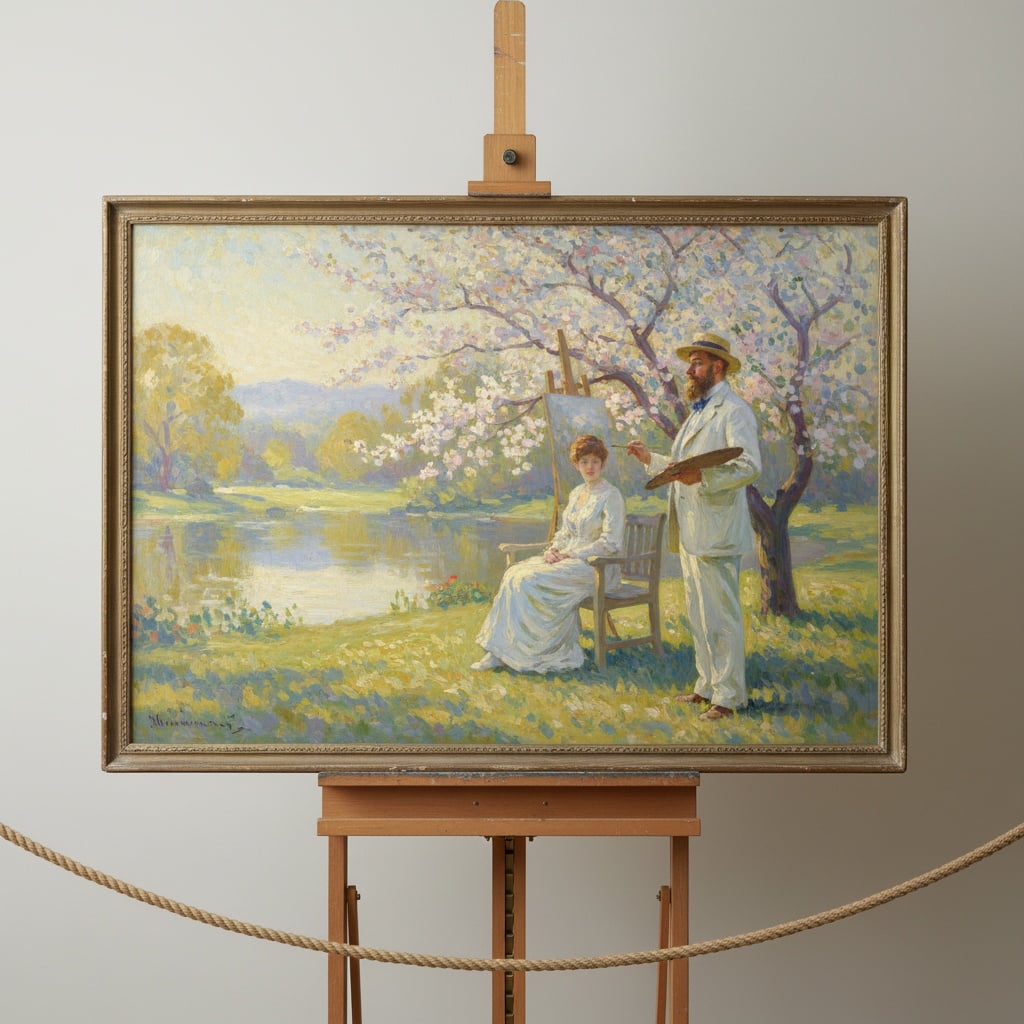
Conversely, his plein air paintings – often executed in the bright sunlight and sea air of Shinnecock – showcased a looser, more painterly approach, emphasizing the fleeting effects of light and atmosphere. This duality wasn’t contradictory; it was a testament to Chase’s versatility and his ability to adapt his style to suit the subject matter. His late-career still lifes, particularly his series of fish studies, represent the culmination of this artistic synthesis – virtuoso brushwork combined with an almost abstract appreciation for form and color.
Legacy and Influence: Beyond the Brushstroke
William Merritt Chase’s impact extends far beyond the canvases he created. As a teacher, he profoundly influenced generations of American artists, including Edward Hopper, Georgia O'Keeffe, Rockwell Kent, and Charles Sheeler. He founded Parsons School of Design (originally the Chase School), shaping the landscape of art education in America for decades to come. While his reputation waned briefly after his death in 1916 – overshadowed by the radical innovations of Abstract Expressionism – a renewed appreciation for his work has emerged in recent years.
Today, Chase is recognized as a pivotal figure in American Impressionism, a bridge between academic tradition and modern experimentation. His paintings are celebrated for their technical brilliance, emotional depth, and uniquely American sensibility. WahooArt offers high-quality reproductions of Chase’s masterpieces, allowing art enthusiasts to experience the luminosity and vibrancy of his work firsthand. Through these reproductions, we invite you to explore the legacy of a truly remarkable artist – a painter who not only captured the beauty of his time but also inspired countless others to pursue their own artistic visions. Discover William Merritt Chase’s enduring influence and bring a touch of American Impressionism into your home.