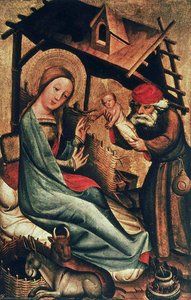
Oil On PanelInternational Gothic
 1395Late Medieval
 31.0 x 24.0 cm
 Museo Thyssen-Bornemisza
Hand-painted oil on canvas in your size and frame, made to order by our artists. ( Switch to Print Switch to Digital Image)





























Pick from our preset sizes that match the artwork's original proportions.

You may enter your own dimensions to fit a specific frame or space. If your selected size does not match the original image's proportions, we will either crop the artwork or extend the painting with additional hand-painted elements. A digital mockup will be sent for your approval before production begins.
Please note that the on-screen preview does not reflect the actual cropping or extension. Only the mockup will accurately show the final composition.
While custom sizes are available, we recommend selecting a dimension from the predefined list to preserve the original proportions.
Worldwide Delivery () in 3/4 weeks instead of standard 5 weeks. (18 September). No compromise on quality.


Triptych: The Holy Visage of Christ
Reproduction Size
To stand before this Triptych: The Holy Visage of Christ is to step across the threshold of time, into a moment suspended between earthly devotion and divine revelation. Created in 1395 by the masterful hand of Master Bertram, this work transcends mere decoration; it is a profound meditation on the nature of divinity itself. The structure of the triptych—its three distinct yet interconnected panels—mirrors the journey of contemplation: from introspection to direct address, and finally, to celestial praise. The very act of opening or closing these wings suggests a ritualistic unveiling, inviting the viewer into an intimate dialogue with the sacred subject matter.
Master Bertram, a pivotal figure in Northern Gothic art, navigated the rich currents flowing between the International Gothic style and the dawning light of the Renaissance. His career, rooted in Minden and flourishing through Hamburg, places him at a fascinating crossroads of artistic evolution. In this piece, his technical prowess shines through; observe the delicate handling of paint that gives life to the drapery and the subtle modeling of the faces. The technique employed speaks to an advanced understanding of tempera on wood panel, allowing for both luminous detail and deep, resonant shadow. It is a testament to a master who understood how material could serve narrative.
The genius of this triptych lies in its tripartite composition, each section offering a unique facet of the divine mystery. The first panel presents Christ with his head turned, suggesting contemplation or perhaps an acknowledgment of a distant event—a moment caught between worlds. In stark contrast, the central panel arrests the viewer entirely; here, the gaze is direct, meeting your own eyes across the centuries. It is an undeniable connection that pulls the observer into the painting's immediate reality. Completing this sacred narrative are the flanking panels, where two angels engage in celestial music. These figures do not merely decorate; they act as heavenly witnesses, their instruments and postures evoking praise and eternal harmony.
For the collector or designer seeking an object imbued with history and soulful depth, this reproduction offers more than just aesthetic beauty. It brings the palpable piety of the late medieval period into contemporary living spaces. Imagine the quiet drama of these panels adorning a hall or chapel—the way the light would catch the painted gold accents (if present in the original) or how the deep tones anchor a room with solemn dignity. Owning this piece is to curate not just art, but a palpable sense of enduring faith and masterful craftsmanship.

Born in Minden, Germany, around 1345 and passing away in Hamburg circa 1415, Master Bertram remains a captivating figure within the history of European art. Often referred to as Meister Bertram or Master of Minden, he stands as a pivotal artist bridging the International Gothic style with the nascent trends of the early Renaissance in Northern Europe. His legacy is primarily defined by his monumental altar panels and religious scenes, most notably the magnificent Grabow Altarpiece housed within the Kunsthalle Hamburg – a testament to his skill and ambition.
Bertram’s life unfolded largely within the bustling port city of Hamburg. Records indicate he first appeared in Hamburg's archives in 1367, quickly establishing himself as a respected citizen and achieving Master status by 1376. This period marked the peak of his professional activity; he amassed considerable wealth through commissions for religious art, reflecting the growing piety and prosperity within the region. Despite making a will anticipating a pilgrimage to Rome in 1390 – an undertaking that ultimately never materialized – Bertram’s artistic output remained remarkably consistent throughout his life. His marriage provided him with a daughter, but tragedy struck when his wife passed away in 1410, leaving him a widower and further solidifying his dedication to his craft.
The Grabow Altarpiece, completed around 1390, represents the pinnacle of Bertram’s artistic achievements. Measuring an impressive size – approximately 6.5 meters high and 8 meters wide – this monumental work is a complex triptych depicting scenes from the Apocalypse. The altarpiece showcases Bertram's mastery of color, detail, and spatial perspective, hallmarks of the International Gothic style. The figures are rendered with a delicate grace and expressive quality, imbued with a sense of solemnity and spiritual depth. Notably, the scene’s composition is remarkably detailed, featuring numerous figures and intricate architectural elements.
Alongside the Grabow Altarpiece, Bertram's workshop produced a significant altarpiece dedicated to Saint Christopher, now residing in Falsterbo Church, Sweden. This piece, along with other surviving fragments and depictions, offers valuable insights into Bertram’s artistic process and stylistic evolution. The Victoria and Albert Museum in London houses a 45-scene depiction of the Apocalypse, likely created by Bertram's workshop, further demonstrating his influence within the artistic community.
Bertram’s style is often characterized as a refined adaptation of International Gothic principles. While sharing similarities with other artists of the period, such as Master Francke (another prominent Hamburg painter), Bertram's work possesses a distinct character—a subtle restraint in emotional expression compared to Francke’s more overtly dramatic approach. However, this doesn’t diminish the beauty or power of his creations; rather, it lends them a quiet dignity and contemplative quality.
It is believed that Bertram was influenced by both French and Netherlandish artistic trends prevalent during his time. The influence of courtly art from France can be observed in the refined elegance of his figures and decorative elements, while the meticulous detail and realism characteristic of Early Netherlandish painting are evident in his depictions of architectural settings and objects. Despite these influences, Bertram maintained a uniquely Northern German sensibility, imbuing his work with a sense of regional identity.
Following the Renaissance, Master Bertram’s artistic legacy largely faded into obscurity. However, in the late 19th century, Alfred Lichtwark, the visionary director of the Hamburg Kunsthalle, spearheaded a renewed interest in his work. Lichtwark recognized the significance of Bertram's art and championed its rediscovery, bringing it to public attention once more.
Today, Master Bertram is rightfully regarded as one of the most important artists of the 14th century in Northern Europe. His monumental altar panels stand as enduring testaments to his skill, creativity, and profound understanding of religious art. Asteroid 85320 Bertram, named in his honor by German astronomer Freimut Börngen in 1995, serves as a lasting reminder of this remarkable artist’s contribution to the world of art.

1345 - 1415 , Germany

Explore the exquisite elegance of Late Gothic art. Discover how masters like Carlo Crivelli and Stefan Lochner blended intricate detail and religious devotion to bridge the Middle Ages and the Renaissance in this expert art history guide for true connoisseurs.

Embark on a journey through the dramatic era of Gothic art. Discover the profound beauty of illuminated manuscripts, sacred gold leaf masterpieces, and the transition to naturalism in this expert-led exploration of medieval artistry and historical grandeur.

 Preview
 Send
Send Share
Share
 Details

 Download
 Similars
 X-Ray
X-Ray Diaporama
 Stats
Stats Read More







 Glass option is only available in size under 110 CM