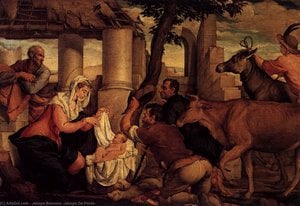
Jacopo Bassano (1510-1592): A Master of Venetian Light and Life
Born in the humble town of Bassano del Grappa, nestled near the bustling heart of Venice, Jacopo da Ponte – later known as Jacopo Bassano – emerged from a family steeped in artistic tradition. His father, Francesco il Vecchio, was already an established painter when he welcomed young Jacopo into his workshop around 1510, initiating him into the demanding world of art. This early training, combined with exposure to the vibrant and innovative atmosphere of Venice, would profoundly shape Bassano’s distinctive style – a captivating blend of religious solemnity, intimate genre scenes, and breathtakingly realistic landscapes.
Bassano's formative years were marked by a unique apprenticeship. Unlike many artists who sought formal training in distant cities like Florence or Rome, he honed his skills within the familiar surroundings of his hometown. His father’s workshop provided him with invaluable experience not only in painting techniques but also in practical trades such as surveying and mapmaking – skills that would later inform his masterful depictions of the Venetian countryside. Crucially, Bassano was exposed to the works of leading Venetian masters like Titian and Giorgione, absorbing their innovative approaches to color, composition, and light. This influence is particularly evident in his early paintings, where he skillfully emulates Titian’s luminous palette and dramatic use of chiaroscuro – the interplay of light and shadow.
The Development of a Unique Style
Bassano's artistic journey can be broadly divided into distinct periods, each characterized by subtle shifts in his style and subject matter. His early works, primarily religious scenes executed in the 1530s and 40s, demonstrate a clear debt to Titian’s influence. Paintings like “The Purification of the Temple” showcase a rich, vibrant color palette and a dynamic composition—a departure from the more static conventions of contemporary artists. However, even in these early pieces, Bassano introduces elements that would become hallmarks of his style: a focus on everyday details, an interest in capturing fleeting moments of human interaction, and a remarkable ability to imbue his scenes with a sense of atmosphere.
As he matured, Bassano’s artistic vision expanded. He increasingly turned his attention to genre paintings – intimate depictions of rural life, featuring peasants, animals, and the rhythms of agricultural labor. These works, often set against the backdrop of the picturesque Venetian landscape, are imbued with a remarkable sense of realism and immediacy. Paintings like “Sheep and Lamb” or “The Return of the Prodigal Son” exemplify this shift, demonstrating Bassano’s ability to capture the essence of human experience within a naturalistic setting. He skillfully blended religious themes with secular subjects, creating works that were both spiritually resonant and visually captivating.
Key Works and Influences
Bassano's oeuvre is remarkably diverse, encompassing a wide range of subjects and styles. Among his most celebrated paintings are “The Supper at Emmaus,” a masterpiece of Venetian painting characterized by its luminous colors, dynamic composition, and evocative portrayal of the biblical scene; “The Fire” – a dramatic depiction of a barn fire that showcases Bassano’s mastery of light and shadow; and “Jacob’s Return to Canaan,” a poignant narrative scene filled with emotional depth and psychological insight. His work also includes numerous portraits, landscapes, and religious compositions, each reflecting his evolving artistic sensibilities.
Beyond Titian, Bassano was influenced by a variety of artists, including the early Renaissance masters like Dürer and Raphael, as well as contemporary Venetian painters such as Tintoretto and Veronese. He skillfully absorbed elements from these diverse sources, synthesizing them into a uniquely personal style that is both innovative and deeply rooted in Venetian tradition.
Legacy and Historical Significance
Jacopo Bassano’s impact on the development of Venetian painting is undeniable. His masterful depictions of light, color, and human emotion helped to shape the course of Venetian art for generations to come. He was a pioneer in the genre of landscape painting, elevating it from a mere decorative element to an integral part of his compositions. Furthermore, Bassano’s ability to seamlessly blend religious and secular subjects—sacred themes with everyday life—established a precedent that would be followed by many subsequent Venetian artists.
Bassano's legacy extends beyond the individual works he created. His four sons – Francesco Bassano the Younger, Giovanni Battista da Ponte, Leandro Bassano, and Girolamo da Ponte – continued his artistic lineage, carrying on his style and contributing to the vibrant artistic community of Bassano del Grappa. Today, Jacopo Bassano is remembered as one of Venice’s most important Renaissance painters—a master of light, color, and human experience whose work continues to captivate audiences around the world.



 Preview
 Buy Print
 Send
Send Share
Share
 Details

 Download
 Similars
 X-Ray
X-Ray Diaporama
 Read More






































 Glass option is only available in size under 110 CM