A Window into the Caucasus: The Soul of Georgian Heritage
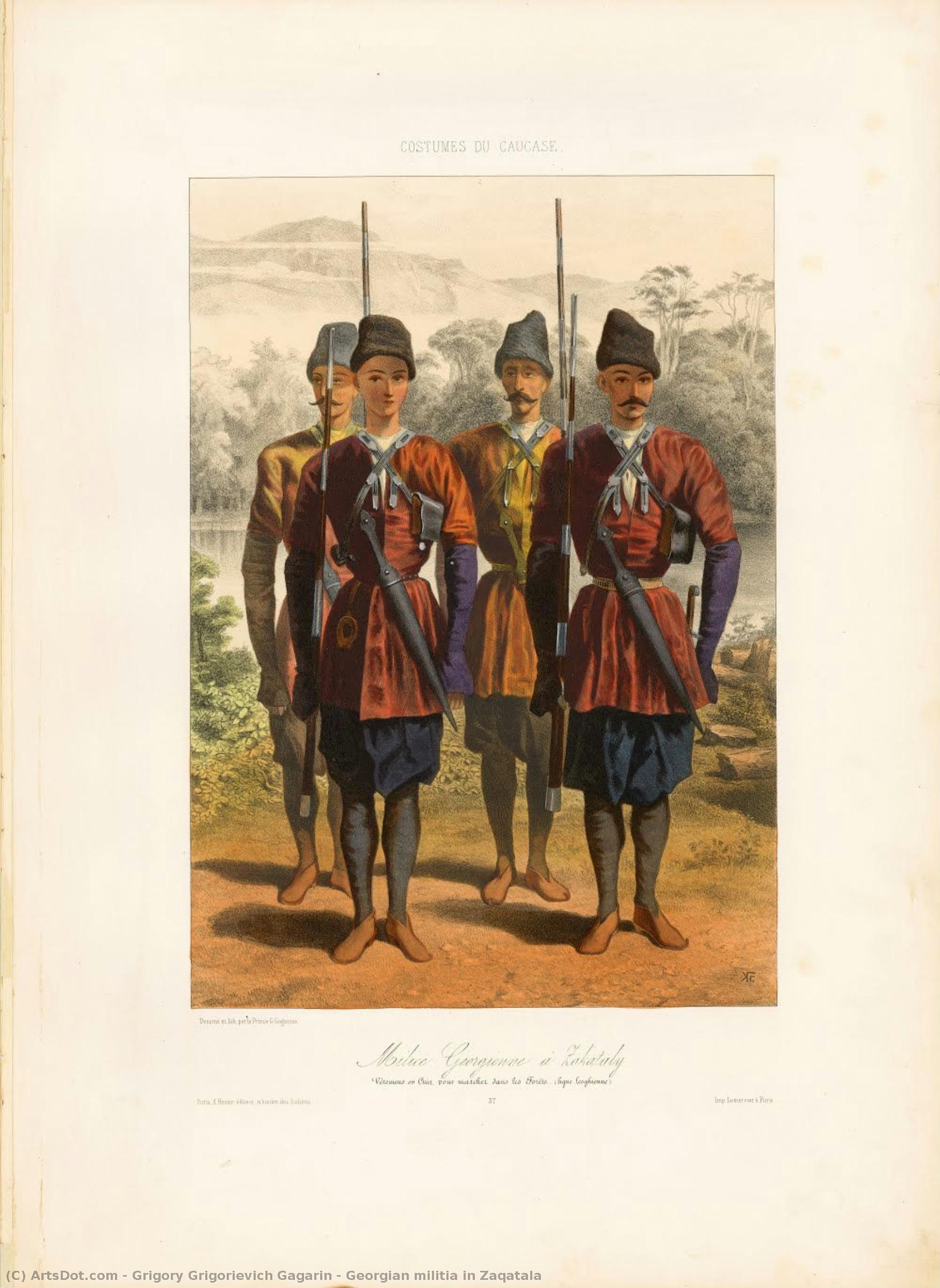
In the delicate strokes of Grigory Grigorievich Gagarin’s 1855 masterpiece, Georgian militia in Zaqatala, we find much more than a mere military portrait; we encounter a profound historical document captured through the lens of romantic realism. The painting presents six Georgian soldiers, standing with a dignified, almost staged poise that speaks to the formal ethnographic traditions of the nineteenth century. Each figure is rendered with meticulous attention to their traditional military attire, serving as a vibrant testament to the cultural identity and martial pride of the region. As the eye wanders across the composition, one is struck by the seamless integration of human presence and the untamed beauty of the landscape, where lush greenery and the tranquil shimmer of distant water create a serene, atmospheric backdrop for these guardians of the Caucasus.
The technique employed by Gagarin reveals the hand of an artist deeply connected to the textures of his surroundings. Utilizing what appears to be a masterful watercolor or fine-wash approach, he achieves a sense of structural solidity through precise, careful linework. The geometric precision of the conical hats and the rectangular silhouettes of the uniforms provide a rhythmic stability to the piece, while subtle washes of color breathe life into the fabric folds and facial expressions. The palette is a sophisticated arrangement of earthy tones, punctuated by strategic accents of deep red and striking blue, which draw the viewer’s gaze toward the intricate details of the soldiers' gear. This soft, diffused lighting avoids harsh contrasts, instead bathing the scene in a gentle glow that lends an aged, nostalgic quality to the entire work.
Beyond its aesthetic allure, the painting carries immense historical and symbolic weight. Born into the noble Rurikid princely family, Gagarin was not merely an observer but a participant in the life of the Caucasus. His deep connections to literary giants like Pushkin and Lermontov, combined with his administrative roles in Tiflis, allowed him to capture the essence of Georgian life with unparalleled authenticity. This work symbolizes the intersection of military prowess and cultural preservation; it is a snapshot of a moment in time when identity was etched into the very fabric of one's uniform and the landscape one defended. For the discerning collector or interior designer, this piece offers more than decoration; it provides a narrative anchor for a room, inviting conversation about history, nobility, and the enduring spirit of the Georgian people.
Integrating such a high-quality reproduction into a curated space allows for a sophisticated dialogue between the past and the present. Whether placed in a study filled with leather-bound books or as a focal point in a contemporary gallery-style living room, Georgian militia in Zaqatala commands attention through its quiet strength and historical depth. It is an evocative piece that resonates with anyone who finds beauty in the intersection of human history and the natural world, making it an invaluable acquisition for those seeking to surround themselves with art that possesses both a soul and a story.



 Preview
 Buy Print
 Send
Send Share
Share
 Details

 Download
 Similars
 X-Ray
X-Ray Diaporama


 Read More






































 Glass option is only available in size under 110 CM





