x


 Acrylic On CanvasWallArtRenaissance Humanism
 1503Renaissance
 282.0 x 203.0 cm
 The Louvre
Hand-painted oil on canvas in your size and frame, made to order by our artists. ( Buy Print Buy Image)





























Pick from our preset sizes that match the artwork's original proportions.

You may enter your own dimensions to fit a specific frame or space. If your selected size does not match the original image's proportions, we will either crop the artwork or extend the painting with additional hand-painted elements. A digital mockup will be sent for your approval before production begins.
Please note that the on-screen preview does not reflect the actual cropping or extension. Only the mockup will accurately show the final composition.
While custom sizes are available, we recommend selecting a dimension from the predefined list to preserve the original proportions.
Worldwide Delivery () in 3/4 weeks instead of standard 5 weeks. (27 August). No compromise on quality.


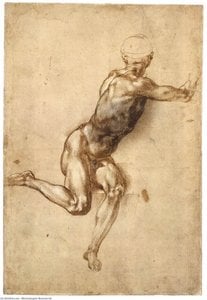
Male Nude, Seen from the Rear (recto)
Reproduction Size
Michelangelo Buonarroti, arguably the titan of the High Renaissance, bequeathed to posterity an unparalleled legacy of artistic achievement—a testament to human creativity at its zenith. Among his monumental creations stands “Male Nude, Seen from the Rear (recto),” a deceptively simple chalk drawing that belies the profound depth of artistic exploration and technical mastery it embodies. Created in 1503 during Michelangelo’s formative years, this artwork resides within the hallowed halls of the Musée du Louvre in Paris, France, serving as a poignant reminder of his unwavering dedication to capturing the human form with breathtaking accuracy.
The drawing depicts a male nude figure—likely Michelangelo himself—positioned in a dynamic pose that speaks volumes about the artist’s understanding of movement and musculature. He is captured mid-action, as if preparing to unleash a forceful swing with his sword or holding it firmly behind his back. One hand rests confidently on his hip, while the other arm extends outwards, conveying an impression of power and readiness. This masterful depiction isn't merely a representation of anatomy; it’s a deliberate exploration of human potential—a cornerstone of Michelangelo’s artistic philosophy.
Michelangelo’s stylistic approach is characterized by meticulous anatomical detail combined with an idealized aesthetic rooted in classical influences. He meticulously studied the sculptures of antiquity, absorbing the principles of proportion and harmonious balance that would inform his own work. The resulting drawing showcases a remarkable sensitivity to muscle tension and subtle gestures—elements that elevate it beyond mere observation into a profound statement about human beauty and strength.
“Male Nude, Seen from the Rear (recto)” emerges from the vibrant intellectual landscape of Renaissance Florence. The humanist movement championed reason and empirical observation—a direct challenge to medieval dogma—and Michelangelo’s artistic endeavors exemplify this paradigm shift. Artists like Michelangelo drew inspiration from Greek and Roman art, seeking to recapture the grandeur and idealism of classical antiquity. This fascination with idealized beauty is palpable in the drawing's composition and execution.
The Louvre’s acquisition of this artwork underscores its significance within the broader artistic canon. It stands alongside other masterpieces—such as “Nude Rider Mounting a Horse” and “Kneeling Man”—demonstrating Michelangelo’s unparalleled ability to convey emotion through form and gesture. These works collectively represent the pinnacle of Renaissance art, reflecting humanity's aspiration for excellence in both intellect and aesthetics.
Beyond its technical brilliance, “Male Nude, Seen from the Rear (recto)” carries symbolic weight. The nude figure embodies the humanist ideal—a celebration of human dignity and physicality—reflecting Michelangelo’s belief in the inherent goodness of humankind. Furthermore, the pose itself suggests dynamism and control—affirming the artist's mastery over his subject matter and conveying a sense of unwavering confidence.
The drawing’s stark black and white palette enhances its emotional impact, emphasizing the contours of the figure’s musculature and creating a dramatic visual experience. Michelangelo skillfully captures the tension inherent in human movement—a testament to his profound understanding of anatomy and his ability to translate emotion into artistic form. Viewing this artwork evokes contemplation on themes of strength, vulnerability, and beauty—themes that resonate across centuries.


1475 - 1564 , Italy

Elevate your artistic practice with this expert guide to mastering the line. Discover advanced techniques in graphite, charcoal, and contour drawing designed for art students seeking technical precision and expressive depth in their fine art studies.

Explore the profound intersection of science and beauty in art history. Discover how masters like Michelangelo used anatomical precision to define the human form through iconic studies of musculature, light, and movement.

Explore the profound genius of Leonardo, Michelangelo, and Raphael. An authoritative deep dive into the High Renaissance masters, analyzing their unique techniques, humanistic vision, and enduring influence on the world of fine art collecting.

Explore the profound artistry of graphite drawing. Discover professional techniques for mastering depth, texture, and detail through a lens of art history, from classical sketches to modern masterpieces. Elevate your understanding of the pencil medium with our expert guide.

Explore the profound beauty of the sketch. Discover how masters use charcoal and graphite to capture raw emotion, anatomical precision, and fluid movement, bridging the gap between ephemeral marks and eternal oil masterpieces.


Stay updated with the latest art news, exclusive offers, and decoration ideas.
Tell us about your project and our art experts will provide you with 3 personalized art suggestions.
Let Us Curate 3 Options Just for You - Free!

 Preview
 Send
Send Share
Share
 Details

 Download
 Similars
 X-Ray
X-Ray Diaporama
 Read More







 Glass option is only available in size under 110 CM