Oil On CanvasWallArtBaroque Drama
 1608Early Modern
 361.0 x 520.0 cm
Hand-painted oil on canvas in your size and frame, made to order by our artists. ( Switch to Print Switch to Digital Image)





























Pick from our preset sizes that match the artwork's original proportions.

Type the width and the height you need, to fit your frame or your wall. This is hand-painted, so for a size with a different shape the artist can paint a bit more around the picture, or cut a bit — you choose. We send you a digital mockup to approve before the painting starts. The picture shown on this page does not show the real result — only the mockup does.
Worldwide Delivery () in 3/4 weeks instead of standard 5 weeks. (26 October). No compromise on quality.
Beheading of Saint John the Baptist
Reproduction Size
To stand before Michelangelo Merisi da Caravaggio’s Beheading of Saint John the Baptist is to witness more than a mere biblical execution; it is to be pulled into an unflinching confrontation with mortality. Painted in 1608, this monumental canvas—stretching an imposing 361 by 520 cm—commands the space of the Museum of Saint John in Malta with a gravity that few works in the Baroque canon can match. Caravaggio does not merely depict a historical or religious event; he orchestrates a psychological drama where light and shadow act as the primary protagonists. The scene is a masterclass in tenebrism, a technique where profound, impenetrable darkness swallows the periphery, forcing the viewer’s gaze onto the stark, agonizing reality of the central figures. This manipulation of light serves as an emotional amplifier, isolating the vulnerability of the Saint against a void that feels both infinite and suffocating.
The composition is a breathtaking study in contrast and anatomical precision. Caravaggio eschews the idealized, graceful forms of the High Renaissance in favor of a gritty, palpable realism. One can almost feel the tension in the strained muscles and the glistening sweat on the bodies of those involved in the grim task. The artist’s use of rapid brushstrokes and strategic layering creates an illusion of immediacy, as if the blade has only just begun its descent. This commitment to anatomical accuracy—the heavy weight of limbs, the slumped posture of the condemned—strips away the divine veil to reveal the raw, human suffering beneath. For the collector or lover of fine art, this piece offers a profound sense of presence; it is a work that does not sit quietly on a wall but actively engages the room with its turbulent energy.
Beyond the surface-level violence lies a complex web of religious fervor and symbolic depth. Created during the height of the Baroque period, the painting reflects the intense piety and spiritual upheaval of an era defined by the Counter-Reformation. The stark highlights on Saint John’s torso draw the eye upward, suggesting a flicker of divine light even amidst the carnage, symbolizing the endurance of faith through martyrdom. The surrounding figures—soldiers, observers, and attendants—represent the various facets of human reaction to injustice: some are complicit, others are indifferent, and some are mere witnesses to the unfolding tragedy. Even the seemingly mundane objects scattered within the scene, such as the bowl or the cup, take on a ritualistic quality, grounding the biblical narrative in a tangible, earthly reality.
For interior designers and curators of high-end reproductions, this artwork serves as a powerful focal point for spaces that demand character and intellectual depth. The dramatic interplay of light and shadow makes it an ideal centerpiece for rooms designed with a moody, sophisticated aesthetic—perhaps a study or a formal gallery space where the play of natural light can interact with the painting's inherent chiaroscuro. To possess a reproduction of such a masterpiece is to invite a conversation about the human condition, bringing into one's home a piece of history that celebrates the beauty found within the most harrowing moments of existence.
"Beheading of Saint John the Baptist" by Caravaggio combines the oil on canvas technique with the Baroque Drama style. Technique and movement describe the making and the style of the work.
"Beheading of Saint John the Baptist" is available as a high-resolution digital image download, purchased directly on its Digital Image page.
Caravaggio made "Beheading of Saint John the Baptist" in 1608.

Milan, 1571. The air is heavy with the scent of plague. Young Michelangelo Merisi watches as death claims his father and grandfather in a single day. He grows up in the grip of poverty, a reality that later finds its way onto his canvases through the faces of ordinary people. By 1584, he begins an apprenticeship under Simone Peterzano, a former pupil of Titian. This training provides the technical foundation, but the spirit of the boy from Milan is already restless.
Rome, around 1592. The city is a crucible of religious fervor and intense competition. Caravaggio arrives without fixed address or provision, a penniless migrant in a landscape of grand ambitions. He finds footing through the patronage of Cardinal Francesco Maria del Monte. In the shadows of the Palazzo Madama, the artist begins to strip away the artificial elegance of Mannerism. He replaces elongated, idealized forms with something far more visceral.
He rejects the polished surfaces of his contemporaries. Instead, he embraces tenebrism, a style where darkness is a physical presence rather than a mere absence of light. In works like The Cardsharps, light does not simply illuminate; it strikes. It carves figures out of an impenetrable black void. This technique, often called chiaroscuro, creates a stage-like intensity that forces the viewer to confront the raw textures of silk, skin, and bone.
His method is direct. He works alla prima, applying paint directly to the canvas without the safety net of preparatory drawings. This immediacy allows for a startling realism. He uses the people of the Roman streets—the drunks, the laborers, the outcasts—as models for the sacred. When he paints the Holy Family, they possess the dirt and weariness of the living. The divine becomes profoundly human.
The brilliance of his art is matched by the volatility of his temperament. A brawl in 1606 leads to a murder charge and a death sentence. The artist becomes an outlaw. He flees Rome, moving through Naples, Malta, and Sicily. Even in exile, the work continues. In Malta, he joins the Order of St. John, but his turbulent nature leads to imprisonment after a quarrel with a superior.
The end comes in 1610. While traveling from Naples back toward Rome in search of a papal pardon, he dies in Porto Ercole. The cause remains a subject of debate—fever, wounds, or perhaps lead poisoning. He leaves behind a legacy that fundamentally altered the course of Western art. His followers, the Caravaggisti, carry his shadows across Europe, ensuring that the darkness he mastered would never truly fade.

1571 - 1610 , Spain

Discover the profound emotional power of Baroque painting. Explore the mastery of chiaroscuro, the realism of Caravaggio, and the dramatic interplay of light and shadow in this expert guide for classical art enthusiasts and collectors.
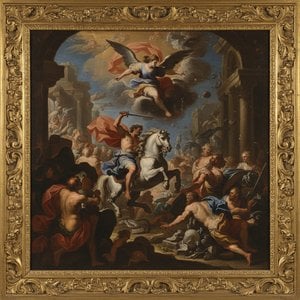
Explore the breathtaking power of Baroque art. Delve into the dramatic interplay of light, shadow, and motion through the works of masters like Caravaggio. Discover how the era's intense emotional realism continues to inspire collectors and connoisseurs of classical grandeur.

Embark on a sophisticated journey through Italian Baroque art. Discover the dramatic interplay of light and emotion in Caravaggio’s masterpieces and explore how to bring this timeless grandeur into your collection with expert art insights.

Explore the profound mastery of Caravaggio's tenebrism. Discover how his dramatic use of chiaroscuro revolutionized Baroque art through intense emotion and realism. An expert guide for classic art enthusiasts seeking to understand the power of shadow in historical masterpieces.

 Preview
 Send
Send Share
Share
 Details
 Guide
Guide

 Download
 Similars
 X-Ray
X-Ray Diaporama
 Stats
Stats Read More









 Glass option is only available in size under 110 CM