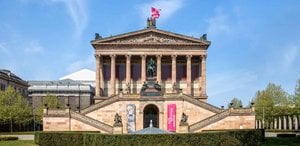
Wilhelm Leibl, 1844 – 1900

Wilhelm Leibl: The 67 Most Famous Paintings

Three Women in Church is the most famous painting by Wilhelm Leibl, held by the Hamburger Kunsthalle in Hamburg. Interior (1897) and Portrait of a boy with a large ruff (1869) are the next two works the world knows best. From the 67 works of Wilhelm Leibl in our catalogue, here are the 67 that collectors and museum visitors look at most, with the year, the museum and the story of each.

Ranked by our popularity score, which combines the searches, visits and orders for each work. Updated October 2026. Every masterpiece on this page can be ordered as a museum-quality, hand-painted oil reproduction or a fine art print, at the size you choose.

Portrait of Wilhelm Leibl
Wilhelm Leibl · 1844 – 1900
Born · died
1844 – 1900, Cologne
Movement
Realism
Works in our catalogue
67
Most famous
Three Women in Church
Most works at
Bavarian State Painting Collections

Top 10: Wilhelm Leibl's best-known paintings

Three Women in Church by Wilhelm Leibl
1

Three Women in Church

Oil On Canvas · Hamburger Kunsthalle, Hamburg

This exquisite painting captures a quiet, contemplative moment of three women engaged in reading within a serene church setting. The scene exudes a sense of reverence and introspection, inviting viewers to reflect on the profound simplicity of daily life and spiritual devotion. The artist masterfully portrays the women’s expressions and gestures, emphasizing their inner worlds and the shared moment of quiet fellowship.

Hand-painted oil reproduction from $231 25 × 40 cm
Interior (1897) by Wilhelm Leibl
2

Interior

1897 · Oil On Panel · Bavarian State Painting Collections, Munich

A heavy, somber stillness settles over the room, where the air feels thick with the scent of old wood and damp earth. To the right, a woman stands partially swallowed by deep, velvety shadows, her presence felt more through the sudden brightness of her white apron than through any sharp detail of her features. She exists in a moment of profound solitude, a solitary figure caught in the dimness of…

Hand-painted oil reproduction from $181 28 × 36 cm Same size as the original $183 29 × 37 cm Order at original size →
Portrait of a boy with a large ruff (1869) by Wilhelm Leibl
3

Portrait of a boy with a large ruff

1869 · Oil On Canvas · Germanisches Nationalmuseum, Nuremberg

In this oil on canvas, titled Portrait of a boy with a large ruff, the artist Wilhelm Leibl presents a quiet study of youth. Created about 1869, the work captures a specific moment of stillness through a careful application of paint. The scale of the piece, measuring 75.8 x 61.0cm, allows for an intimate encounter with the subject, inviting a close observation of the textures present on the surface.

Hand-painted oil reproduction from $181 29 × 34 cm Same size as the original $292 61 × 76 cm Order at original size →
Women from Dachau (Girl with a black headscarf) (1879) by Wilhelm Leibl
4

Women from Dachau (Girl with a black headscarf)

1879 · Oil On Panel · Alte Nationalgalerie, Berlin

Women from Dachau (Girl with a black headscarf) is a portrait executed by Wilhelm Leibl in 1879. The work originated in Berbling, located in the Voralpenland region. Leibl produced this piece during a period of intense creative focus, capturing a subject who was the daughter of a local resident living near the artist's own residence.

Hand-painted oil reproduction from $181 29 × 35 cm
The Painter Julius Bodenstein (1876) by Wilhelm Leibl
5

The Painter Julius Bodenstein

1876 · Oil On Canvas · Lenbachhaus, Munich

A formal, realistic portrait of a man, rendered in a traditional academic style. The subject is positioned slightly off-center, facing towards the viewer's right while his gaze is directed forward. A dark, somber background and clothing provide a stark contrast to the warm, natural flesh tones of the face. The composition is a bust-length portrait, capturing the subject with a direct, eye-level perspective that establishes an immediate connection.

Hand-painted oil reproduction from $181 29 × 35 cm Same size as the original $200 37 × 45 cm Order at original size →
Portrait of Ernst Schoenlin (?) (1866) by Wilhelm Leibl
6

Portrait of Ernst Schoenlin (?)

1866 · Oil On Canvas · Staatliche Kunsthalle Karlsruhe, Carlsruhe

A somber, three-quarter view portrait emerges from a dark, indistinct background, focusing on the head and upper torso of a middle-aged man. The composition relies heavily on chiaroscuro, with light entering from the upper left to strike the subject's forehead and hands, leaving the remainder of the figure in deep shadow. This directional lighting creates a profound sense of three-dimensional volume, carving the man's features out of the gloom. He…

Hand-painted oil reproduction from $181 29 × 35 cm Same size as the original $371 77 × 94 cm Order at original size →
Dachau Woman and Child (1873) by Wilhelm Leibl
7

Dachau Woman and Child

1873 · Oil On Panel · Alte Nationalgalerie, Berlin

The painting titled Dachau Woman and Child is a significant work by the German realist Wilhelm Leibl. Created around 1873 or 1874, this oil on panel work captures a quiet, intimate moment from the Bavarian countryside. The subjects are not anonymous figures of a generic scene, but rather the miller’s wife of Plon, depicted with a directness that defines the artist's approach to his subjects.

Hand-painted oil reproduction from $206 28 × 36 cm Same size as the original $354 68 × 86 cm Order at original size →
Farmboy (1876) by Wilhelm Leibl
8

Farmboy

1876 · Oil On Canvas · Alte Nationalgalerie, Berlin

In this intimate portrait titled Farmboy, the artist Wilhelm Leibl presents a quiet, unadorned moment from the late 19th century. Created about 1876, the work captures a sense of stillness that feels both immediate and deeply personal. The subject is a shy boy, appearing somewhat awkward and vulnerable as he slouches in a chair that seems slightly too large for his frame. There is a certain heaviness to his posture,…

Hand-painted oil reproduction from $181 29 × 35 cm Same size as the original $323 68 × 83 cm Order at original size →

The rest of the Wilhelm Leibl ranking, 11 to 67

Left Hand (1867) by Wilhelm Leibl
#37

Left Hand

1867 · Staatliche Kunsthalle Karlsruhe

A single left hand is positioned vertically against a dark, indistinct background. The composition focuses on the anatomical structure of the hand, from the knuckles to the tips…

Bring it home from $181 →

Wilhelm Leibl's paintings by period

The subjects Wilhelm Leibl painted most

The four subjects that return most often among these masterpieces, with the finest example of each.

Where to see Wilhelm Leibl's paintings

The 8 museums that hold the most of the paintings on this page.

Museum City Works by Wilhelm Leibl Paintings from this list
Bavarian State Painting Collections, MunichBavarian State Painting Collections Munich 11 Interior, Portrait Study of a Young Bearded Man, Portrait of Lina Kirchdorffer
Staatliche Kunsthalle Karlsruhe, CarlsruheStaatliche Kunsthalle Karlsruhe Carlsruhe 8 Portrait of Ernst Schoenlin (?), Portrait of a Lady in Black Dress with White Ruff, Portrait of the Artist's Sister, Katharina (later Frau Kirchdorffer)
Wallraf-Richartz-Museum, CologneWallraf-Richartz-Museum Cologne 5 Portrait of Johann Heinrich Pallenberg, The Painter Victor Müller, Young Parisian woman
Alte Nationalgalerie, BerlinAlte Nationalgalerie Berlin 4 Women from Dachau (Girl with a black headscarf), Dachau Woman and Child, Farmboy
Lenbachhaus, MunichLenbachhaus Munich 4 The Painter Julius Bodenstein, Boy's Head, Head of a Blind Man
Städel Museum, FrankfurtStädel Museum Frankfurt 2 Portrait of the Painter Louis Eysen, The Dissimilar Couple
Hamburger Kunsthalle, HamburgHamburger Kunsthalle Hamburg 1 Three Women in Church
Germanisches Nationalmuseum, NurembergGermanisches Nationalmuseum Nuremberg 1 Portrait of a boy with a large ruff

Wilhelm Leibl through the decades: one masterpiece for each

  1. 1860s
    Portrait of a boy with a large ruff (1869) by Wilhelm Leibl
    Rank 3 / 67

    Portrait of a boy with a large ruff

    Age 16 – 25 · Germanisches Nationalmuseum

    In this oil on canvas, titled Portrait of a boy with a large ruff, the artist Wilhelm Leibl presents a quiet study of youth. Created about 1869, the…

  2. 1870s
    Women from Dachau (Girl with a black headscarf) (1879) by Wilhelm Leibl
    No. 4 of 67

    Women from Dachau (Girl with a black headscarf)

    Age 26 – 35 · Alte Nationalgalerie

    Women from Dachau (Girl with a black headscarf) is a portrait executed by Wilhelm Leibl in 1879. The work originated in Berbling, located in the Voralpenland region. Leibl…

  3. 1880s
  4. 1890s
    Interior (1897) by Wilhelm Leibl
    Rank 2 / 67

    Interior

    Age 46 – 55 · Bavarian State Painting Collections

    A heavy, somber stillness settles over the room, where the air feels thick with the scent of old wood and damp earth. To the right, a woman stands…

Wilhelm Leibl's paintings: frequently asked questions

What is the most famous Wilhelm Leibl painting?Show the answer

Three Women in Church, Hamburger Kunsthalle, Hamburg. Next come Interior (1897) and Portrait of a boy with a large ruff (1869).

Which are the 10 most famous Wilhelm Leibl paintings?Show the answer

Three Women in Church, Interior, Portrait of a boy with a large ruff, Women from Dachau (Girl with a black headscarf), The Painter Julius Bodenstein, Portrait of Ernst Schoenlin (?), Dachau Woman and Child, Farmboy, Man in a Top Hat and Portrait Study of a Young Bearded Man. The ranking above gives the year and the museum of each.

How many paintings by Wilhelm Leibl are there?Show the answer

Our catalogue lists 67 works by Wilhelm Leibl, dated from 1866 to 1899.

Where can I see the most famous Wilhelm Leibl paintings?Show the answer

Most of them are in Bavarian State Painting Collections (Munich), Staatliche Kunsthalle Karlsruhe (Carlsruhe) and Wallraf-Richartz-Museum (Cologne). The table above lists the museums one by one.

In which period did Wilhelm Leibl paint the best-known works?Show the answer

In 1870s: 20 of the 67 works on this page date from then, among them Women from Dachau (Girl with a black headscarf).

What is the earliest famous Wilhelm Leibl painting, and the latest?Show the answer

The earliest on this page is Portrait of Ernst Schoenlin (?) (1866), the latest Girl standing at a window (1899).

What subjects did Wilhelm Leibl paint?Show the answer

Portrait (6), Dark background (5) and Woman (4), among the 67 works on this page.

What did Wilhelm Leibl paint on, and with what?Show the answer

Oil On Canvas: 9 of the 67 works on this page.

Which movement does Wilhelm Leibl's art belong to?Show the answer

Realism, as the paintings on this page show.

What Wilhelm Leibl paintings does the Bavarian State Painting Collections hold?Show the answer

Interior, Portrait Study of a Young Bearded Man and Portrait of Lina Kirchdorffer are among the 11 works on this page held by the Bavarian State Painting Collections, Munich.

Where can I buy a Wilhelm Leibl reproduction?Show the answer

Yes. Every painting on this page can be ordered as a museum-quality, hand-painted oil reproduction or a fine art print, in the size you choose, from the painting's own page.

Wilhelm Leibl: biography

A Life Rooted in Realism: Wilhelm Leibl and the Depiction of Bavarian Existence

Wilhelm Maria Hubertus Leibl, born in Cologne in 1844, emerged as a pivotal figure in German painting during a period grappling with artistic identity. His father’s position as director of the cathedral choir instilled an early appreciation for discipline and form, yet Leibl's path wasn’t immediately destined for canvas. An apprenticeship to a locksmith preceded his formal artistic training under Hermann Becker in 1861, signaling a pragmatic grounding before embracing creative pursuits. This initial experience perhaps contributed to the solidity and directness that would later characterize his work. In 1864, he entered the Munich Academy, immersing himself in the established art world but soon seeking alternatives to prevailing Romantic sensibilities. His studies with artists like Carl Theodor von Piloty provided technical foundation, yet it was the arrival of Gustave Courbet in Munich around 1869 that proved truly transformative.

The Influence of Courbet and the Pursuit of ‘Alla Prima’

Courbet's exhibition and demonstrations of *alla prima* painting – working directly from nature with bold, immediate brushstrokes – resonated deeply with Leibl and a cohort of young German artists. This approach liberated them from the meticulous academic style then dominant, encouraging a more visceral connection to their subjects. Leibl’s existing admiration for Dutch Old Masters, particularly their mastery of light and character, found new expression through Courbet's influence. His paintings began to loosen in style, embracing thicker applications of paint against darker backgrounds, capturing fleeting moments with an unprecedented immediacy. A brief sojourn to Paris in 1869, facilitated by Courbet’s suggestion, introduced Leibl to Édouard Manet, further broadening his artistic horizons. However, the outbreak of the Franco-Prussian War forced a premature return to Germany in 1870, curtailing what might have been an extended period of Parisian immersion.

Bavarian Landscapes and the Essence of Peasant Life

In 1873, Leibl deliberately retreated from Munich’s artistic center, seeking solitude and authenticity in the isolated Bavarian countryside. This marked a turning point in his career. He dedicated himself to depicting the lives of local peasants, not with romanticized idealization, but with unflinching realism. He eschewed sentimentality or anecdotal storytelling, instead focusing on capturing the dignity and hardship inherent in their daily existence. The sketchlike quality of his earlier works gave way to greater precision and a meticulous attention to drawing. Living in Berbling from 1878 to 1882, he produced some of his most celebrated paintings, including Three Women in Church, now housed at the Kunsthalle Hamburg. This masterpiece exemplifies his intensely realistic style, recalling the clarity and psychological depth of Hans Holbein.

A Legacy of Realism: The Leibl Circle and Lasting Impact

Leibl’s commitment to representing reality as he perceived it – without embellishment or pretense – earned him recognition as a leading figure in German art. He became the central influence for a group known as the “Leibl-Kreis” (Leibl Circle), which included artists such as Carl Schuch, Wilhelm Trübner, Otto Scholderer, and Hans Thoma. These artists shared Leibl’s dedication to realism and his rejection of academic conventions. He painted directly with color, without preliminary drawings, a technique paralleling the innovations of Impressionism while remaining firmly rooted in observational accuracy. His later works, created during periods living in Bad Aibling and Kutterling, demonstrated a refined balance between disciplined drawing and a newfound luminosity. Wilhelm Leibl died in Würzburg in 1900, leaving behind a body of work that continues to resonate for its honesty, technical mastery, and profound empathy for the lives of ordinary people. His paintings stand as powerful testaments to the beauty and dignity found within the everyday realities of Bavarian existence.