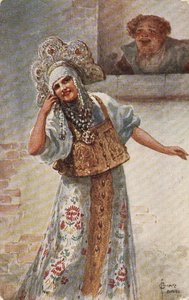
Sergey Solomko, 1867 – 1928

Sergey Solomko: The 100 Most Famous Paintings

Memory (1910) is the most famous painting by Sergey Solomko. Sketch of the poster. Pillory. (1916) and Priestess (1915) are the next two works the world knows best. From the 119 works of Sergey Solomko in our catalogue, here are the 100 that collectors and museum visitors look at most, with the year, the museum and the story of each.

Ranked by our popularity score, which combines the searches, visits and orders for each work. Updated November 2026. Every masterpiece on this page can be ordered as a museum-quality, hand-painted oil reproduction or a fine art print, at the size you choose.

Portrait of Sergey Solomko
Sergey Solomko · 1867 – 1928
Born · died
1867 – 1928, Saint Petersburg
Movement
Art nouveau
Works in our catalogue
119
Most famous
Memory (1910)

Top 10: Sergey Solomko's best-known paintings

Memory (1910) by Sergey Solomko
1

Memory

1910 · Watercolor

The scene unfolds within the work titled Memory, a creation by the artist Sergey Solomko. This piece emerges from 1910, a moment when the artist's hand captures a sense of ethereal presence. The image holds a quiet weight, as if a single breath has been suspended in time. It invites a sense of wonder regarding the figures that inhabit its soft, dreamlike space.

Hand-painted oil reproduction from $206 26 × 39 cm
Sketch of the poster. Pillory. (1916) by Sergey Solomko
2

Sketch of the poster. Pillory.

1916 · Ink On Paper

In this piece, titled Sketch of the poster. Pillory., we encounter a work of significant historical weight. Created by Sergey Solomko in 1916, the artwork functions as a black and white political cartoon. It is a stark departure from the more decorative or historical subjects often associated with the artist's broader oeuvre, focusing instead on the immediate, visceral realities of the era.

Hand-painted oil reproduction from $206 27 × 38 cm
Priestess (1915) by Sergey Solomko
3

Priestess

1915 · Watercolor

In the artwork Priestess, created by Sergey Solomko around 1915, a nude female figure occupies the center of the composition. She stands amidst a scene of swirling clouds and architectural elements. The figure holds an open book aloft with both hands, positioning the object at the top of the vertical arrangement. This central action directs attention toward the book, which functions as a symbol of knowledge, wisdom, or enlightenment. The…

Hand-painted oil reproduction from $181 23 × 43 cm
Glowworm by Sergey Solomko
4

Glowworm

In this quiet composition, a woman is suspended in a moment of deep contemplation. She is positioned centrally, her form occupying much of the frame as she gazes downward, lost in thought. The scene is defined by a soft, ethereal light that emanates from a glowing orb held in her hand, casting a gentle illumination across her face and hands. This light provides the only reprieve from the surrounding darkness,…

Hand-painted oil reproduction from $181 26 × 39 cm
Find by Sergey Solomko
5

Find

The painting Find presents a contemplative scene featuring two figures set against a backdrop of natural elements, including branches and leaves. On the left, a seated female figure is dressed in elaborate attire characterized by intricate patterns in shades of red, yellow, and blue. She wears a headdress that appears to be adorned with feathers or plumes and holds an object resembling a book or a scroll. Her gaze is…

Hand-painted oil reproduction from $181 26 × 39 cm
Blarney by Sergey Solomko
6

Blarney

The scene unfolds within the work titled Blarney, a piece that carries the original title Сладкие речи. This genre painting captures a specific, suspended moment of interaction between figures. Sergey Solomko, the artist behind this composition, brings a sense of narrative to the canvas through his distinct approach to storytelling.

Hand-painted oil reproduction from $181 26 × 39 cm
Blue Bird (Bird Sirin) by Sergey Solomko
7

Blue Bird (Bird Sirin)

This work, titled Blue Bird (Bird Sirin), was created by Sergey Solomko. A Russian painter, watercolorist, illustrator, and designer, Solomko brought a specific sensibility to his depictions of myth and nature. His hand is evident in the delicate execution of this piece, which reflects the artistic training he received at the Moscow School of Painting, Sculpture and Architecture and his later studies at the Imperial Academy of Arts.

Hand-painted oil reproduction from $181 27 × 37 cm

The rest of the Sergey Solomko ranking, 11 to 100

Sergey Solomko's paintings by period

The subjects Sergey Solomko painted most

The four subjects that return most often among these masterpieces, with the finest example of each.

Sergey Solomko through the decades: one masterpiece for each

  1. 1890s
  2. 1900s
  3. 1910s
    Memory (1910) by Sergey Solomko
    #1 of 100

    Memory

    Age 43 – 52

    The scene unfolds within the work titled Memory, a creation by the artist Sergey Solomko. This piece emerges from 1910, a moment when the artist's hand captures a…

Sergey Solomko's paintings: frequently asked questions

What is the most famous Sergey Solomko painting?Show the answer

Memory (1910). Next come Sketch of the poster. Pillory. (1916) and Priestess (1915).

At what age did Sergey Solomko paint Memory?Show the answer

43 years old: Memory dates from 1910 and Sergey Solomko was born in 1867.

Which are the 10 most famous Sergey Solomko paintings?Show the answer

Memory, Sketch of the poster. Pillory., Priestess, Glowworm, Find, Blarney, Blue Bird (Bird Sirin), Reading, Mermaid and faun and Temptation. The ranking above gives the year and the museum of each.

How many paintings by Sergey Solomko are there?Show the answer

Our catalogue lists 119 works by Sergey Solomko, dated from 1895 to 1916.

In which period did Sergey Solomko paint the best-known works?Show the answer

In 1910s: 8 of the 100 works on this page date from then, among them Memory.

What is the earliest famous Sergey Solomko painting, and the latest?Show the answer

The earliest on this page is Reading (1895), the latest Sketch of the poster. Pillory. (1916).

What subjects did Sergey Solomko paint?Show the answer

Couple (22), Books (12) and Women (12), among the 100 works on this page.

What did Sergey Solomko paint on, and with what?Show the answer

Watercolor: 2 of the 100 works on this page.

Which movement does Sergey Solomko's art belong to?Show the answer

Art nouveau, as the paintings on this page show.

Where can I buy a Sergey Solomko reproduction?Show the answer

Yes. Every painting on this page can be ordered as a museum-quality, hand-painted oil reproduction or a fine art print, in the size you choose, from the painting's own page.

Sergey Solomko: biography

Sergey Solomko: Life and Legacy

Early Life and Education

  • Born: August 22, 1867, in Saint Petersburg, Russia.
  • Sergey Sergeyevich Solomko was the son of Colonel (later Major-General) Sergey Solomko, who served under Grand Duke Konstantin Nikolayevich. He grew up within the Konstantinovsky Palace, providing early exposure to aristocratic life and culture.
  • Education: From 1883 to 1887, he attended the Moscow School of Painting, Sculpture and Architecture. He later audited classes at the Imperial Academy of Arts for a year.

Early Career as an Illustrator

  • Solomko began his career as a magazine illustrator around 1888, contributing to publications like Север (North), a weekly literary journal.
  • Key Publications: He quickly gained employment with Нива (Grainfield), Russia’s most popular magazine at the time. He also worked for Мир искусства (World of Art) and the satirical journal Шут (The Fool).
  • He illustrated works by prominent Russian authors such as Pushkin, Chekhov, and Lermontov.

Artistic Development and Diverse Projects

  • Illustrative Work: In 1901, Solomko illustrated a special edition of Gogol’s Dead Souls, published by Adolf Marks.
  • Design Versatility: After 1900, he expanded his design work to include theater posters and a popular series of postcards depicting Old Russia, published by Maison Lapine in Paris.
  • Imperial Commissions: He created models for the Imperial Porcelain Factory and collaborated with the House of Fabergé. In 1903, he designed elaborate historical costumes for the famous ball at the Winter Palace, some adorned with real jewelry.

Parisian Period and World War I

  • Move to Paris: In 1910, Solomko moved to Paris but continued to exhibit in Russia and contribute to Russian magazines.
  • War Work: During World War I, he painted portraits of officers from the Russian Expeditionary Force in France under commission by a government committee dedicated to collecting war trophies.

Post-Revolutionary Life and Exile

  • Political Shift: After the Russian Revolution, Solomko fell out of favor with the new Soviet government and became a self-imposed exile.
  • Continued Artistic Work: He created costumes for renowned dancers Mathilde Kschessinska and Anna Pavlova. He also illustrated books by French authors like Émile Gebhart, Ernest Renan, and Albert Samain.
  • Exile Activities: In 1921, he participated in an exhibition of exiled artists from the former Imperial Academy of Arts. Later, he helped establish the “Russian Art and Industry Institute.”

Death and Legacy

  • Final Years: Solomko died on February 2, 1928, while convalescing at the “Maison Russe,” a retirement home for White émigrés near Paris.
  • Historical Significance: During the Soviet period, his work was criticized as decadent and bourgeois. However, interest in Solomko’s art revived in the 1990s. His detailed and accurate depictions of Old Russian culture are highly valued today.
  • His legacy lies in his ability to capture a vanishing world with remarkable detail and artistry.