Fyodor Vasilyev: A Russian Soul Captured in Light and Shadow
Fyodor Alexandrovich Vasilyev (1850-1873) stands as a pivotal, yet tragically short-lived, figure in the development of Russian landscape painting. His brief career, spanning just two decades, nonetheless produced a body of work that profoundly influenced a generation of artists and established him as a pioneer of the lyrical landscape style – a movement characterized by its atmospheric depth, emotional resonance, and intimate portrayal of the Russian countryside and Crimean mountains. Born in Gatchina, near St. Petersburg, Vasilyev’s life was marked by hardship and early responsibility, experiences that undoubtedly shaped his artistic vision.
His origins were humble; he was born to a low-level government official, Alexander Vasilyevich Vasilyev, and Olga Emelyanova Polyntseva. The marriage of his parents occurred four years after his birth, leading to him being considered an illegitimate child from the outset. This early circumstance instilled in him a sense of self-reliance and resilience that would later manifest in his art. From the age of twelve, he was forced to earn his living through various manual labor jobs – as a mailman, scribe, and assistant restoring paintings – a stark contrast to the privileged artistic circles he would eventually encounter.
Vasilyev’s formal artistic education began in 1863 when he enrolled in evening classes at the School of Painting within the Society for Promotion of Artists. This institution provided him with a foundational understanding of technique and art history, but it was his encounters with established painters that truly ignited his creative spirit. Notably, he befriended Ivan Shishkin, one of Russia’s most celebrated landscape artists, who recognized Vasilyev's exceptional talent and took on the role of mentor. Shishkin’s influence is readily apparent in Vasilyev’s early works, particularly those created during their collaborative period on the island of Valaam in 1867. This experience exposed him to the grandeur and spiritual depth of the Russian wilderness.
Shishkin's mentorship extended beyond technical instruction; he introduced Vasilyev to a network of influential figures within the St. Petersburg art world, including Ivan Kramskoi, Ilya Repin, Pavel Tretyakov, and Pavel Stroganov – patrons who would later champion his work. These connections proved invaluable, providing him with access to exhibitions, commissions, and critical acclaim. However, Vasilyev’s rise was not without its challenges. His talent attracted the attention of Shishkin's rivals, leading to a period of intense competition and accusations of artistic manipulation within the art community.
The Barbizon Influence and Vasilyev’s Unique Style
Vasilyev’s early paintings demonstrate a clear debt to the Barbizon school of French landscape painting. Artists associated with this movement – such as Théodore Rousseau and Jean-François Millet – prioritized capturing the essence of nature, often depicting scenes of rural life with a focus on atmospheric effects and subtle color variations. Vasilyev initially adopted many of their techniques, employing loose brushwork and prioritizing mood over precise detail. However, he quickly transcended mere imitation, developing his own distinctive style that blended Barbizon influences with a uniquely Russian sensibility.
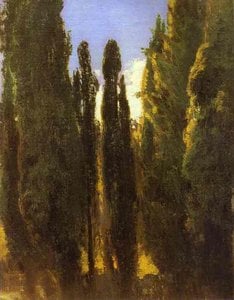
Unlike the French Barbizon painters who often sought to represent idealized landscapes, Vasilyev’s work was deeply rooted in the realities of the Russian countryside and the Crimean mountains. He captured not just the visual appearance of these locations but also their emotional resonance – the quiet solitude of a forest path, the melancholy beauty of a rain-swept field, the dramatic grandeur of the mountain peaks. His paintings are imbued with a sense of nostalgia and longing, reflecting his own personal experiences and the spirit of the Russian people.
Key works from this period, such as *After a Thunderstorm* (1868) and *Near a Watering Place* (1868), showcase Vasilyev’s ability to evoke atmosphere through color and light. His use of muted tones, subtle gradations of shade, and dynamic brushwork creates a sense of depth and movement that draws the viewer into the scene. He was particularly adept at capturing the effects of weather – rain, fog, and mist – transforming ordinary landscapes into realms of ethereal beauty.
Collaborations and Artistic Circles
Vasilyev’s artistic journey was intertwined with several significant collaborations and interactions within the vibrant St. Petersburg art scene. His association with Ivan Shishkin proved to be particularly formative, providing him with invaluable guidance and exposure. However, Vasilyev also engaged in a productive working relationship with Ilya Repin during their Volga River expedition in 1870, resulting in the evocative painting *Volga View. Barges*. This experience broadened his artistic horizons and exposed him to new subjects and techniques.
Furthermore, Vasilyev became a member of the Peredvizhniki (Wanderers), a group of realist artists who sought to depict the lives and struggles of ordinary Russians. While he was initially hesitant to fully embrace this movement’s political agenda, he recognized its value as a platform for promoting his work and engaging with a wider audience. His membership in the Peredvizhniki brought him into contact with other prominent artists such as Repin, Kramskoi, and Viktor Mazurin.
A Tragic End and Lasting Legacy
Despite his burgeoning success, Vasilyev’s life was tragically cut short at the age of 23. Diagnosed with tuberculosis, he sought refuge in the Crimean mountains, hoping to find respite from his illness. However, his health continued to deteriorate, and he ultimately succumbed to the disease in Yalta in October 1873.
His untimely death left a void in the Russian art world, but Vasilyev’s legacy endures through his remarkable body of work. His paintings are celebrated for their atmospheric depth, emotional resonance, and intimate portrayal of the Russian landscape. He is widely regarded as one of the pioneers of the lyrical landscape style, and his influence can be seen in the works of later generations of Russian artists, including Isaac Levitan and Valentin Serov. Vasilyev’s brief but brilliant career serves as a testament to the power of artistic vision and the enduring beauty of the natural world.
Key Works
- After a Thunderstorm (1868): Demonstrates early Barbizon influence, capturing dramatic weather effects.
- Near a Watering Place (1868): Exhibits skillful use of light and shadow to create atmospheric depth.
- After a Rain (1869): A prime example of Vasilyev’s ability to evoke mood through color and brushwork.
- Volga View. Barges (1870): Collaboration with Ilya Repin, showcasing the artist's versatility.
- Thaw (1871): A pivotal work that brought Vasilyev widespread recognition.
- Wet Meadow (1872): Considered his masterpiece, reflecting a mature style and profound connection to the Russian landscape.
Fyodor Vasilyev’s life was tragically brief, but his artistic legacy continues to inspire and captivate viewers today. His paintings offer a poignant glimpse into the soul of Russia – its beauty, its melancholy, and its enduring spirit.