A Life Shaped by Displacement
The early years of Simon Samsonyan were defined by the sudden, violent shifts of history. Born in 1912, he was a child of the Armenian Genocide, orphaned as a toddler and forced into a life of movement. He survived the fires of Smyrna and the fall of Constantinople, moving through the chaos of the early twentieth century before finding a sense of place in Egypt. This early experience of loss and survival left a mark on his perspective, a quiet weight that would eventually settle into the lines and shapes of his canvases. He lived through the upheaval of wars and the shifting borders of the Middle East, eventually finding a later home in the United States.
In Cairo, the artist found a receptive environment where his work could take root. He became part of a community of Armenian diaspora artists, working alongside others who shared his background and his sense of being elsewhere. His presence in the Egyptian art scene was marked by a steady, persistent presence at Le Salon du Caire, where he exhibited for thirty years. He was not a man who sought the spotlight through loud gestures, yet his work earned him significant recognition, including seven gold medals at the annual exhibitions of the Salon.
The Language of Form and Line
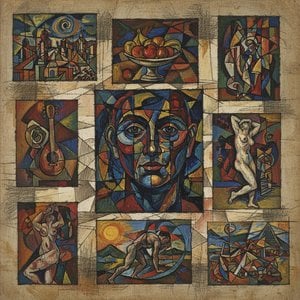
His approach to the canvas was a blend of structure and feeling. He worked with a style that combined elements of Cubism and Impressionism, often described as Symbolic Cubism. His paintings were built upon bold, strong lines and a geometric precision that gave his subjects a sense of permanence. He did not merely depict a scene; he reconstructed it through a designer-painter's lens, using abstraction to reach toward something more essential. His work often focused on:
- Cityscapes that captured the rhythm of urban life.
- Portraits that sought the character beneath the surface.
- Landscapes that translated the natural world into geometric planes.
- Humanist themes expressed through symbolic abstraction.
By 1961, his development had reached a point where he was granted a solo exhibition at Le Salon du Caire, featuring works created since 1950. This period saw him traveling to Paris and London to study the contemporary movements of the time, further refining the way he used color and form. He remained a constant painter, even when he felt he had little left to prove to the critics or the galleries.
A Quiet Legacy
The later years of his life were spent in the United States, where he continued to paint and draw. While he moved away from the intense public recognition he had enjoyed in Egypt, his influence remained within the Armenian community and among those who followed his path. In 1978, a monograph was published by an Armenian association to document his contributions. His family has since worked to ensure his place in the history of modernism is recognized, looking back at a career that spanned six decades and multiple continents. His works remain held in significant collections, including the National Gallery of Armenia, Yerevan.
Ερωτήσεις και Απαντήσεις
Μπορώ να περιηγηθώ στα έργα του/της Simon Samsonyan ανά παλέτα χρώματος;
Μπορείτε να περιηγηθείτε στα έργα του/της Simon Samsonyan ανά χρωματική παλέτα στη σελίδα των χρωμάτων του/της Simon Samsonyan, στην ενότητα Κατά Παλέτα Χρωμάτων.
Πού μπορώ να βρω τα έργα του/της Simon Samsonyan ομαδοποιημένα ανά τεχνική;
Μπορείτε να περιηγηθείτε στα έργα του/της Simon Samsonyan ανά τεχνική στη σελίδα των δημιουργημάτων ανά τεχνική του/της Simon Samsonyan (Κατά Τεχνική).
Μπορώ να ταξινομήσω τα έργα του/της Simon Samsonyan ανά χρώμα;
Στη σελίδα Δείκτης Χρώματος του Simon Samsonyan, τα έργα του καλλιτέχνη είναι οργανωμένα ανά χρώμα.
Με τι άλλα ονόματα είναι γνωστός/η ο/η Simon Samsonyan;
Ο/Η Simon Samsonyan είναι γνωστός/η επίσης ως Simon Samsonian.