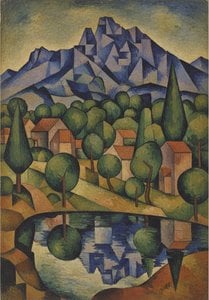
A life shaped by movement and light
Ibrahim Kodra began his days in the coastal village of Ishëm, Albania. His early years were marked by the quiet presence of his father, who worked in the Commercial Marine, and the loss of his mother when he was young. Before the brush became his primary tool, his hands were occupied with the weight of the discus and the hammer throw. He practiced these disciplines with a steady focus, even though such sports had little place in Albania at that time. In 1929, he began taking drawing classes under Odhise Paskali, finding a different kind of rhythm in the movement of charcoal across paper.
A shift occurred when a drawing caught the eye of Queen Geraldine. This moment pulled him toward a larger stage. By 1938, at twenty years old, he left Albania behind, supported by a scholarship from the royal court. He traveled to Italy, eventually finding his way to the Academy of Fine Arts of Brera in Milan. It was here, amidst the studios of Milan, that his visual language began to settle into its distinct form.
The geometry of a new vision
His work moved toward post-cubism, a style built on structure and fragmented forms. In 1948, he opened an exhibition in Rome at the Art Club, a place where his path crossed with Pablo Picasso. These interactions were not merely social; they informed the way he approached space and shape on the canvas. He shared exhibition spaces with figures like Matisse, Modigliani, and Braque, placing his work alongside the heavyweights of the era.
The textures of his paintings reflect a deep engagement with the modern movement. His hands worked through the complexities of color and line, often participating in collective exhibitions that spanned from Milan to New York. In 1950, he applied his skills to frescos in important buildings and museums throughout Milan, leaving a permanent mark on the city's architecture.
A lasting presence
Kodra’s career was defined by a series of international exhibitions in cities such as Venice, Paris, Belgrade, and Rome. He lived through a period where art was being redefined, and he helped bring an Albanian perspective into that global conversation. His later years were spent in Milan, where he passed away in 2006.
The legacy of his work is kept alive through organized efforts to protect and archive his output. The Ibrahim Kodra Swiss Foundation, based in Paradiso, works to maintain the records of his life and art. His contributions are recognized by honors such as the Honor of Nation Order, granted by the President of the Republic of Albania in 1996.
Ερωτήσεις και Απαντήσεις
Με τι άλλα ονόματα είναι γνωστός/η ο/η Ibrahim Kodra;
Ο/Η Ibrahim Kodra αναγνωρίζεται και με τα εναλλακτικά ονόματα Ibrahim Likmetaj Kodra, إبراهيم كودرا, Ιμπραχίμ Κόντρα, Ибрагим Кодра, 易卜拉欣·科德拉.
Ποια χρώματα χρησιμοποίησε πιο συχνά ο/η Ibrahim Kodra;
Η Γενετικό Σύστατο Παλέτας του Ibrahim Kodra παρουσιάζει το χρωματικό προφίλ του συνολικού έργου του καλλιτέχνη.
Υπάρχει χρονολόγιο με τα έργα του/της Ibrahim Kodra;
Μπορείτε να δείτε τη χρονολογία των έργων του/της Ibrahim Kodra στη σελίδα Χρονολόγιο Έργων, όπου τα έργα είναι ταξινομημένα ανά ημερομηνία δημιουργίας.
Μπορώ να εξερευνήσω τα έργα του/της Ibrahim Kodra μέσω λέξεων-κλειδιών;
Στη σελίδα Με Λέξεις-Κλειδιά του Ibrahim Kodra, τα έργα του καλλιτέχνη ομαδοποιούνται ανά λέξεις-κλειδιά.