In echtem Maßstab anzeigen In AR an der Wand sehen Handgemalte Reproduktion kaufen Zum digitalen Bild wechseln Versenden als Grußkarte
Details anzeigen Leitfaden Zu Favoriten hinzufügen Herunterladen Ähnliche Objekte Röntgenaufnahme Diashow Besucherstatistiken

Fruit and a White Rose

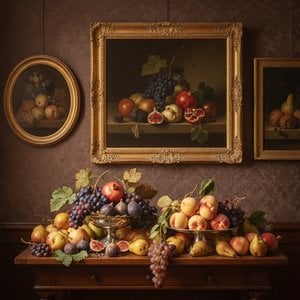
William James Glackens’ ‘Fruit and a White Rose’ (1930) captures a vibrant still life in the Ashcan School style, showcasing apples, grapes, and oranges on a table. Admire this realistic depiction of everyday beauty by a pioneering American artist – explore owning a piece of art history.

Entdecken Sie William James Glackens (1870-1938), Pionier der Ashcan School! Realistische Gemälde des frühen 20. Jh., die New York & Paris mit Detail zeigen.

Giclée / Kunstdruck

Giclée- oder Leinwanddruck in Museumsqualität mit schneller Produktion und flexiblen Veredelungsoptionen. ( Handgemalte Reproduktion kaufen Zum digitalen Bild wechseln)

P118B $10
P118H $10
P118W $10
P438Z $10
P508JH $12
P508YH $12
P805H $10
P805Z $10
P919BZ $10
P919G $10
P919XJ $10
P959ZH $10
P968JZ $12
W106C $8
W218G $10
W218JH $8
W218Y $10
W307PJ $10
W316G $10
W316PJ $8
W316Y $10
W398PJ $8
W4111J $10
W500HY $15
W500JH $15
W692G $12
W849H $8
W940BG $15
W953PJ $8

Standardformat
individuell anpassbar
CM
INCH

Wählen Sie aus unseren vordefinierten Formaten, die den ursprünglichen Proportionen des Kunstwerks entsprechen.

Breite
Höhe

Sie können Ihre eigenen Maße eingeben, um ein bestimmtes Format oder einen speziellen Platz einzupassen. Wenn das von Ihnen gewählte Format nicht den Proportionen des Originalbildes entspricht, werden wir das Kunstwerk entweder beschneiden oder das Bild mit einem gespiegelten oder einfarbigen Rand erweitern. Ein digitaler Entwurf wird Ihnen zur Genehmigung zugesandt, bevor die Produktion beginnt.
Bitte beachten Sie, dass die Vorschau auf dem Bildschirm nicht den tatsächlichen Zuschnitt oder die Erweiterung widerspiegelt. Nur der Entwurf zeigt die endgültige Komposition präzise an.
Obwohl Sondermaße verfügbar sind, empfehlen wir die Auswahl eines Maßes aus der vordefinierten Liste, um die ursprünglichen Proportionen zu bewahren.

Weltweiter Versand () innerhalb von 2 Wochen statt der üblichen 4/5 Wochen. (22 September)

why_choose_icon
Kostenloser weltweiter Expressversand
why_choose_icon
Hochwertige Leinenleinwand
why_choose_icon
Vollständiger Versicherungsschutz beim Versand
why_choose_icon
Zollgebühren-Rückerstattungsgarantie
why_choose_icon
Garantie für exakte Farbtreue
why_choose_icon
100-tägiges Rückgaberecht (nur bei Mängeln)
why_choose_icon
100% Geld-zurück-Garantie
why_choose_icon
Angebot für Mengenrabatt

Gesamtpreis

$ 68

reproduction

Fruit and a White Rose

Giclée / Kunstdruck

Format der Reproduktion

-

Gesamtpreis

$ 68

Kurzübersicht

  • Notable elements: Fruit, rose, detail
  • Location: Fort Lauderdale Museum
  • Artist: William Glackens
  • Subject or theme: Still life
  • Influences: Renoir
  • Title: Fruit and a White Rose
  • Medium: Oil on panel

Introduction to William James Glackens and ‘Fruit and a White Rose’

William James Glackens stands as a pivotal figure in American art, inextricably linked to the rise of the Ashcan School. This movement, born from a desire to depict unfiltered reality rather than idealized visions, sought to capture the pulse of urban life – its grit, its beauty, and its inherent contradictions. ‘Fruit and a White Rose,’ painted in 1930, exemplifies Glackens’ commitment to this aesthetic, offering a deceptively simple still life that resonates with profound historical and artistic significance. The painting, currently residing within the Museum of Art in Fort Lauderdale, United States, is more than just a depiction of fruit; it's a window into the sensibilities of an era grappling with modernity.

Composition and Technique: A Masterclass in Realism

Glackens’ masterful handling of oil on panel immediately draws the viewer into the scene. The composition is anchored by a prominent table, acting as both stage and backdrop to the vibrant arrangement of fruit. The artist's meticulous attention to detail is evident in the layering of textures – the smooth skin of the apples, the plumpness of the grapes, and the subtle variations in the oranges’ surfaces. Multiple apples are strategically placed, creating a sense of depth and inviting the eye to wander across the bowl. The use of color is particularly noteworthy; Glackens employs a restrained palette—muted reds, yellows, and browns—that enhances the realism rather than overwhelming it. This technique reflects a conscious decision to prioritize observation and direct representation over purely expressive gestures, aligning him with the core tenets of the Ashcan School.

Historical Context: The Ashcan School and the Spirit of New York

'Fruit and a White Rose' was created during a transformative period in American history. The 1930s witnessed rapid urbanization, industrial growth, and social change in New York City – themes frequently explored by Glackens and his contemporaries. The Ashcan School emerged as a reaction against the academic traditions of the time, seeking to portray the lives of ordinary people—immigrants, laborers, and artists—within the city’s bustling streets. The painting's subject matter – everyday objects arranged in a still life – subtly reflects this concern with the mundane, elevating it through Glackens’ skilled execution. The Burton Art Gallery’s founding in 1930 further underscores the artistic climate of the time, highlighting a dedication to showcasing contemporary art and historical artifacts.

Symbolism and Emotional Impact

Beyond its technical brilliance, ‘Fruit and a White Rose’ possesses a quiet emotional resonance. The inclusion of a white rose adds an element of delicate beauty to the otherwise robust scene, perhaps representing fleeting moments of grace or contemplation amidst the chaos of urban life. The arrangement itself – a collection of fruits ripe for consumption – can be interpreted as a symbol of abundance and nourishment, yet also hints at the transient nature of pleasure. Glackens’ ability to evoke such subtle emotions through seemingly simple imagery is a testament to his artistic vision and his profound understanding of human experience. The painting's enduring appeal lies in its capacity to connect with viewers on an intuitive level, prompting reflection on themes of beauty, mortality, and the everyday wonders of the world.


Biografie des Künstlers

Ein Pionier der Ashcan School

William James Glackens, eine bedeutende Figur in der amerikanischen Kunst, hinterließ mit seinen fesselnden realistischen Gemälden einen bleibenden Eindruck auf die Leinwand der Geschichte. Geboren 1870 in Philadelphia, Pennsylvania, war Williams künstlerische Reise ein Beweis für seine unerschütterliche Leidenschaft, das Wesen des täglichen Lebens einzufangen.

Frühes Leben und Einflüsse

Glackens' frühe Jahre waren von einer angeborenen Neigung zur Kunst geprägt, was ihn dazu veranlasste, sich an der Pennsylvania Academy of the Fine Arts einzuschreiben. Unter der Anleitung von Thomas Anshutz, einem renommierten Realisten, verfeinerte Glackens seine Fähigkeiten und wurde schließlich einer der Gründer der Ashcan School. Diese Bewegung lehnte die konventionellen Grenzen künstlerischer Schönheit ab und konzentrierte sich stattdessen auf die rauen Realitäten des städtischen Lebens.

Künstlerische Laufbahn

Glackens' Werk zeichnet sich durch seine dunkel getönten, lebhaft gemalten Straßenszenen und Darstellungen des täglichen Lebens im vorwendezeitlichen New York und Paris aus. Seine späteren Werke, die von Renoir beeinflusst waren, zeigten einen helleren Ton, der sein Wachstum als Künstler widerspiegelte. Bemerkenswert ist, dass Glackens auch als Illustrator für Zeitungen und Zeitschriften in Philadelphia und New York City arbeitete.
  • View of Haarlem with Bleaching Grounds, ein Gemälde von Jacob Isaakszoon van Ruisdael (Ruisdael), veranschaulicht das Maß an Detailgenauigkeit und Handwerkskunst, das Glackens' Werk definiert. Dieses Stück befindet sich jetzt in der Sammlung des Chrysler Museum of Art.
  • Glackens' eigenes Meisterwerk, The Shoppers, ist ein Beweis für seine Fähigkeit, das Wesen des Stadtlebens einzufangen. Dieses Gemälde befindet sich in der New Realism-Kollektion auf WahooArt.com.

Vermächtnis und Bedeutung

Glackens' Beiträge zur amerikanischen Kunst sind vielschichtig und gehen über seine eigenen Werke hinaus. Er spielte eine entscheidende Rolle bei der Unterstützung von Albert C. Barnes beim Ankauf europäischer Gemälde für die Barnes Foundation in Philadelphia. Diese Sammlung ist zu einem Eckpfeiler der amerikanischen Kunstgeschichte geworden. Wichtige Werke und Sammlungen: * The Shoppers (New Realism, Öl auf Leinwand, Chrysler Museum of Art) * View of Haarlem with Bleaching Grounds (Ruisdael, Sforza Castle, Mailand, Italien) Empfohlene Lektüre: * [https://WahooArt.com/@/william-james-glackens](https://WahooArt.com/@/william-james-glackens) - Entdecken Sie die umfangreiche Sammlung von Glackens' Werken auf WahooArt.com. * [https://en.wikipedia.org/wiki/william_glackens](https://en.wikipedia.org/wiki/william_glackens) - Tauchen Sie ein in die detaillierte Biografie von William James Glackens auf Wikipedia.
William James Glackens

William James Glackens

1870 - 1938 , Vereinigte Staaten von Amerika

Eckdaten zum Künstler

  • Bemerkenswerte Kunstwerke:
    • The Shoppers
    • View of Haarlem with Bleaching Grounds
  • Geburtsdatum: 1870
  • Geburtsort (Stadt Und Land): Philadelphia, USA
  • Künstler Oder Bewegungen, Von Denen Dieser Künstler Beeinflusst Wurde: ['Ashcan School']
  • Künstler, Die Diesen Künstler Beeinflussten:
    • Thomas Anshutz
    • Renoir
  • Künstlerische Bewegung Oder Stil: Ashcan School, Realismus
  • Nationalität: Amerikanisch
  • Sterbedatum: 1938
  • Vollständiger Name: William James Glackens
Entdecken Sie Kunstwerke, die nach Themen, Stilen und Merkmalen sortiert sind.