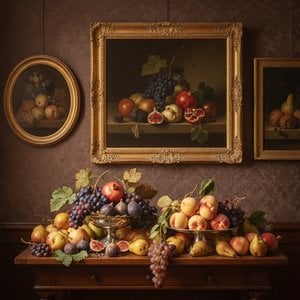
Pierre-Auguste Renoir’s Still Life – A Symphony of Light and Fruit
Pierre-Auguste Renoir's "Still Life" is more than just a depiction of apples and oranges; it’s a vibrant snapshot of Impressionist philosophy, capturing the fleeting beauty of light and color with an almost palpable immediacy. Painted around 1880-85, this work exemplifies Renoir’s masterful ability to transform commonplace objects into moments of exquisite visual pleasure. The painting isn't merely about fruit; it’s a meditation on perception, inviting the viewer to share in the artist’s subjective experience of observing and recreating the world around him.
The composition is deceptively simple yet profoundly effective. A rustic wooden table anchors the scene, its surface subtly textured and bathed in diffused light – a key element of Renoir's technique. The arrangement of the fruit—a cluster of blushing apples and vibrant oranges—is carefully considered, creating a sense of balance and harmony that draws the eye across the canvas. Notice how Renoir doesn’t strive for photographic realism; instead, he employs loose, expressive brushstrokes to suggest form and volume, prioritizing the *impression* of light and color over precise detail. The apples, rendered in shades of crimson and gold, seem to glow with an inner radiance, while the oranges radiate warmth and a sense of ripeness.
Impressionism: Capturing the Ephemeral
Renoir’s “Still Life” is deeply rooted in the principles of Impressionism, a movement that revolutionized painting by rejecting academic conventions and embracing subjective perception. Inspired by artists like Monet and Degas, Renoir sought to capture the *impression* of a scene – its fleeting qualities of light, color, and atmosphere – rather than meticulously recreating it with photographic accuracy. This is evident in his use of broken brushstrokes, applied in short, rapid movements, which create a shimmering effect that mimics the way light interacts with surfaces.
The painting’s palette is remarkably bright and cheerful, dominated by warm hues—reds, oranges, and yellows—that evoke feelings of warmth, abundance, and vitality. However, Renoir skillfully employs subtle variations in tone and color to create depth and dimension, preventing the composition from feeling flat or superficial. He masterfully uses light to define form, creating a sense of volume and three-dimensionality that belies the painting’s relatively simple subject matter.
Symbolism and Context
While seemingly straightforward, “Still Life” carries subtle symbolic weight within the context of late 19th-century French culture. Fruit, particularly apples and oranges, were frequently used in still life paintings to represent abundance, prosperity, and even mortality – a reminder of the fleeting nature of earthly pleasures. The arrangement itself can be interpreted as an allegory for the cycles of life and death, with the vibrant fruit symbolizing vitality and beauty juxtaposed against the inevitable decay.
Furthermore, Renoir’s work reflects the broader social and artistic trends of his time. Impressionism was a reaction against the rigid formality of academic art, embracing a more democratic approach to subject matter and technique. Renoir's focus on everyday objects—a table, fruit, and a simple bowl—reflects this shift towards valuing the beauty of ordinary life. The painting’s influence can be seen in the work of later artists such as Paul Cézanne and Paul Gauguin, who built upon Renoir’s innovations to develop their own distinctive styles.
Owning a Piece of History
WahooArt offers meticulously crafted, handmade oil painting reproductions of Pierre-Auguste Renoir's "Still Life," allowing art lovers to experience the beauty and artistry of this iconic masterpiece firsthand. Each reproduction is created by skilled artisans using traditional techniques and high-quality materials, ensuring that it faithfully captures the original’s vibrant colors, expressive brushstrokes, and overall atmosphere. Bringing this piece into your home or office will not only add a touch of elegance and sophistication but also connect you to a pivotal moment in art history.
To acquire your own reproduction of Renoir's "Still Life," please visit https://WahooArt.com



 Vorschau anzeigen
 Zu Druck wechseln
 Versenden
 Teilen
 Details anzeigen

 Herunterladen
 Ähnliche Objekte
 Röntgenaufnahme
 Diashow
 Statistiken
 Weiterlesen






































 Die Glasoption ist nur für Größen unter 110 cm verfügbar.