Vorschau anzeigen In AR ansehen Handgemalte Reproduktion bestellen Zum digitalen Bild wechseln Versenden
Details anzeigen Leitfaden Zu Favoriten hinzufügen Herunterladen Ähnliche Objekte Röntgenaufnahme Diashow Statistiken

Unititled

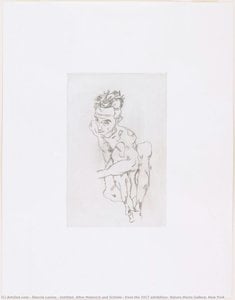
A poignant black and white depiction of a military gathering by Korean War combat artist Norval E. Packwood Jr. captures a historic moment of camaraderie that you can explore further in our collection.

Norval E. Packwood Jr. (USMC) was a Korean War combat artist known for his realistic drawings documenting the war's history & experience. Also creator of 'Leatherhead in Korea'. Preserving WWII & Korean War stories through art.

Die auf dieser Seite dargestellten Kunstwerke sind urheberrechtlich geschützt, was bedeutet, dass wir keine identische Reproduktion rechtmäßig erstellen oder verkaufen dürfen. Dieser Schutz wird durch internationale Abkommen wie die Berner Übereinkunft und durch nationale Gesetze, einschließlich derer, die von den US-Urheberrecht – Titel 17.

Diese Methode entspricht vollumfänglich den Urheberrechtsbestimmungen, da sie keine Kopie oder Vervielfältigung des geschützten Kunstwerks darstellt. Stattdessen handelt es sich um eine kreative Neuinterpretation – ein neues Gemälde, das vom Original inspiriert, aber nicht identisch mit ihm ist.

Giclée / Kunstdruck

Giclée- oder Leinwanddruck in Museumsqualität mit schneller Produktion und flexiblen Veredelungsoptionen. ( Handgemalte Reproduktion bestellen Zum digitalen Bild wechseln)

Corner sample of the P118B picture frame: formgepresstes Polystyrol, 5 cm wide and 3 cm thick
P118B €10
Corner sample of the P118H picture frame: formgepresstes Polystyrol, 5 cm wide and 3 cm thick
P118H €10
Corner sample of the P118W picture frame: formgepresstes Polystyrol, 5 cm wide and 3 cm thick
P118W €10
Corner sample of the P438Z picture frame: formgepresstes Polystyrol, 5.5 cm wide and 3.5 cm thick
P438Z €10
Corner sample of the P508JH picture frame: formgepresstes Polystyrol, 7 cm wide and 3.5 cm thick
P508JH €12
Corner sample of the P508YH picture frame: formgepresstes Polystyrol, 7 cm wide and 3.5 cm thick
P508YH €12
Corner sample of the P805H picture frame: formgepresstes Polystyrol, 5 cm wide and 3.5 cm thick
P805H €10
Corner sample of the P805Z picture frame: formgepresstes Polystyrol, 5 cm wide and 3.5 cm thick
P805Z €10
Corner sample of the P919BZ picture frame: formgepresstes Polystyrol, 7 cm wide and 3.5 cm thick
P919BZ €10
Corner sample of the P919G picture frame: formgepresstes Polystyrol, 7 cm wide and 3.5 cm thick
P919G €10
Corner sample of the P919XJ picture frame: formgepresstes Polystyrol, 7 cm wide and 3.5 cm thick
P919XJ €10
Corner sample of the P959ZH picture frame: formgepresstes Polystyrol, 5 cm wide and 3 cm thick
P959ZH €10
Corner sample of the P968JZ picture frame: formgepresstes Polystyrol, 6 cm wide and 4 cm thick
P968JZ €12
Corner sample of the W106C picture frame: Massivholz, 5 cm wide and 3 cm thick
W106C €8
Corner sample of the W218G picture frame: Massivholz, 5 cm wide and 3 cm thick
W218G €10
Corner sample of the W218JH picture frame: Massivholz, 5 cm wide and 3 cm thick
W218JH €8
Corner sample of the W218Y picture frame: Massivholz, 5 cm wide and 3 cm thick
W218Y €10
Corner sample of the W307PJ picture frame: Massivholz, 6 cm wide and 3 cm thick
W307PJ €10
Corner sample of the W316G picture frame: Massivholz, 6 cm wide and 3 cm thick
W316G €10
Corner sample of the W316PJ picture frame: Massivholz, 6 cm wide and 3 cm thick
W316PJ €8
Corner sample of the W316Y picture frame: Massivholz, 6 cm wide and 3 cm thick
W316Y €10
Corner sample of the W398PJ picture frame: Massivholz, 5 cm wide and 3 cm thick
W398PJ €8
Corner sample of the W4111J picture frame: Massivholz, 6.5 cm wide and 3.5 cm thick
W4111J €10
Corner sample of the W500HY picture frame: Massivholz, 7 cm wide and 5 cm thick
W500HY €15
Corner sample of the W500JH picture frame: Massivholz, 7 cm wide and 5 cm thick
W500JH €15
Corner sample of the W692G picture frame: Massivholz, 8 cm wide and 4 cm thick
W692G €12
Corner sample of the W849H picture frame: Massivholz, 5 cm wide and 3 cm thick
W849H €8
Corner sample of the W940BG picture frame: Massivholz, 7.5 cm wide and 4.5 cm thick
W940BG €15
Corner sample of the W953PJ picture frame: Massivholz, 6 cm wide and 3.5 cm thick
W953PJ €8

Standardformat
individuell anpassbar
CM
INCH

Wählen Sie aus unseren vordefinierten Formaten, die den ursprünglichen Proportionen des Kunstwerks entsprechen.

Breite
Höhe

Geben Sie die benötigte Breite und Höhe an, damit der Druck perfekt in Ihren Rahmen oder an Ihre Wand passt. Ein Druck kann nur beschnitten, aber niemals größer als das Originalbild angefertigt werden; daher verliert ein Format mit anderen Proportionen einen Teil des Bildes. Wir senden Ihnen ein digitales Mockup zur Freigabe, bevor wir den Druck ausführen. Das auf dieser Seite gezeigte Bild zeigt nicht den tatsächlichen Beschnitt – dies ist nur im Mockup ersichtlich.

Weltweiter Versand () innerhalb von 2 Wochen statt der üblichen 4/5 Wochen. (27 Oktober)

Kostenloser weltweiter Expressversand
Hochwertige Leinenleinwand
Umfassender Versicherungsschutz beim Versand
Zollgebühren-Rückerstattungsgarantie
Garantie für exakte Farbtreue
100 Tage Rückgaberecht (nur bei Mängeln)
100% Geld-zurück-Garantie
Mengenrabatt verfügbar

Gesamtpreis

€ 60

Unititled

Giclée / Kunstdruck

Format der Reproduktion

-

Endpreis

€ 60

Eckdaten

  • Year: 1951
  • Location: National Museum of the Marine Corps
  • Subject or theme: Military gathering or historical event
  • Artist: Norval E. Packwood, Jr.

A Moment Frozen in Time: The Quietude of War

In the evocative depths of this monochromatic masterpiece, we are transported to a moment of profound stillness amidst the turbulence of history. Created in 1951 by Technical Sergeant Norval E. Packwood, Jr., this untitled work serves as a hauntingly beautiful window into the lives of those stationed during the Korean War. The scene captures a group of individuals gathered within a room, perhaps a mess hall or a communal gathering space, where the heavy atmosphere of military life meets the simple, human necessity of companionship. Through the masterful use of light and shadow, Packwood invites us to sit at these very tables, feeling the weight of the era and the quiet tension that exists between moments of respite and the call to duty.

The composition is a delicate dance of figures and furniture, where the arrangement of chairs and dining tables creates a sense of structured intimacy. As eyes wander across the canvas, one notices the subtle interplay of textures—the stark contrast of light hitting a tabletop against the deep, velvety blacks of the shadows. This technique does more than just define form; it builds an emotional landscape. The presence of a clock on the wall acts as a silent sentinel, a poignant symbol of the passing time and the uncertain future awaiting those in uniform. It is a piece that speaks to the universality of the human condition, finding beauty in the mundane even when surrounded by the specter of conflict.

The Hand of a Combat Artist

To understand this work, one must understand the soul of its creator. Norval “Gene” Packwood, Jr. was not merely an observer; he was a witness. Having served in the Marine Corps during both World War II and the Korean War, his art is imbued with an authenticity that only comes from lived experience. His training at the Art Institute of Chicago provided him with the technical prowess to execute such detailed realism, yet it was his deployment to Korea that gave his work its heartbeat. This drawing reflects a sophisticated command of line and tonal gradation, characteristic of a skilled commercial artist turned combat chronicler.

For the discerning collector or interior designer, this reproduction offers more than just aesthetic value; it offers a narrative of resilience. The monochromatic palette lends itself perfectly to sophisticated, modern, or even classic historical decor, allowing it to serve as a focal point in a room that values depth and storytelling. It is an ideal acquisition for those who seek art that transcends mere decoration, providing a conversation piece that honors the dignity of the human spirit during times of great upheaval. Bringing this work into a space invites a sense of contemplative history, making it a timeless addition to any curated collection.

Fragen & Antworten

Warum wird "Unititled" von Technical Sergeant Norval E. Packwood, Jr. Usmc als Geschenk empfohlen?

Mit seiner Nostalgic emotionalen Stimmung ist "Unititled" von Technical Sergeant Norval E. Packwood, Jr. Usmc als Geschenk für Corporate Gift zu empfehlen.

Wie harmonieren die Farben von "Unititled" miteinander?

Die Farben von "Unititled" von Technical Sergeant Norval E. Packwood, Jr. Usmc weisen eine Unified Palette Harmonie auf. Harmonie beschreibt das Zusammenspiel der Farben untereinander.

Welche Grundfarbe prägt "Unititled" von Technical Sergeant Norval E. Packwood, Jr. Usmc?

Ein Ochre to Sepia Farbton durchzieht "Unititled" von Technical Sergeant Norval E. Packwood, Jr. Usmc.


Künstlerbiografie

The Eye of the Storm: The Life and Legacy of Norval E. Packwood, Jr.

Born in the quiet landscape of Dona Vista, New Mexico, on November 18, 1923, Norval E. Packwood, Jr.—known to many as “Gene”—possessed a spirit that would eventually find its most profound expression amidst the turbulence of mid-century warfare. His journey from a childhood nurtured by his father’s passion for art to the front lines of global conflict is a testament to the power of the witness. Early influences played a pivotal role in shaping his hand; his father, Gene Sr., instilled in him a foundational love for drawing and painting that would later serve as his most vital tool for historical preservation. This early training provided the technical scaffolding upon which he would build a career defined by both artistic precision and immense courage.

Packwood’s life was irrevocably altered by the call of duty. Enlisting in the United States Marine Corps in 1942, he served during the harrowing years of World War II aboard the USS Boise (CVE-76). It was within the steel confines of naval vessels and the vast, uncertain reaches of the Pacific that his worldview began to coalesce around a singular mission: to document the human experience of war. This conviction reached its zenith during the Korean War, where Packwood transitioned from a soldier to a combat artist. Volunteering for the Combat Artist Program alongside fellow artist Fred Lasswell, he helped establish Leatherneck Studios in Arlington, Virginia. Through this studio, he and Lasswell produced iconic illustrations that did more than merely record troop movements; they captured the very soul of the conflict.

Mastery of the Medium: Realism and the Korean Landscape

The artistry of Packwood is characterized by a meticulous realism that eschews the sensational for the profound. He possessed a rare ability to find the quietude within the chaos, utilizing watercolor to evoke the atmospheric weight of the Korean Peninsula. His technique was not merely about the replication of form, but about the mastery of light and shadow to convey psychological depth. In his works, one does not simply see a landscape; one feels the biting chill of the terrain and the heavy silence of the moments between battles.

His portfolio serves as a poignant gallery of the human condition during wartime. Notable pieces include:

  • Crow: A hauntingly beautiful depiction where a Marine observes the Korean landscape, bridging the gap between the observer and the observed.
  • Untitled (1951): A monochromatic masterpiece that captures a group of individuals in a communal space, illustrating the profound need for companionship amidst the tension of military life.
  • Bn Forward Aid Station: A work that brings the visceral reality of medical care on the front lines into sharp, empathetic focus.

Through his use of watercolor, Packwood could blend hues to create a sense of atmosphere that felt both immediate and eternal. His compositions often focused on the "everyday"—the small, human moments of respite, contemplation, and camaraderie—which served to highlight the psychological toll endured by servicemen. By focusing on these intimate vignettes, he elevated the combat artist's role from mere reporter to a chronicler of the human spirit.

A Legacy of Preservation

Beyond his immediate contributions to wartime illustration, Packwood’s significance lies in his lifelong commitment to historical memory. After his active duty, his career expanded into the realms of commercial art and direction, running his own company, Design Direction, and working for various newspapers. Yet, the shadow of his combat years always remained a guiding light. His work remains an essential archive for the National Museum of the Marine Corps, ensuring that the stories of the Korean War are not lost to the passage of time.

The historical significance of Norval E. Packwood, Jr. cannot be overstated. He stood at the intersection of art and history, using his brush as both a shield and a lens. In an era of rapid technological change, his hand-painted records provide a tactile, emotional connection to a generation of Marines that digital imagery can rarely replicate. He remains a celebrated figure whose work continues to invite viewers to sit at the tables of the past, feeling the weight of duty and the enduring strength of the human heart.

Kurzinfos

  • Full Name: Norval E. Packwood Jr.
  • Nationality: American
  • Date Of Birth: Dona Vista
  • Place Of Birth: Dona Vista, United States of America
  • Notable Artworks:
    • Crow
    • Unititled
    • Untitled
  • Artistic Movement Or Style: Realism
  • Artists Or Movements Influenced By This Artist: ['Leatherhead in Korea']