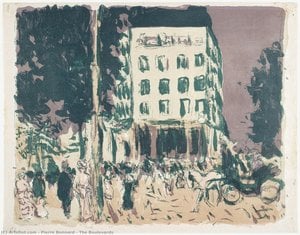
A Portrait of Introspection: Pierre Bonnard’s *Intimit*
Pierre Bonnard's *Intimit*, painted in 1896, is more than just a portrait; it’s a carefully constructed mood, a whisper of melancholy rendered with the vibrant intensity that would define his career. This intimate scene, measuring 38 x 36 cm, captures a solitary man lost in contemplation, a figure instantly recognizable as a hallmark of Bonnard's mature style – a style deeply rooted in Symbolism and foreshadowing the expressive currents of early Expressionism. The photograph reveals a tightly cropped composition, focusing intently on the subject’s face and upper torso, allowing the viewer to become acutely aware of his internal state. The background, richly decorated with opulent details, serves not as a distraction but as a subtle reinforcement of the man's contemplative mood, hinting at wealth and status while simultaneously isolating him within his own thoughts.
- Style & Influence: *Intimit* exemplifies Bonnard’s shift away from purely representational art. While retaining elements of realism in his depiction of form – particularly the carefully rendered lines defining the man's features and clothing – he prioritizes conveying emotion and atmosphere above strict accuracy. The loose brushwork, a key characteristic of Symbolism, allows for an expressive interpretation of light and shadow, creating a palpable sense of unease and introspection.
- Technique: Bonnard’s masterful use of oil paint is immediately apparent. Thick impasto – the application of paint in thick layers – creates a remarkable textural richness, particularly evident in the fabric and wall surfaces. This technique isn't merely decorative; it actively contributes to the painting’s emotional impact, inviting the viewer to almost physically touch the scene.
Decoding Symbolism: The Man and His Setting
The man himself is the focal point of *Intimit*, a figure shrouded in quiet contemplation as he puffs on his pipe. This simple act – a gesture often associated with solitude and reflection – immediately invites us to consider the subject’s inner world. Bonnard's skillful use of directional lighting, casting strong shadows across the man’s face, amplifies this sense of introspection, adding to the painting’s dramatic atmosphere. The richly decorated room, characteristic of the Nabis group to which Bonnard belonged, is not merely a backdrop; it functions symbolically. The ornate details – the patterned wallpaper, the luxurious furniture – suggest a life of comfort and privilege, yet they also contribute to the man's isolation, emphasizing his solitary state.
- The Nabis Connection: Bonnard’s association with the Nabis (meaning “prophets”) was crucial in shaping his artistic vision. This group sought to use color as a primary means of expression, rejecting academic realism and exploring spiritual themes through their art. *Intimit* embodies this approach, prioritizing emotional resonance over photographic accuracy.
- Color Palette: Bonnard’s bold color choices – deep reds, muted greens, and ochre tones – contribute significantly to the painting's mood. These colors aren’t used in a purely descriptive manner; they are employed strategically to evoke specific emotions and enhance the overall atmosphere of melancholy and quiet contemplation.
A Window into the Late 19th Century
*Intimit*, painted in 1896, offers a fascinating glimpse into the intellectual and artistic climate of late 19th-century France. The painting reflects a growing disillusionment with materialism and a renewed interest in spirituality and introspection – themes that were prevalent among artists and intellectuals of the time. Bonnard’s work aligns with this broader cultural shift, reflecting a desire to move beyond the superficial and explore deeper truths about human existence. The slightly flattened perspective further enhances the sense of intimacy, drawing the viewer into the scene as if they are sharing in the man's private moment of reflection.
Collecting *Intimit*: A Masterpiece of Emotional Resonance
A hand-painted reproduction of Pierre Bonnard’s *Intimit* is more than just a beautiful artwork; it’s an investment in a legacy of artistic innovation and emotional depth. This piece offers a unique opportunity to bring a touch of Symbolist introspection into your home or office, capturing the essence of Bonnard's masterful technique and profound understanding of human emotion. Its evocative power continues to resonate with viewers today, making it a timeless addition to any discerning collection.
Fragen & Antworten
Wo kann ich Kunstwerke finden, die "Intimit" von Pierre Bonnard ähneln?
Die Seite Ähnliche Werke von "Intimit" von Pierre Bonnard zeigt verwandte Kunstwerke.
Welche Bedeutung kommt "Intimit" von Pierre Bonnard in der Kunstgeschichte zu?
"Intimit" von Pierre Bonnard gehört der Symbolism-Strömung innerhalb der 19th Century-Epoche an. Zusammen verleihen sie dem Werk seinen Platz in der Kunstgeschichte.
Kann ich Augmented Reality nutzen, um "Intimit" von Pierre Bonnard in meinem Raum zu sehen?
Die AR-Vorschau-Seite von "Intimit" von Pierre Bonnard nutzt Augmented Reality, um das Kunstwerk auf einem kompatiblen Gerät in Ihrem eigenen Raum anzuzeigen.



 In echtem Maßstab anzeigen
 Zum Druck wechseln
 Versenden als Grußkarte
 Teilen
 Details anzeigen
 Leitfaden öffnen

 Herunterladen
 Ähnliche Objekte
 Röntgenaufnahme
 Diashow
 Besucherstatistiken


 Mehr anzeigen






































 Die Glasoption ist nur für Größen unter 110 cm verfügbar.