Paul Cézanne’s “In the Forest”: A Journey into Post-Impressionist Vision
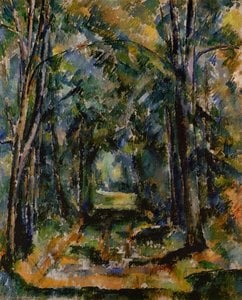
Paul Cézanne's "In the Forest," painted in 1899, isn’t merely a landscape; it’s an invitation. An invitation to step beyond the fleeting impressions of light and color that defined Impressionism and enter a world sculpted by feeling, memory, and the artist’s profound connection with nature. This work stands as a cornerstone of Post-Impressionism, a movement born from a desire to move beyond mere representation and delve into the very essence of what it means to see – and to feel – the world around us. Cézanne, a man who famously declared that he was “only trying to paint things as they appear to me,” sought not to replicate reality but to distill its core elements into a vibrant, emotionally resonant form.
The painting immediately captivates with its rich palette dominated by the fiery hues of autumn. Deep oranges and reds blaze across the foliage, contrasted against the cooler greens and browns of the undergrowth and rocky terrain. These aren’t the soft, blended colors of Impressionism; instead, Cézanne employs bold, distinct brushstrokes – visible and deliberate – that build up layers of color and texture. He uses a technique known as “alla prima,” working directly onto the canvas with minimal layering, resulting in an immediacy and energy rarely seen in earlier styles. The trees themselves are rendered not as photographic copies but as simplified geometric forms—cones, cylinders, and planes—suggesting a deeper understanding of their structure and volume.
Composition and Perspective – Breaking the Rules
Cézanne’s compositional choices were revolutionary for his time. He deliberately distorted perspective, flattening the space and creating an illusion of depth through color and form rather than traditional linear recession. The foreground trees appear almost tactile, pressing forward towards the viewer, while those in the background recede with a subtle ambiguity. This manipulation of perspective wasn't intended to deceive but to convey Cézanne’s subjective experience of the forest—his feeling of being enveloped by its vastness and complexity. Notice how he uses overlapping planes and ambiguous spatial relationships to create a sense of dynamism and movement, as if the viewer is stepping into the heart of the scene.
Symbolism and the Artist's Soul
“In the Forest” resonates with symbolism beyond its purely visual elements. The vibrant orange leaves, particularly prominent in the foreground, can be interpreted as symbols of vitality, passion, and perhaps even a hint of melancholy – reflecting the transient beauty of autumn and the passage of time. Cézanne’s lifelong study of nature wasn't simply an artistic pursuit; it was a deeply spiritual one. He believed that art should reflect the underlying order and harmony of the universe, and this belief is powerfully expressed in his landscapes. The rugged rocks, the dense undergrowth, and the interplay of light and shadow all contribute to a sense of profound connection between the artist and the natural world.
Influence and Legacy – A Bridge to Modern Art
Cézanne’s influence on subsequent generations of artists is undeniable. He paved the way for movements like Cubism, where objects are broken down into geometric forms and reassembled in new ways. Artists such as Picasso and Braque were deeply inspired by Cézanne's exploration of form and space, adopting his techniques to create radically new visual languages. “In the Forest” isn’t just a beautiful painting; it’s a pivotal work that marked a turning point in art history, demonstrating the power of subjective vision and paving the way for modern abstraction. It stands as a testament to Cézanne's ability to capture not just what he saw, but how he *felt* about what he saw – a truly remarkable achievement.
Bringing “In the Forest” Home: A WahooArt Reproduction
WahooArt offers meticulously crafted, hand-painted oil painting reproductions of Paul Cézanne’s "In the Forest," allowing you to experience this iconic artwork in stunning detail and quality. Each reproduction is created by skilled artists who painstakingly recreate Cézanne's brushstrokes, color palette, and compositional choices. Whether displayed in a grand salon or a cozy corner, our reproductions bring the emotional depth and artistic brilliance of “In the Forest” into your home, serving as a timeless reminder of Cézanne’s revolutionary vision. Explore our collection today and discover the perfect way to own a piece of art history.
Fragen & Antworten
Ist ein hochauflösender Download von "Im Wald" verfügbar?
Um eine digitale Datei von "Im Wald" von Paul Cézanne zu erhalten, bestellen Sie ein hochauflösender digitaler Bild-Download auf diese Seite.
Welche Stimmung vermittelt "Im Wald" von Paul Cézanne innerhalb der Post-Impressionism?
Innerhalb der Post-Impressionism-Strömung ist „Im Wald“ mit einem Beschaulich Ton festgehalten.
Worum geht es in "Im Wald" und welche Atmosphäre vermittelt es?
"Im Wald" von Paul Cézanne stellt forest, trees, orange leaves, landscape, cézanne, composition, depth, texture in einer Gelassen Stimmung dar. Motiv und Atmosphäre beschreiben gemeinsam das Werk.
Welcher Strömung und welcher Epoche ist "Im Wald" von Paul Cézanne zuzuordnen?
"Im Wald" von Paul Cézanne lässt sich der Post-Impressionism-Strömung innerhalb der – 19. Jahrhundert-Ära seines Schöpfers zuordnen.
Worum geht es in "Im Wald"?
Die in "Im Wald" von Paul Cézanne enthaltenen Themen umfassen forest, trees, orange leaves, landscape, cézanne, composition, depth, texture. Zusammen fassen sie den Gegenstand des Kunstwerks zusammen.
In welcher Phase der Karriere von Paul Cézanne lässt sich „Im Wald“ angesichts seines Entstehungsdatums einordnen?
"Im Wald", entstanden im Jahr 1899, stammt aus der Late Period von Paul Cézanne.
Warum ist der Urheberrechtsstatus von "Im Wald" so, wie er ist?
"Im Wald" von Paul Cézanne ist gemeinfrei – das Urheberrecht ist abgelaufen. Die Dauer des Urheberrechts beginnt mit dem Tod des Künstlers, der im Jahr 1906 verstarb.
Ist "Im Wald" von Paul Cézanne ein bekanntes Kunstwerk?
"Im Wald" wird als Anerkannt eingestuft.



 In echtem Maßstab anzeigen
 Handgemalte Reproduktion kaufen
 Versenden als Grußkarte
 Teilen
 Details anzeigen
 Leitfaden öffnen

 Herunterladen
 Ähnliche Objekte
 Röntgenaufnahme
 Diashow
 Besucherstatistiken


 Mehr anzeigen






































 Die Glasoption ist nur für Größen unter 110 cm verfügbar.