In echtem Maßstab anzeigen In AR an der Wand sehen Zum Druck wechseln Zum digitalen Bild wechseln Versenden als Grußkarte
Details anzeigen Leitfaden öffnen Zu Favoriten hinzufügen Herunterladen Ähnliche Objekte Röntgenaufnahme Diashow Besucherstatistiken

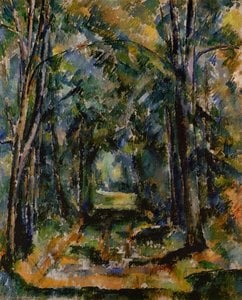
Im Wald

Paul Cézannes Meisterwerk 'Im Wald' fesselt mit seiner Farbvielfalt und der Darstellung einer friedlichen, verschwommenen Landschaft. Entdecken Sie den Zauber des Post-Impressionismus!

Erkunden Sie die revolutionäre Kunst von Paul Cézanne (1839–1906), einem Postimpressionisten, der Impressionismus und Kubismus miteinander verband. Entdecken Sie seine geometrischen Formen, seine einzigartigen Pinselstriche, Stilllebenmalereien und seinen bleibenden Einfluss auf die moderne Kunst. #Cézanne #PostImpressionismus

Handgefertigte Ölreproduktion

Handgemaltes Ölgemälde auf Leinwand in Ihrer Wunschgröße und mit Rahmen, auf Bestellung von unseren Künstlern angefertigt. ( Zum Druck wechseln Zum digitalen Bild wechseln)

Corner sample of the P118B picture frame: formgepresstes Polystyrol, 5 cm wide and 3 cm thick
P118B 10
Corner sample of the P118H picture frame: formgepresstes Polystyrol, 5 cm wide and 3 cm thick
P118H 10
Corner sample of the P118W picture frame: formgepresstes Polystyrol, 5 cm wide and 3 cm thick
P118W 10
Corner sample of the P438Z picture frame: formgepresstes Polystyrol, 5.5 cm wide and 3.5 cm thick
P438Z 10
Corner sample of the P508JH picture frame: formgepresstes Polystyrol, 7 cm wide and 3.5 cm thick
P508JH 12
Corner sample of the P508YH picture frame: formgepresstes Polystyrol, 7 cm wide and 3.5 cm thick
P508YH 12
Corner sample of the P805H picture frame: formgepresstes Polystyrol, 5 cm wide and 3.5 cm thick
P805H 10
Corner sample of the P805Z picture frame: formgepresstes Polystyrol, 5 cm wide and 3.5 cm thick
P805Z 10
Corner sample of the P919BZ picture frame: formgepresstes Polystyrol, 7 cm wide and 3.5 cm thick
P919BZ 10
Corner sample of the P919G picture frame: formgepresstes Polystyrol, 7 cm wide and 3.5 cm thick
P919G 10
Corner sample of the P919XJ picture frame: formgepresstes Polystyrol, 7 cm wide and 3.5 cm thick
P919XJ 10
Corner sample of the P959ZH picture frame: formgepresstes Polystyrol, 5 cm wide and 3 cm thick
P959ZH 10
Corner sample of the P968JZ picture frame: formgepresstes Polystyrol, 6 cm wide and 4 cm thick
P968JZ 12
Corner sample of the W106C picture frame: Massivholz, 5 cm wide and 3 cm thick
W106C 8
Corner sample of the W218G picture frame: Massivholz, 5 cm wide and 3 cm thick
W218G 10
Corner sample of the W218JH picture frame: Massivholz, 5 cm wide and 3 cm thick
W218JH 8
Corner sample of the W218Y picture frame: Massivholz, 5 cm wide and 3 cm thick
W218Y 10
Corner sample of the W307PJ picture frame: Massivholz, 6 cm wide and 3 cm thick
W307PJ 10
Corner sample of the W316G picture frame: Massivholz, 6 cm wide and 3 cm thick
W316G 10
Corner sample of the W316PJ picture frame: Massivholz, 6 cm wide and 3 cm thick
W316PJ 8
Corner sample of the W316Y picture frame: Massivholz, 6 cm wide and 3 cm thick
W316Y 10
Corner sample of the W398PJ picture frame: Massivholz, 5 cm wide and 3 cm thick
W398PJ 8
Corner sample of the W4111J picture frame: Massivholz, 6.5 cm wide and 3.5 cm thick
W4111J 10
Corner sample of the W500HY picture frame: Massivholz, 7 cm wide and 5 cm thick
W500HY 15
Corner sample of the W500JH picture frame: Massivholz, 7 cm wide and 5 cm thick
W500JH 15
Corner sample of the W692G picture frame: Massivholz, 8 cm wide and 4 cm thick
W692G 12
Corner sample of the W849H picture frame: Massivholz, 5 cm wide and 3 cm thick
W849H 8
Corner sample of the W940BG picture frame: Massivholz, 7.5 cm wide and 4.5 cm thick
W940BG 15
Corner sample of the W953PJ picture frame: Massivholz, 6 cm wide and 3.5 cm thick
W953PJ 8

Standardformat
individuell anpassbar
CM
INCH

Wählen Sie aus unseren vordefinierten Formaten, die den ursprünglichen Proportionen des Kunstwerks entsprechen.

Breite
Höhe

Sie können Ihre eigenen Maße eingeben, um einen bestimmten Rahmen oder Platz auszufüllen. Wenn die gewählte Größe nicht den Proportionen des Originalbildes entspricht, werden wir das Kunstwerk entweder beschneiden oder das Gemälde durch zusätzliche, handgemalte Elemente erweitern. Ein digitales Mockup wird Ihnen zur Genehmigung zugesandt, bevor die Produktion beginnt.
Bitte beachten Sie, dass die Bildschirmvorschau nicht die tatsächliche Beschneidung oder Erweiterung widerspiegelt. Nur das Mockup zeigt die endgültige Komposition exakt an.
Obwohl Sondermaße verfügbar sind, empfehlen wir, eine Größe aus der vordefinierten Liste zu wählen, um die ursprünglichen Proportionen beizubehalten.

Beispiele für Anpassungsmöglichkeiten: Gesicht durch Kundenfoto ersetzen; Haustier hinzufügen (z. B. Katze durch Hund ersetzen); eine versteckte Nachricht im Hintergrund einfügen; Hintergrundlandschaft oder -elemente ändern.
Nach der Bestellung wird das WahooArt.com-Team dem Kunden Anweisungen per E-Mail zusenden und eine Mockup-Vorschau bereitstellen.

Weltweiter Versand () in nur 3 bis 4 Wochen statt der üblichen 5 Wochen. (13 Oktober). Keine Kompromisse bei der Qualität.

Kostenloser weltweiter Expressversand
Hochwertige Leinenleinwand
Vollständiger Versicherungsschutz beim Versand
Zollgebühren-Rückerstattungsgarantie
Garantie für exakte Farbtreue
100-tägiges Rückgaberecht (nur bei Mängeln)
100% Geld-zurück-Garantie
Angebot für Mengenrabatt

Gesamtpreis

€ 235

Im Wald

Reproduktionsmedium

Format der Reproduktion

-

Gesamtpreis

€ 235

Kurzübersicht

  • Year: 1899
  • Notable elements: Orange Blätter, Felsen
  • Medium: Öl auf Leinwand
  • Artist: Paul Cézanne
  • Movement: Post-Impressionismus
  • Influences:
    • Monet
    • Seurat

Kunst-Quiz

Jede Frage hat nur eine richtige Antwort.

Frage 1:
Welche Kunstrichtung wird in "In der Wäsche" hauptsächlich mit Paul Cézanne assoziiert?
Frage 2:
Welche Farbe dominiert die Blätter der Bäume in "In der Wäsche"?
Frage 3:
Wie groß ist die Leinwand von "In der Wäsche"?
Frage 4:
Welche der folgenden Aussagen beschreibt am besten Cézannes Stil in "In der Wäsche"?
Frage 5:
Welche Bewegung beeinflusste Cézanne maßgeblich und trug zur Entwicklung seines Stils bei?

Paul Cézanne’s “In the Forest”: A Journey into Post-Impressionist Vision

Paul Cézanne's "In the Forest," painted in 1899, isn’t merely a landscape; it’s an invitation. An invitation to step beyond the fleeting impressions of light and color that defined Impressionism and enter a world sculpted by feeling, memory, and the artist’s profound connection with nature. This work stands as a cornerstone of Post-Impressionism, a movement born from a desire to move beyond mere representation and delve into the very essence of what it means to see – and to feel – the world around us. Cézanne, a man who famously declared that he was “only trying to paint things as they appear to me,” sought not to replicate reality but to distill its core elements into a vibrant, emotionally resonant form.

The painting immediately captivates with its rich palette dominated by the fiery hues of autumn. Deep oranges and reds blaze across the foliage, contrasted against the cooler greens and browns of the undergrowth and rocky terrain. These aren’t the soft, blended colors of Impressionism; instead, Cézanne employs bold, distinct brushstrokes – visible and deliberate – that build up layers of color and texture. He uses a technique known as “alla prima,” working directly onto the canvas with minimal layering, resulting in an immediacy and energy rarely seen in earlier styles. The trees themselves are rendered not as photographic copies but as simplified geometric forms—cones, cylinders, and planes—suggesting a deeper understanding of their structure and volume.

Composition and Perspective – Breaking the Rules

Cézanne’s compositional choices were revolutionary for his time. He deliberately distorted perspective, flattening the space and creating an illusion of depth through color and form rather than traditional linear recession. The foreground trees appear almost tactile, pressing forward towards the viewer, while those in the background recede with a subtle ambiguity. This manipulation of perspective wasn't intended to deceive but to convey Cézanne’s subjective experience of the forest—his feeling of being enveloped by its vastness and complexity. Notice how he uses overlapping planes and ambiguous spatial relationships to create a sense of dynamism and movement, as if the viewer is stepping into the heart of the scene.

Symbolism and the Artist's Soul

“In the Forest” resonates with symbolism beyond its purely visual elements. The vibrant orange leaves, particularly prominent in the foreground, can be interpreted as symbols of vitality, passion, and perhaps even a hint of melancholy – reflecting the transient beauty of autumn and the passage of time. Cézanne’s lifelong study of nature wasn't simply an artistic pursuit; it was a deeply spiritual one. He believed that art should reflect the underlying order and harmony of the universe, and this belief is powerfully expressed in his landscapes. The rugged rocks, the dense undergrowth, and the interplay of light and shadow all contribute to a sense of profound connection between the artist and the natural world.

Influence and Legacy – A Bridge to Modern Art

Cézanne’s influence on subsequent generations of artists is undeniable. He paved the way for movements like Cubism, where objects are broken down into geometric forms and reassembled in new ways. Artists such as Picasso and Braque were deeply inspired by Cézanne's exploration of form and space, adopting his techniques to create radically new visual languages. “In the Forest” isn’t just a beautiful painting; it’s a pivotal work that marked a turning point in art history, demonstrating the power of subjective vision and paving the way for modern abstraction. It stands as a testament to Cézanne's ability to capture not just what he saw, but how he *felt* about what he saw – a truly remarkable achievement.

Bringing “In the Forest” Home: A WahooArt Reproduction

WahooArt offers meticulously crafted, hand-painted oil painting reproductions of Paul Cézanne’s "In the Forest," allowing you to experience this iconic artwork in stunning detail and quality. Each reproduction is created by skilled artists who painstakingly recreate Cézanne's brushstrokes, color palette, and compositional choices. Whether displayed in a grand salon or a cozy corner, our reproductions bring the emotional depth and artistic brilliance of “In the Forest” into your home, serving as a timeless reminder of Cézanne’s revolutionary vision. Explore our collection today and discover the perfect way to own a piece of art history.

Fragen & Antworten

Ist ein hochauflösender Download von "Im Wald" verfügbar?

Um eine digitale Datei von "Im Wald" von Paul Cézanne zu erhalten, bestellen Sie ein hochauflösender digitaler Bild-Download auf diese Seite.

Welche Stimmung vermittelt "Im Wald" von Paul Cézanne innerhalb der Post-Impressionism?

Innerhalb der Post-Impressionism-Strömung ist „Im Wald“ mit einem Beschaulich Ton festgehalten.

Worum geht es in "Im Wald" und welche Atmosphäre vermittelt es?

"Im Wald" von Paul Cézanne stellt forest, trees, orange leaves, landscape, cézanne, composition, depth, texture in einer Gelassen Stimmung dar. Motiv und Atmosphäre beschreiben gemeinsam das Werk.

Welcher Strömung und welcher Epoche ist "Im Wald" von Paul Cézanne zuzuordnen?

"Im Wald" von Paul Cézanne lässt sich der Post-Impressionism-Strömung innerhalb der – 19. Jahrhundert-Ära seines Schöpfers zuordnen.

Worum geht es in "Im Wald"?

Die in "Im Wald" von Paul Cézanne enthaltenen Themen umfassen forest, trees, orange leaves, landscape, cézanne, composition, depth, texture. Zusammen fassen sie den Gegenstand des Kunstwerks zusammen.

In welcher Phase der Karriere von Paul Cézanne lässt sich „Im Wald“ angesichts seines Entstehungsdatums einordnen?

"Im Wald", entstanden im Jahr 1899, stammt aus der Late Period von Paul Cézanne.

Warum ist der Urheberrechtsstatus von "Im Wald" so, wie er ist?

"Im Wald" von Paul Cézanne ist gemeinfrei – das Urheberrecht ist abgelaufen. Die Dauer des Urheberrechts beginnt mit dem Tod des Künstlers, der im Jahr 1906 verstarb.

Ist "Im Wald" von Paul Cézanne ein bekanntes Kunstwerk?

"Im Wald" wird als Anerkannt eingestuft.


Biografie des Künstlers

frühes Leben und Einflüsse

Paul Cézanne, ein französischer Post-Impressionist-Maler, wurde am 19. Januar 1839 in Aix-en-Provence, Frankreich, geboren. Sein frühes Leben war geprägt von einer starken Verbindung zu seiner Familie’s Bankgeschäft, das ihm finanzielle Sicherheit verschaffte. Dies ermöglichte es ihm, sich ohne finanziellen Druck auf seine künstlerischen Bestrebungen zu konzentrieren. Les Nabis, Neo-Impressionismus und Symbolismus beeinflussten Cézannes frühe Arbeit, die sich durch seinen Schwerpunkt auf geometrische Formen und eine reduzierte Farbpalette auszeichnete. Sein Interesse an den Werken von Paul Gauguin und Georges Seurat festigte seinen Post-Impressionismusstil.

Künstlerischer Stil und Techniken

Cézannes innovative Verwendung von Farbflächen und kleinen, sich wiederholenden Pinselstrichen schuf komplexe Felder, die seine intensive Beschäftigung mit den Motiven widerspiegelten. Sein oft explorativer Ansatz in der Kunst führte zur Entwicklung einer neuen bildlichen Sprache, die die zugrunde liegende Struktur von Objekten in einer Komposition betonte.

Vermächtnis und Einfluss

Cézannes bahnbrechende Arbeit im Post-Impressionismus ebnete den Weg für verschiedene Avantgarde-Bewegungen, darunter Kubismus, Fauvismus und Surrealismus. Sein Einfluss ist in den Werken von Pablo Picasso, Henri Matisse und Georges Braque zu sehen. Cézannes Vermächtnis inspiriert weiterhin Künstler und Kunstinteressierte gleichermaßen und festigt seinen Platz als eine zentrale Figur in der Geschichte der modernen Kunst.
Paul Cézanne

Paul Cézanne

1839 - 1906 , Frankreich

Eckdaten zum Künstler

  • Beeinflusste Künstler:
    • Paul Gauguin
    • Georges Seurat
  • Bemerkenswerte Werke:
    • Der Teich in Jas de Bouffan
    • Porträt von Émile Zola
    • Wald
    • Mont Sainte-Victoire
  • Geburtsdatum: 19. Januar 1839
  • Geburtsort: Aix-en-Provence, Frankreich
  • Künstlerische Bewegung: Postimpressionismus
  • Nationalität: Französisch
  • Sterbedatum: 1906
  • Vollständiger Name: Paul Cézanne
  • Von Ihm Beeinflusste Künstler:
    • Pablo Picasso
    • Henri Matisse
    • Georges Braque
Entdecken Sie Kunstwerke, die nach Themen, Stilen und Merkmalen sortiert sind.