In echtem Maßstab anzeigen In AR an der Wand sehen Handgemalte Reproduktion kaufen Zum digitalen Bild wechseln Versenden als Grußkarte
Details anzeigen Zu Favoriten hinzufügen Herunterladen Ähnliche Objekte Röntgenaufnahme Diashow Besucherstatistiken

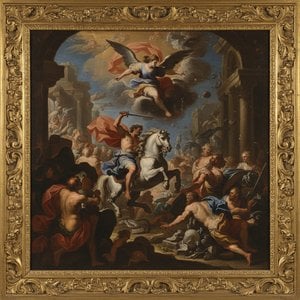
Two Girls Accompanied by Cupid

The painting depicts two women accompanied by Cupid, embodying classical ideals of beauty and innocence. Nicolas Poussin's masterful composition captures the serenity of the outdoor setting and celebrates maternal tenderness.

Erkunden Sie die Meisterwerke von Nicolas Poussin (1594-1665), einem führenden französischen Barockmaler. Entdecken Sie seine klassischen Kompositionen, historische und mythologische Szenen sowie ruhige Landschaften – welche Künstler wie David & Cézanne beeinflussten. #Poussin #Barockkunst #

Giclée / Kunstdruck

Giclée- oder Leinwanddruck in Museumsqualität mit schneller Produktion und flexiblen Veredelungsoptionen. ( Handgemalte Reproduktion kaufen Zum digitalen Bild wechseln)

P118B $10
P118H $10
P118W $10
P438Z $10
P508JH $12
P508YH $12
P805H $10
P805Z $10
P919BZ $10
P919G $10
P919XJ $10
P959ZH $10
P968JZ $12
W106C $8
W218G $10
W218JH $8
W218Y $10
W307PJ $10
W316G $10
W316PJ $8
W316Y $10
W398PJ $8
W4111J $10
W500HY $15
W500JH $15
W692G $12
W849H $8
W940BG $15
W953PJ $8

Standardformat
individuell anpassbar
CM
INCH

Wählen Sie aus unseren vordefinierten Formaten, die den ursprünglichen Proportionen des Kunstwerks entsprechen.

Breite
Höhe

Sie können Ihre eigenen Maße eingeben, um ein bestimmtes Format oder einen speziellen Platz einzupassen. Wenn das von Ihnen gewählte Format nicht den Proportionen des Originalbildes entspricht, werden wir das Kunstwerk entweder beschneiden oder das Bild mit einem gespiegelten oder einfarbigen Rand erweitern. Ein digitaler Entwurf wird Ihnen zur Genehmigung zugesandt, bevor die Produktion beginnt.
Bitte beachten Sie, dass die Vorschau auf dem Bildschirm nicht den tatsächlichen Zuschnitt oder die Erweiterung widerspiegelt. Nur der Entwurf zeigt die endgültige Komposition präzise an.
Obwohl Sondermaße verfügbar sind, empfehlen wir die Auswahl eines Maßes aus der vordefinierten Liste, um die ursprünglichen Proportionen zu bewahren.

Weltweiter Versand () innerhalb von 2 Wochen statt der üblichen 4/5 Wochen. (15 September)

why_choose_icon
Kostenloser weltweiter Expressversand
why_choose_icon
Hochwertige Leinenleinwand
why_choose_icon
Vollständiger Versicherungsschutz beim Versand
why_choose_icon
Zollgebühren-Rückerstattungsgarantie
why_choose_icon
Garantie für exakte Farbtreue
why_choose_icon
100-tägiges Rückgaberecht (nur bei Mängeln)
why_choose_icon
100% Geld-zurück-Garantie
why_choose_icon
Angebot für Mengenrabatt

Gesamtpreis

$ 68

reproduction

Two Girls Accompanied by Cupid

Giclée / Kunstdruck

Format der Reproduktion

-

Gesamtpreis

$ 68

Kurzübersicht

  • Medium: Oil on Canvas
  • Movement: Baroque
  • Subject or theme: Love and Fertility
  • Notable elements or techniques: Allegorical Composition; Drapery; Classical Mythology
  • Dimensions: 283 × 375 cm
  • Year: 1640
  • Artist: Nicolas Poussin

Kunst-Quiz

Jede Frage hat nur eine richtige Antwort.

Frage 1:
What artistic movement is Nicolas Poussin's “Two Girls Accompanied by Cupid” primarily associated with?
Frage 2:
The painting depicts two women, one holding a baby. What is the significance of this imagery within the context of Baroque art?
Frage 3:
Nicolas Poussin spent most of his artistic career in Rome. Why was this location crucial for developing his style?
Frage 4:
What technique is commonly employed by Nicolas Poussin in his paintings, contributing to their luminous quality?
Frage 5:
“Two Girls Accompanied by Cupid” exemplifies the Baroque fascination with dramatic composition and emotional intensity. Describe how this is achieved in the painting.

A Vision of Innocence and Divine Grace: Exploring Nicolas Poussin’s “Two Girls Accompanied by Cupid”

The painting "Two Girls Accompanied by Cupid," attributed to Nicolas Poussin, stands as a cornerstone of French Baroque art—a testament to the artist's mastery of classical ideals blended seamlessly with emotive expression. Completed around 1645-1646, it resides within the Musée du Louvre in Paris and continues to captivate audiences with its serene beauty and profound symbolic depth. This essay delves into the multifaceted layers of this iconic artwork, examining its subject matter, stylistic innovations, artistic technique, historical significance, and enduring emotional resonance.

Subject Matter: A Pastoral Ideal

At first glance, “Two Girls Accompanied by Cupid” presents a deceptively simple tableau: two young women standing amidst lush foliage—specifically olive trees—with one cradling a baby in her arms. However, beneath this pastoral surface lies an intricate tapestry of mythological allusion. The figures embody the Virgin Mary and Saint Anne, representing humility and maternal devotion – concepts central to Christian iconography. Cupid, the Roman god of love, delicately intervenes, showering them with blossoms symbolizing fertility and renewal. This deliberate juxtaposition elevates the scene beyond mere depiction; it speaks to themes of divine grace, spiritual purity, and the promise of eternal life—a hallmark of Poussin’s artistic philosophy.

Style and Technique: Baroque Refinement

Poussin's style exemplifies the Baroque aesthetic – characterized by dramatic lighting, meticulous detail, and a calculated sense of grandeur. Unlike the turbulent dynamism prevalent in other Baroque canvases, “Two Girls Accompanied by Cupid” exudes tranquility through masterful chiaroscuro—the interplay between light and shadow—creating an ethereal atmosphere that draws viewers into the scene’s contemplative mood. The artist employs painstaking brushwork to render textures with astonishing realism, capturing the velvety softness of olive leaves and the delicate folds of fabric. Furthermore, Poussin utilizes pyramidal composition – a technique borrowed from Renaissance artists like Raphael – to stabilize the image and guide the eye towards the central figures, reinforcing their importance within the narrative framework.

Historical Context: Rome’s Artistic Ascendancy

Poussin's artistic journey culminated in his relocation to Rome during the papal patronage of Cardinal Mazarin—a period witnessing an unprecedented flourishing of classical art and scholarship. The rediscovery of ancient texts and sculptures fueled a renewed interest in humanist ideals, prompting artists like Poussin to reinterpret mythological narratives through the lens of Christian theology. “Two Girls Accompanied by Cupid” reflects this intellectual climate, embodying the Baroque conviction that beauty could elevate the soul and inspire contemplation—a sentiment deeply resonant with the spiritual fervor of the era. It stands as a powerful emblem of Rome’s artistic dominance during Mazarin's reign, showcasing the transformative influence of classical antiquity on European art.

Symbolism: Blossoms of Hope and Divine Intervention

The olive trees themselves symbolize peace and prosperity—traditionally associated with Jerusalem and representing divine blessing upon Mary and Saint Anne. The blossoms raining down upon the women signify fertility and rebirth – mirroring the Virgin Mary’s conception and foreshadowing the arrival of Christ. Cupid's presence underscores the notion that love, guided by divine grace, is instrumental in achieving spiritual fulfillment. Each element within the painting contributes to a complex symbolic system designed to convey profound theological truths—a testament to Poussin’s erudition and artistic ambition.

Emotional Impact: A Balm for the Soul

Ultimately, “Two Girls Accompanied by Cupid” transcends mere visual representation; it evokes an emotional response rooted in contemplation and reverence. The painting's serene beauty inspires feelings of tranquility, compassion, and spiritual aspiration—capturing the essence of Christian piety. Its masterful technique – particularly chiaroscuro – creates a palpable sense of atmosphere, transporting viewers to a timeless pastoral landscape imbued with divine grace. As a result, this artwork continues to resonate powerfully with audiences today, serving as an enduring reminder of the transformative power of art to nourish the soul and illuminate the human condition.

Biografie des Künstlers

frühes Leben und Ausbildung

Nikos Poussin, geboren im Juni 1594, war die Quintessenz der französischen Barockmalerei des Klassikers. Obwohl er den Großteil seiner Karriere in Rom verbrachte, blieb er tief in den französischen künstlerischen Traditionen verwurzelt. Seine frühen Tage als Maler waren von Unsicherheit umhüllt, aber bereits im Jahr 1612 hatte er formale Studien in Paris begonnen und sich von weniger bekannten Künstlern beeinflussen lassen, bevor er 1624 nach Rom zog.

Künstlerischer Stil und Einflüsse

Poussins Ästhetik, die für ihre kohärente Komposition und Priorisierung der Linearität bekannt ist, legte einen Präzedenzfall fest, der Meister wie Jacques-Louis David und Paul Cézanne noch bis ins 20. Jahrhundert beeinflusste. Sein unverwechselbarer Stil kristallisierte sich in herausragenden Werken wie Der Tod des Germanikers und seiner einflussreichen Sieben Sakramente-Serie.

Bekannte Werke und Museen

Vermächtnis und Einfluss

Poussins Loyalität blieb Rom, wo er schließlich darauf konzentrierte sich, weitreichende Landschaften in seine Kunst zu integrieren. Seine Reife als Künstler wird in Werken wie Orion, der von der Sonne geblendet sucht und Die Jahreszeiten verkörpert, die eine Ära strenger Komposition einleitet, die von der ruhigen Schönheit der Natur durchdrungen ist.

Erfahren Sie mehr mit WahooArt.com

Entdecken Sie die Meisterwerke des Musée France und tauchen Sie ein in die Welt der französischen Barockmalerei mit Musée Picasso, Musée des Beaux-Arts de Carcassonne und anderen bemerkenswerten Museen. Besuchen Sie Nikos Poussins Seite auf WahooArt.com, um mehr über seine Werke zu erfahren und den Kontext, in dem sie entstanden sind.

Referenzen

Nikolaus Poussin

Nikolaus Poussin

1594 - 1665 , Frankreich

Eckdaten zum Künstler

  • Bemerkenswerte Werke:
    • Der Tod des Germanicus
    • Die Sieben Sakramente
    • Eine römische Straße
    • Orion auf der Suche nach der Sonne
    • Die Jahreszeiten
  • Geburtsdatum: Juni 1594
  • Geburtsort: Le Havre, Frankreich
  • Künstler, Die Ihn Beeinflussten:
    • Raphael
    • Titian
  • Künstlerische Bewegung: Barock
  • Nationalität: Französisch
  • Todatum: 1665
  • Vollständiger Name: Nicolas Poussin
  • Von Ihm Beeinflusste Künstler:
    • Jacques-Louis David
    • Paul Cézanne
Entdecken Sie Kunstwerke, die nach Themen, Stilen und Merkmalen sortiert sind.