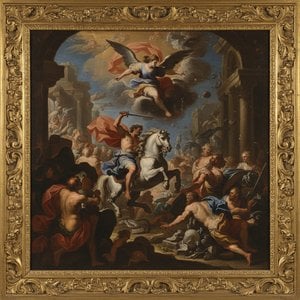
St Cecilia: A Symphony of Classical Grace
Nicolas Poussin’s St. Cecilia transcends mere depiction; it embodies the very essence of Neoclassical idealism—a testament to Poussin’s unparalleled ability to distill complex theological concepts into breathtaking visual harmony.
Painted in 1627 during his formative years in Rome, this monumental oil on canvas resides within the hallowed halls of Museo del Prado, Madrid, where it continues to captivate viewers with its serene beauty and profound spiritual resonance. The painting’s enduring fame stems not only from its artistic merit but also from its place within a broader narrative of European art history.
The Composition: Balance and Narrative
At first glance, St. Cecilia presents a meticulously crafted scene—Saint Cecilia, the patron saint of musicians and composers, is portrayed playing an organ while surrounded by children. This seemingly simple arrangement serves as a cornerstone for Poussin’s masterful storytelling.
The artist employs a pyramidal composition, anchoring St. Cecilia at its apex and distributing the supporting figures—the children—across the base. This deliberate structuring reinforces the sense of stability and grandeur characteristic of Neoclassical art, mirroring the architectural principles prevalent during the period. The organ itself dominates the visual space, symbolizing St. Cecilia’s devotion and artistic vocation.
Artistic Significance: Classical Idealization
Poussin's stylistic approach distinguishes him from his contemporaries—a deliberate rejection of Baroque exuberance in favor of clarity and restraint. He achieves this through a technique rooted in disegno, the Italian concept of “drawing,” prioritizing careful observation and idealized representation.
The artist skillfully blends realism with classical ideals, capturing the textures of drapery and skin with remarkable accuracy while simultaneously elevating figures to an ethereal beauty reminiscent of ancient sculptures. The muted palette—dominated by earthy tones—contributes to the painting’s contemplative mood, inviting viewers into a realm of spiritual contemplation.
Contextualizing St Cecilia: Poussin's Wider Legacy
To fully appreciate St. Cecilia’s significance, it is crucial to consider Poussin's broader artistic output—particularly his monumental frescoes adorning the Panthéon in Paris and his depiction of Apollo and Vulcan.
These works demonstrate Poussin’s unwavering commitment to classical themes and stylistic conventions—a legacy that profoundly influenced subsequent generations of artists, including David and Cézanne. Like Velázquez's masterpieces, Las Meninas and Coronation of the Virgin exemplify Poussin’s meticulous attention to detail and compositional balance—qualities that continue to inspire admiration today.
WahooArt.com offers exceptional reproductions of St. Cecilia—allowing art enthusiasts to experience the sublime beauty and intellectual depth of this iconic artwork firsthand. Explore more of Poussin’s oeuvre at Nicolas Poussin: St. Cecilia and Nicolas Poussin: Parnasus.
Fragen & Antworten
Kann ich "St Cecilia" von Nikolaus Poussin vor der Bestellung in einer Vorschau ansehen?
Um eine Reproduktion von "St Cecilia" von Nikolaus Poussin in der Vorschau zu sehen, öffnen Sie die Vorschau-Seite des Kunstwerks.
Welcher Phase der Karriere von Nikolaus Poussin entspricht das Datum 1627 von „St Cecilia“?
Die Datierung auf 1627 ordnet „St Cecilia“ der Barockzeit von Nikolaus Poussins künstlerischer Entwicklung zu.
Wie finde ich Kunstwerke, die "St Cecilia" von Nikolaus Poussin ähneln?
Werke, die "St Cecilia" ähneln, sind auf der Ähnliche Werke-Seite des Kunstwerks aufgelistet.



 In echtem Maßstab anzeigen
 Zum Druck wechseln
 Versenden als Grußkarte
 Teilen
 Details anzeigen
 Leitfaden öffnen

 Herunterladen
 Ähnliche Objekte
 Röntgenaufnahme
 Diashow
 Besucherstatistiken


 Mehr anzeigen






































 Die Glasoption ist nur für Größen unter 110 cm verfügbar.