Jetzt verkaufen
x
Vorschau anzeigenVorschau anzeigen In AR erlebenIn AR erleben Handgemalte Reproduktion bestellen Handgemalte Reproduktion bestellenBild kaufen Bild kaufen VersendenVersenden
Details anzeigenDetails anzeigen Zu Favoriten hinzufügen Zu Favoriten hinzufügen HerunterladenHerunterladen Ähnliche ObjekteÄhnliche Objekte RöntgenaufnahmeRöntgenaufnahme DiashowDiashow

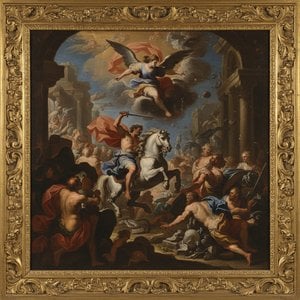
The eucharist

Nicolas Poussin’s monumental ‘The Institution of the Eucharist,’ a masterpiece of neoclassicism from 1640, captures the solemn beauty of Christ's final meal with profound classical elegance. Explore this iconic Baroque painting and bring timeless artistry into your home.

Erkunden Sie die Meisterwerke von Nicolas Poussin (1594-1665), einem führenden französischen Barockmaler. Entdecken Sie seine klassischen Kompositionen, historische und mythologische Szenen sowie ruhige Landschaften – welche Künstler wie David & Cézanne beeinflussten. #Poussin #Barockkunst #

Giclée / Kunstdruck

Giclée- oder Leinwanddruck in Museumsqualität mit schneller Produktion und flexiblen Veredelungsoptionen. (Handgemalte Reproduktion bestellen Handgemalte Reproduktion bestellenBild kaufen Bild kaufen)

P118B $10
P118H $10
P118W $10
P438Z $10
P508JH $12
P508YH $12
P805H $10
P805Z $10
P919BZ $10
P919G $10
P919XJ $10
P959ZH $10
P968JZ $12
W106C $8
W218G $10
W218JH $8
W218Y $10
W307PJ $10
W316G $10
W316PJ $8
W316Y $10
W398PJ $8
W4111J $10
W500HY $15
W500JH $15
W692G $12
W849H $8
W940BG $15
W953PJ $8

Standard
custom
CM
INCH

Wählen Sie aus unseren vordefinierten Formaten, die den ursprünglichen Proportionen des Kunstwerks entsprechen.

Breite
Höhe

Sie können Ihre eigenen Maße eingeben, um ein bestimmtes Format oder einen speziellen Platz einzupassen. Wenn das von Ihnen gewählte Format nicht den Proportionen des Originalbildes entspricht, werden wir das Kunstwerk entweder beschneiden oder das Bild mit einem gespiegelten oder einfarbigen Rand erweitern. Ein digitaler Entwurf wird Ihnen zur Genehmigung zugesandt, bevor die Produktion beginnt.
Bitte beachten Sie, dass die Vorschau auf dem Bildschirm nicht den tatsächlichen Zuschnitt oder die Erweiterung widerspiegelt. Nur der Entwurf zeigt die endgültige Komposition präzise an.
Obwohl Sondermaße verfügbar sind, empfehlen wir die Auswahl eines Maßes aus der vordefinierten Liste, um die ursprünglichen Proportionen zu bewahren.

Weltweiter Versand () innerhalb von 2 Wochen statt der üblichen 4/5 Wochen. (17 August)

why_choose_icon
Kostenloser weltweiter Expressversand
why_choose_icon
Hochwertige Leinenleinwand
why_choose_icon
Umfassender Versicherungsschutz beim Versand
why_choose_icon
Zollgebühren-Rückerstattungsgarantie
why_choose_icon
Garantie für exakte Farbtreue
why_choose_icon
60 Tage Rückgaberecht (nur bei Mängeln)
why_choose_icon
100% Geld-zurück-Garantie
why_choose_icon
Mengenrabatt verfügbar

Gesamtpreis

$ 68

reproduction

The eucharist

Giclée / Kunstdruck

Format der Reproduktion

-

Gesamtpreis

$ 68

Eckdaten

  • Artistic style: Classical
  • Influences: Italian Renaissance
  • Medium: Oil on canvas
  • Artist: Nicolas Poussin
  • Notable elements or techniques: Dramatic use of light; Foreshortening; Precise rendering
  • Subject or theme: Religious scene; Last Supper
  • Title: The Eucharist

Kunst-Quiz

Jede Frage hat nur eine richtige Antwort.

Frage 1:
What is the primary subject matter depicted in Nicolas Poussin’s ‘The Institution of the Eucharist’?
Frage 2:
Where was Nicolas Poussin born?
Frage 3:
What artistic style is most characteristic of Nicolas Poussin’s work?
Frage 4:
The painting utilizes dramatic lighting to create a sense of...
Frage 5:
Which museum houses a significant collection of paintings by Nicolas Poussin?

Sammlerstück-Beschreibung

A Divine Encounter in Oil: The Essence of Poussin’s Masterpiece

In the quiet, hallowed atmosphere of Nicolas Poussin’s The Institution of the Eucharist, time seems to suspend itself, inviting the viewer into a moment of profound spiritual gravity. Completed in 1640, this monumental work serves as a cornerstone of the French Baroque, yet it eschews the frantic energy often associated with the era in favor of a serene, intellectual clarity. As one gazes upon the canvas, the scene unfolds not merely as a historical recount of the Last Supper, but as an eternal ritual. Pous sin captures the precise instant where the earthly meets the divine, orchestrating a composition that feels both monumental and intimately personal. For the discerning collector or interior designer, this piece offers more than just visual beauty; it provides a focal point of contemplative depth, capable of anchoring a room with its solemnity and grace.

The technical mastery on display is a testament to Poussin’s unique position as a bridge between the sensuality of the Venetian school and the rigorous logic of Neoclassicism. Through a masterful command of chiaroscuro, the artist utilizes light not just to illuminate, but to sculpt. The flickering glow from unseen candles breathes life into the figures, casting dramatic shadows that lend a sculptural solidity to the disciples. This interplay of light and dark creates a sense of three-dimensional presence, making the figures feel as though they occupy the same physical space as the observer. The pyramidal composition, with Christ positioned at the apex, directs the eye upward in a silent prayer, ensuring that the viewer’s gaze is perpetually drawn toward the spiritual heart of the narrative.

Symbolism and the Architecture of Faith

Beyond its aesthetic brilliance, the painting is a complex tapestry of theological symbolism and historical resonance. Painted during the height of the Counter-Reformation, every element within the frame serves to reaffirm the sanctity of the Eucharist. The meticulous arrangement of objects—the books, the vessels, and the subtle placement of light—reflects the humanist ideals of the age, blending Christian doctrine with the structured logic of classical antiquity. Poussin’s ability to weave these intellectual threads into a cohesive visual narrative allows the painting to function as both an object of devotion and a triumph of academic precision.

For those seeking to integrate such a masterpiece into a curated space, The Institution of the Eucharist offers an unparalleled emotional impact. It possesses a quiet authority that commands respect without overwhelming its surroundings. Whether placed in a library, a formal study, or a grand hall, a high-quality reproduction of this work brings with it an aura of timelessness and intellectual rigor. It is a piece that does not merely decorate a wall; it transforms an environment into a sanctuary of thought and reflection, celebrating the enduring power of classical beauty and the profound mysteries of the human spirit.


Über den Künstler

frühes Leben und Ausbildung

Nikos Poussin, geboren im Juni 1594, war die Quintessenz der französischen Barockmalerei des Klassikers. Obwohl er den Großteil seiner Karriere in Rom verbrachte, blieb er tief in den französischen künstlerischen Traditionen verwurzelt. Seine frühen Tage als Maler waren von Unsicherheit umhüllt, aber bereits im Jahr 1612 hatte er formale Studien in Paris begonnen und sich von weniger bekannten Künstlern beeinflussen lassen, bevor er 1624 nach Rom zog.

Künstlerischer Stil und Einflüsse

Poussins Ästhetik, die für ihre kohärente Komposition und Priorisierung der Linearität bekannt ist, legte einen Präzedenzfall fest, der Meister wie Jacques-Louis David und Paul Cézanne noch bis ins 20. Jahrhundert beeinflusste. Sein unverwechselbarer Stil kristallisierte sich in herausragenden Werken wie Der Tod des Germanikers und seiner einflussreichen Sieben Sakramente-Serie.

Bekannte Werke und Museen

Vermächtnis und Einfluss

Poussins Loyalität blieb Rom, wo er schließlich darauf konzentrierte sich, weitreichende Landschaften in seine Kunst zu integrieren. Seine Reife als Künstler wird in Werken wie Orion, der von der Sonne geblendet sucht und Die Jahreszeiten verkörpert, die eine Ära strenger Komposition einleitet, die von der ruhigen Schönheit der Natur durchdrungen ist.

Erfahren Sie mehr mit WahooArt.com

Entdecken Sie die Meisterwerke des Musée France und tauchen Sie ein in die Welt der französischen Barockmalerei mit Musée Picasso, Musée des Beaux-Arts de Carcassonne und anderen bemerkenswerten Museen. Besuchen Sie Nikos Poussins Seite auf WahooArt.com, um mehr über seine Werke zu erfahren und den Kontext, in dem sie entstanden sind.

Referenzen

Nikolaus Poussin

Nikolaus Poussin

1594 - 1665 , Frankreich

Kurzinfos

  • Bemerkenswerte Werke:
    • Der Tod des Germanicus
    • Die Sieben Sakramente
    • Eine römische Straße
    • Orion auf der Suche nach der Sonne
    • Die Jahreszeiten
  • Geburtsdatum: Juni 1594
  • Geburtsort: Le Havre, Frankreich
  • Künstler, Die Ihn Beeinflussten:
    • Raphael
    • Titian
  • Künstlerische Bewegung: Barock
  • Nationalität: Französisch
  • Todatum: 1665
  • Vollständiger Name: Nicolas Poussin
  • Von Ihm Beeinflusste Künstler:
    • Jacques-Louis David
    • Paul Cézanne
Entdecken Sie Kunstwerke, die nach Themen, Stilen und Merkmalen sortiert sind.