Erwerben Sie ein hochauflösendes, optimiertes digitales Bild, das der Online-Vorschau weit überlegen ist.
Jede Datei wird von unseren hauseigenen Spezialisten mit modernsten Werkzeugen und fachmännischer manueller Retusche sorgfältig vorbereitet. Wir stellen sicher, dass jedes Bild eine außergewöhnliche Klarheit, präzise Farbgenauigkeit und feinste Details aufweist.
Die endgültige Datei wird innerhalb von 72 Stunden per E-Mail zugestellt und ist für den sofortigen Einsatz in professionellen, redaktionellen und Druckumgebungen optimiert. Es handelt sich um dieselbe Qualität, der führende Designstudios, Verlage und Galerien vertrauen.
Laden Sie eine hochauflösende Datei für die persönliche Präsentation, den Druck und kreative Projekte herunter. ( Druck bestellen Handgemalte Reproduktion bestellen)
Wenn Sie sich für WahooArt.com entscheiden, erhalten Sie nicht nur ein Bild – Sie erhalten ein professionell aufbereitetes digitales Kunstwerk, das mit höchster Präzision erstellt und durch eine Zufriedenheitsgarantie abgesichert wird. Hier ist alles, was automatisch mit Ihrer Bestellung geliefert wird:

Ihre hochauflösende digitale Bilddatei wird Ihnen innerhalb von 72 Stunden nach der Bestellung per E-Mail zugestellt – bereit zur sofortigen Verwendung.

Ihre Kunstwerke werden professionell mithilfe fortschrittlicher KI-Tools und manueller Bearbeitung optimiert, um maximale Detailtreue, Klarheit und Farbgenauigkeit zu gewährleisten.

Datei versehentlich gelöscht oder verloren? Keine Sorge – wir senden sie Ihnen jederzeit kostenlos erneut zu.

Genießen Sie Ihr Kunstwerk sofort ohne Zollgebühren, Einfuhrabgaben oder Versandkosten – digitale Downloads sind immer steuerfrei.

Wir garantieren, dass Ihr digitales Bild mithilfe professioneller Werkzeuge und Farbmanagement die Originalfarben so präzise wie möglich wiedergibt.

Wenn Sie mit Ihrem digitalen Bild nicht zufrieden sind, werden wir es überarbeiten oder 100% innerhalb von 100 Tagen erstatten – ohne Wenn und Aber.

Nicht zufrieden? Erhalten Sie innerhalb von 100 Tagen nach Erhalt Ihrer digitalen Datei eine vollständige Rückerstattung – ohne Wenn und Aber.

3 Bilder kaufen, 10% sparen – 5 Bilder kaufen, 15% sparen – Ab 10 Bildern 20% sparen. Ideal für kreative Projekte, Galerien und Agenturen.
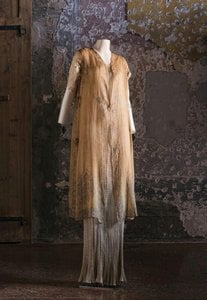
In the realm of textile art, few pieces command the same reverence as Mariano Fortuny’s 1930 masterpiece, ‘Cape.’ This is not merely a garment; it is a profound reimagining of theatrical presentation and a masterful fusion of historical inspiration with avant-garde technique. To behold this work is to witness a moment where fashion transcends utility to become pure sculpture. The piece embodies a sophisticated dialogue between the weight of history and the lightness of innovation, making it an essential inspiration for collectors and designers who seek to infuse their spaces with a sense of storied grandeur.
The soul of the ‘Cape’ lies in its ability to reinterpret antiquity through a modern lens. Fortuny, a true polymath, drew deep inspiration from Greco-Roman mythology, specifically evoking the dramatic drapery associated with Zeus during the siege of Mount Olympus. By translating these epic narratives into fabric, he transformed a mannequin into a conduit for mythological grandeur. The garment serves as a visual spectacle where the heavy, luxurious velvet of the collar and hood meets the ethereal, delicate patterns of a lace-like overlay. This deliberate juxtaposition creates a captivating interplay of surfaces, inviting the eye to wander through layers of texture and light.
Technique is the heartbeat of this work. Fortuny was as much an inventor as he was a designer, and his mastery over material is evident in every fold of the ‘Cape.’ The way the dark, sumptuous velvet absorbs light stands in stark contrast to the translucent, patterned overlay that allows glimpses of the form beneath to emerge like a half-remembered dream. This interplay mirrors Fortuny’s revolutionary work with the cyclorama dome, where he used reflected light to create seamless, immersive environments in theater. In this piece, the fabric itself acts as a stage, performing a silent drama of shadow and brilliance.
For the interior designer or art enthusiast, the ‘Cape’ offers a rich palette of textures that can elevate any setting. The verticality of the pleated skirt provides a rhythmic stability, while the organic, flowing lines of the draped coat introduce a sense of movement. It is a study in balance—the heavy against the light, the structured against the fluid. This complexity makes a high-quality reproduction of such a work an extraordinary focal point, capable of anchoring a room with its profound sense of craftsmanship and historical weight.
Beyond its physical attributes, the ‘Cape’ carries an emotional resonance that speaks to the enduring human desire for beauty and transcendence. It evokes a sense of timelessness, bridging the gap between the ancient world and the modern era. There is a certain mystery held within its folds, a whisper of the aristocratic intrigue and theatrical magic that defined Fortuny’s life in Venice. To possess or display an homage to this work is to celebrate the spirit of the alchemist of aesthetics—an artist who refused to see boundaries between fashion, stagecraft, and fine art.
Whether integrated into a curated gallery collection or used as a sophisticated element in high-end decor, the ‘Cape’ remains a symbol of refined beauty. It invites viewers to contemplate the intersection of memory and innovation, making it a timeless investment for those who appreciate art that does not merely decorate a space, but breathes life and narrative into it.


1871 - 1949 , Spanien

 Versenden
 Teilen
 Details anzeigen

 Herunterladen
 Ähnliche Objekte
 Diashow


 Weiterlesen