In echtem Maßstab anzeigen In AR an der Wand sehen Handgemalte Reproduktion kaufen Zum digitalen Bild wechseln Versenden als Grußkarte
Details anzeigen Leitfaden öffnen Zu Favoriten hinzufügen Herunterladen Ähnliche Objekte Röntgenaufnahme Diashow Besucherstatistiken

Untitled

Experience the vibrant energy of Karel Appel's COBRA masterpiece; this abstract burst of color captures raw instinct from 1960—discover your own artistic freedom.

Entdecken Sie Karel Appel, niederländischen Maler & Bildhauer und Mitbegründer der CoBrA-Bewegung! Erleben Sie seine kühne, ausdrucksstarke Kunst voller poetischem Geist.

Die auf dieser Seite dargestellten Kunstwerke sind urheberrechtlich geschützt, was bedeutet, dass wir keine identische Reproduktion rechtmäßig erstellen oder verkaufen dürfen. Dieser Schutz wird durch internationale Abkommen wie die Berner Übereinkunft und durch nationale Gesetze, einschließlich derer, die von den ... festgelegt wurden US-Urheberrecht – Titel 17.

Diese Methode entspricht vollumfänglich den Urheberrechtsbestimmungen, da sie keine Kopie oder Vervielfältigung des geschützten Kunstwerks darstellt. Stattdessen handelt es sich um eine kreative Neuinterpretation – ein neues Gemälde, das vom Original inspiriert, aber nicht identisch mit ihm ist.

Giclée / Kunstdruck

Giclée- oder Leinwanddruck in Museumsqualität mit schneller Produktion und flexiblen Veredelungsoptionen. ( Handgemalte Reproduktion kaufen Zum digitalen Bild wechseln)

Corner sample of the P118B picture frame: formgepresstes Polystyrol, 5 cm wide and 3 cm thick
P118B €10
Corner sample of the P118H picture frame: formgepresstes Polystyrol, 5 cm wide and 3 cm thick
P118H €10
Corner sample of the P118W picture frame: formgepresstes Polystyrol, 5 cm wide and 3 cm thick
P118W €10
Corner sample of the P438Z picture frame: formgepresstes Polystyrol, 5.5 cm wide and 3.5 cm thick
P438Z €10
Corner sample of the P508JH picture frame: formgepresstes Polystyrol, 7 cm wide and 3.5 cm thick
P508JH €12
Corner sample of the P508YH picture frame: formgepresstes Polystyrol, 7 cm wide and 3.5 cm thick
P508YH €12
Corner sample of the P805H picture frame: formgepresstes Polystyrol, 5 cm wide and 3.5 cm thick
P805H €10
Corner sample of the P805Z picture frame: formgepresstes Polystyrol, 5 cm wide and 3.5 cm thick
P805Z €10
Corner sample of the P919BZ picture frame: formgepresstes Polystyrol, 7 cm wide and 3.5 cm thick
P919BZ €10
Corner sample of the P919G picture frame: formgepresstes Polystyrol, 7 cm wide and 3.5 cm thick
P919G €10
Corner sample of the P919XJ picture frame: formgepresstes Polystyrol, 7 cm wide and 3.5 cm thick
P919XJ €10
Corner sample of the P959ZH picture frame: formgepresstes Polystyrol, 5 cm wide and 3 cm thick
P959ZH €10
Corner sample of the P968JZ picture frame: formgepresstes Polystyrol, 6 cm wide and 4 cm thick
P968JZ €12
Corner sample of the W106C picture frame: Massivholz, 5 cm wide and 3 cm thick
W106C €8
Corner sample of the W218G picture frame: Massivholz, 5 cm wide and 3 cm thick
W218G €10
Corner sample of the W218JH picture frame: Massivholz, 5 cm wide and 3 cm thick
W218JH €8
Corner sample of the W218Y picture frame: Massivholz, 5 cm wide and 3 cm thick
W218Y €10
Corner sample of the W307PJ picture frame: Massivholz, 6 cm wide and 3 cm thick
W307PJ €10
Corner sample of the W316G picture frame: Massivholz, 6 cm wide and 3 cm thick
W316G €10
Corner sample of the W316PJ picture frame: Massivholz, 6 cm wide and 3 cm thick
W316PJ €8
Corner sample of the W316Y picture frame: Massivholz, 6 cm wide and 3 cm thick
W316Y €10
Corner sample of the W398PJ picture frame: Massivholz, 5 cm wide and 3 cm thick
W398PJ €8
Corner sample of the W4111J picture frame: Massivholz, 6.5 cm wide and 3.5 cm thick
W4111J €10
Corner sample of the W500HY picture frame: Massivholz, 7 cm wide and 5 cm thick
W500HY €15
Corner sample of the W500JH picture frame: Massivholz, 7 cm wide and 5 cm thick
W500JH €15
Corner sample of the W692G picture frame: Massivholz, 8 cm wide and 4 cm thick
W692G €12
Corner sample of the W849H picture frame: Massivholz, 5 cm wide and 3 cm thick
W849H €8
Corner sample of the W940BG picture frame: Massivholz, 7.5 cm wide and 4.5 cm thick
W940BG €15
Corner sample of the W953PJ picture frame: Massivholz, 6 cm wide and 3.5 cm thick
W953PJ €8

Standardformat
individuell anpassbar
CM
INCH

Wählen Sie aus unseren vordefinierten Formaten, die den ursprünglichen Proportionen des Kunstwerks entsprechen.

Breite
Höhe

Sie können Ihre eigenen Maße eingeben, um ein bestimmtes Format oder einen speziellen Platz einzupassen. Wenn das von Ihnen gewählte Format nicht den Proportionen des Originalbildes entspricht, werden wir das Kunstwerk entweder beschneiden oder das Bild mit einem gespiegelten oder einfarbigen Rand erweitern. Ein digitaler Entwurf wird Ihnen zur Genehmigung zugesandt, bevor die Produktion beginnt.
Bitte beachten Sie, dass die Vorschau auf dem Bildschirm nicht den tatsächlichen Zuschnitt oder die Erweiterung widerspiegelt. Nur der Entwurf zeigt die endgültige Komposition präzise an.
Obwohl Sondermaße verfügbar sind, empfehlen wir die Auswahl eines Maßes aus der vordefinierten Liste, um die ursprünglichen Proportionen zu bewahren.

Weltweiter Versand () innerhalb von 2 Wochen statt der üblichen 4/5 Wochen. (11 Oktober)

Kostenloser weltweiter Expressversand
Hochwertige Leinenleinwand
Vollständiger Versicherungsschutz beim Versand
Zollgebühren-Rückerstattungsgarantie
Garantie für exakte Farbtreue
100-tägiges Rückgaberecht (nur bei Mängeln)
100% Geld-zurück-Garantie
Angebot für Mengenrabatt

Gesamtpreis

€ 59

Untitled

Giclée / Kunstdruck

Format der Reproduktion

-

Gesamtpreis

€ 59

Kurzübersicht

  • Notable elements or techniques: Gestural forms, Layered texture
  • Subject or theme: Organic shapes
  • Location: Private Collection
  • Title: Untitled
  • Artistic style: Abstract Expressionism

Kunst-Quiz

Jede Frage hat nur eine richtige Antwort.

Frage 1:
What avant-garde movement is Karel Appel strongly associated with for this artwork?
Frage 2:
Which element of the artwork's composition is described as eschewing traditional perspective?
Frage 3:
According to the description, what emotion is often symbolized by the color yellow in Appel's work?
Frage 4:
What type of forms populate the artwork, described as rounded and organic, reminiscent of natural elements?
Frage 5:
What medium is the artwork most likely to be, given the visible layering and texture?

A Symphony of Spontaneity: The Primal Energy of Karel Appel

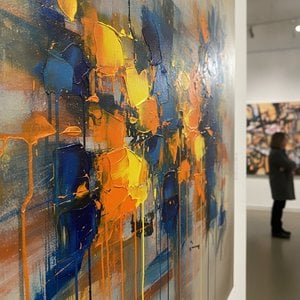
In the landscape of post-war European modernism, few voices resonate with as much raw, unbridled vitality as that of Karel Appel. His 1960 work, Untitled, serves as a breathtaking manifesto of the COBRA movement, an avant-garde collective that sought to strip away the suffocating layers of academic tradition in favor of something far more primal. To encounter this piece is to witness a deliberate rebellion; it is not merely a composition of pigment on paper, but an explosion of instinctual expression. The artwork captures a moment where the artist’s hand moves with the freedom of a child, yet carries the profound weight of a man navigating a world recovering from the shadows of conflict. Through its vibrant palette and gestural urgency, the work invites the viewer into a realm where emotion dictates form, and where the boundaries between the creator and the canvas dissolve into pure, rhythmic motion.

The visual language of this masterpiece is defined by its biomorphic forms—organic, rounded shapes that seem to pulse with an internal life force. There is no rigid geometry here, nor any attempt at traditional perspective; instead, Appel utilizes an asymmetrical arrangement where colors and shapes overlap in a dance of beautiful chaos. The palette is nothing short of celebratory, dominated by sun-drenched yellows, deep oceanic blues, and fiery reds, all anchored by bold strokes of black and punctuated by flashes of orange and white. These colors are not merely decorative choices but are deeply symbolic; the yellow radiates an infectious optimism, while the blue offers a moment of contemplative stillness amidst the surrounding energy. This interplay of hues creates a complex textural landscape, where the visible layering of the printmaking process suggests a tactile depth that draws the eye into a continuous, wandering exploration.

Historical Resonance and Interior Inspiration

To understand the soul of this work, one must look to the historical heartbeat of the COBRA movement. Born from a desire to break free from the constraints of Surrealism and Cubism, Appel and his contemporaries looked toward the "primitive"—finding profound inspiration in African masks, tribal art, and the uninhibably honest drawings of children. This 1960 print embodies that search for authenticity, rejecting meticulous representation in favor of intuition and gesture. The technique, likely a screenprint or lithograph, allows for a fascinating tension between the flatness of the medium and the perceived movement of the brushstrokes. Each layer of ink contributes to a sense of immediacy, as if the artist’s energetic movements were captured in mid-motion, frozen forever in a state of becoming.

For the discerning collector or interior designer, this artwork offers more than just visual interest; it provides a transformative emotional atmosphere. Its lack of a singular focal point allows it to integrate seamlessly into sophisticated modern environments, acting as a dynamic anchor in a room. In a minimalist setting, its bold colors can provide a much-needed burst of life and character, while in a more eclectic space, it serves as a testament to the enduring power of the avant-garde. Owning a high-quality reproduction of this piece is an invitation to live alongside a fragment of art history—a piece that celebrates the joy of existence, the beauty of imperfection, and the eternal, restless spirit of human creativity.

Fragen & Antworten

Wie kann ich eine Reproduktion von "Untitled" von Karel Appel in der Vorschau ansehen?

Auf der Vorschau-Seite von „Untitled“ können Sie das Kunstwerk vor der Bestellung in einer Vorschau betrachten.

Ist "Untitled" im Heimatland seines Künstlers verblieben?

Nein – das Kunstwerk wird im Ausland aufbewahrt. Das Geburtsland des Künstlers ist Niederlande, und das Museum, das das Original beherbergt, befindet sich in Vereinigtes Königreich.

Kann ich "Untitled" als Vollbild-Diashow ansehen?

"Untitled" von Karel Appel kann als Diashow auf der Diashow-Seite des Kunstwerks betrachtet werden.

Verwendet "Untitled" von Karel Appel starke Kontraste oder sanfte Harmonien?

Die Farbkomposition von "Untitled" von Karel Appel vereint einen Statement Kontrast mit einer Balanced Harmony Harmonie.

Wofür wird eine Reproduktion von "Untitled" von Karel Appel empfohlen?

Die empfohlene Verwendung eines Drucks von „Untitled“ ist Accent.

In welcher Beziehung stehen die Farben von "Untitled" von Karel Appel zu dessen emotionaler Wirkung?

In "Untitled" begleiten Neutrals-Farben ein Joyful Gefühl.

Wo kann ich das Original von "Untitled" von Karel Appel sehen?

Das Original von "Untitled" von Karel Appel befindet sich im Tate Britain, London, Vereinigtes Königreich. Eine Reproduktion ermöglicht es, das Werk zu Hause auszustellen.

Welche Gemeinsamkeiten weist "Untitled" mit dem restlichen Werk von Karel Appel auf?

"Untitled" gehört zu Karel Appels Werk der COBRA Expressionism-Epoche, dessen dokumentierte Themen unter anderem expressionist roots, organic forms exploration, bold color dialogue, rejection formal norms, central cobra vision umfassen.


Biografie des Künstlers

Frühes Leben und Ausbildung

  • Geboren: 25. April 1921, Amsterdam, Niederlande
  • Gestorben: 3. Mai 2006, Zürich, Schweiz
  • Eltern: Jan Appel (Barbier), Johanna Chevalier (Nachfahrin französischer Hugenotten)
  • Früher Spitzname: 'Kik'
  • Erste Malerei im Alter von vierzehn Jahren: Stillleben eines Obstkorbs.
  • Erhielt mit fünfzehn Jahren ein Malkasten und Staffelei von seinem Onkel Karel Chevalier, der ihm auch frühe Kunstunterrichte gab.
  • Studierte an der Rijksakademie van Beeldende Kunsten in Amsterdam (1940-1943) während der deutschen Besetzung. Traf dort die Künstler Corneille und Constant, mit denen er lebenslange Freundschaften schloss.
  • Verließ das Elternhaus aufgrund des Widerstands seiner Eltern gegen seine künstlerischen Bestrebungen und um einer Zwangsarbeit durch die deutsche Polizei zu entgehen.

Die CoBrA-Bewegung und künstlerische Entwicklung

  • Erste Ausstellung in Groningen (1946).
  • Bedeutliche Teilnahme an der Ausstellung im Stedelijk Museum Amsterdam 1949, was Kontroversen und öffentliche Debatten auslöste.
  • Einflüsse: Pablo Picasso, Henri Matisse, Jean Dubuffet.
  • Begann 1947 mit dem Bildhauerei unter Verwendung von gefundenen Materialien (Assemblagetechnik) und malte diese in leuchtenden Farben wie Weiß, Rot, Gelb, Blau und Schwarz.
  • Trug der Experimentellen Gruppe mit Anton Rooskens, Theo Wolvecamp und Jan Nieuwenhuys bei; später stieß Hugo Claus hinzu.
  • Mitbegründer von CoBrA (Kopenhagen, Brüssel, Amsterdam) 1948 zusammen mit Corneille, Constant, Jan Nieuwenhuys und Christian Dotremont.
  • Der künstlerische Stil von CoBrA betonte Spontanität, kindliche Bildsprache und eine Ablehnung traditioneller Kunstkonventionen. Inspiriert von dänischer und nordischer Mythologie.
  • Schuf das umstrittene Wandgemälde "Fragende Kinder" (1949) für das Amsterdamer Rathaus, das aufgrund öffentlicher Empörung später abgedeckt wurde.

Internationale Anerkennung und Späteres Schaffen

  • Zog 1950 nach Paris um, nachdem er in den Niederlanden negative Reaktionen auf CoBrA erfahren hatte.
  • Entwickelte einen internationalen Ruf durch Reisen nach Mexiko, die USA, Jugoslawien und Brasilien.
  • Lebte und arbeitete in New York City und Florenz.
  • Erste amerikanische Galerieausstellung in der Martha Jackson Gallery (1954).
  • Das Gemälde "Kind und Tier II" (1951) wurde in der einflussreichen Ausstellung des Museum of Modern Art “The New Decade” (1955) gezeigt.
  • Bekannt für seine Wandmalereien.
  • Erlebte nach 1990 eine Wiederbelebung seiner Popularität in den Niederlanden, mit wichtigen Ausstellungen in Amsterdam und Brüssel, die von Rudy Fuchs organisiert wurden.

  • Seine Werke wurden prominent im CoBrA Museum in Amstelveen gezeigt.

Vermächtnis und Anerkennung

  • Gründete die Karel-Appel-Stiftung, um seine Kunstwerke zu bewahren und das öffentliche Bewusstsein für sein Werk zu fördern.
  • Erlebte 2002 einen vorübergehenden Verlust seiner Kunstwerke, die jedoch 2012 wiedergefunden wurden.
  • Die Karel-Appel-Stiftung dient als sein offizielles Nachlass und Bildarchiv.
  • U.S.-Urheberrechtsvertreter der Stiftung ist The Artists Rights Society.
  • Appels Werk wird weiterhin international ausgestellt und stellt einen bedeutenden Beitrag zur europäischen Kunst nach dem Zweiten Weltkrieg dar, insbesondere innerhalb der CoBrA-Bewegung.
Karel Appel

Karel Appel

1921 - 2006 , Niederlande

Eckdaten zum Künstler

  • Bemerkenswerte Werke:
    • Kind und Tier II (1951)
    • Fragende Kinder
  • Einflüsse:
    • Pablo Picasso
    • Henri Matisse
    • Jean Dubuffet
  • Geburtsdatum: 25. April 1921
  • Geburtsort: Amsterdam, Niederlande
  • Künstlerische Bewegung: CoBrA, abstrakter Expressionismus
  • Nationalität: Niederländisch
  • Todatum: 3. Mai 2006
  • Vollständiger Name: Christiaan Karel Appel