x
Handgemaltes Ölgemälde auf Leinwand in Ihrer Wunschgröße und mit Rahmen, auf Bestellung von unseren Künstlern angefertigt.
Wählen Sie aus unseren vordefinierten Größen, die den ursprünglichen Proportionen des Kunstwerks entsprechen.
Sie können Ihre eigenen Maße eingeben, um einen bestimmten Rahmen oder Platz auszufüllen. Wenn die gewählte Größe nicht den Proportionen des Originalbildes entspricht, werden wir das Kunstwerk entweder beschneiden oder das Gemälde durch zusätzliche, handgemalte Elemente erweitern. Ein digitales Mockup wird Ihnen zur Genehmigung zugesandt, bevor die Produktion beginnt.
Bitte beachten Sie, dass die Bildschirmvorschau nicht die tatsächliche Beschneidung oder Erweiterung widerspiegelt. Nur das Mockup zeigt die endgültige Komposition exakt an.
Obwohl Sondermaße verfügbar sind, empfehlen wir, eine Größe aus der vordefinierten Liste zu wählen, um die ursprünglichen Proportionen beizubehalten.
Weltweiter Versand () in nur 3 bis 4 Wochen statt der üblichen 5 Wochen. (2 Juli). Keine Kompromisse bei der Qualität.
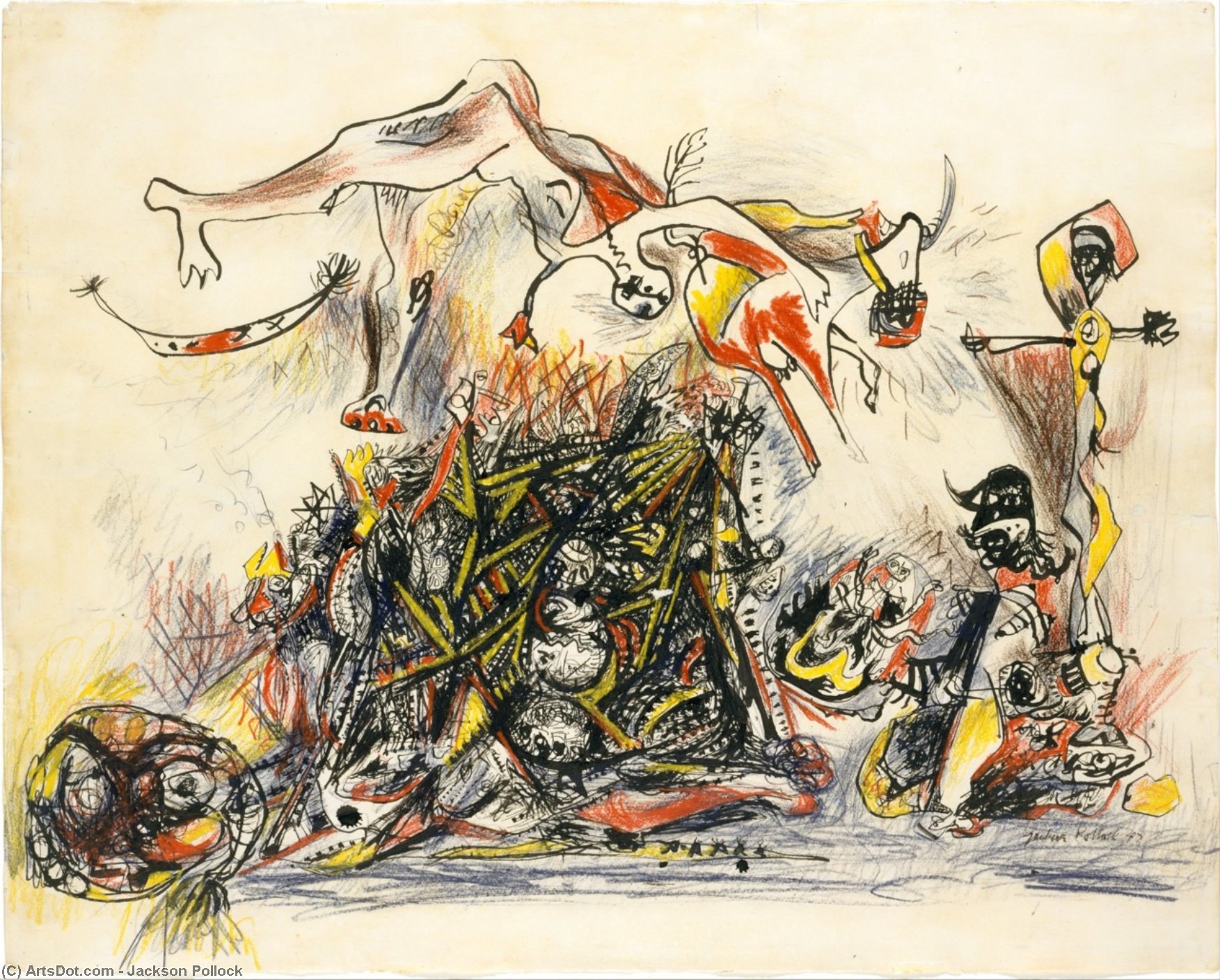
Krieg
Größe der Reproduktion
Jackson Pollock's "War," painted in 1947, isn’t merely a canvas splashed with color; it’s a visceral embodiment of the anxieties and turmoil gripping the post-war world. This monumental work, a cornerstone of Abstract Expressionism, transcends simple representation to become a raw, unfiltered expression of conflict – not just on a battlefield, but within the human psyche itself. The painting immediately assaults the viewer with its chaotic composition: a swirling vortex of black, red, and yellow paint, applied through Pollock’s signature “drip” technique. This method, developed over years of experimentation, involved pouring, dripping, and splattering paint directly onto the canvas laid on the floor, allowing the artist to become fully immersed in the act of creation – a process that mirrored the frenzied energy he sought to convey.
The genesis of “War” is deeply intertwined with the historical context of its time. Created in the immediate aftermath of World War II, a conflict marked by unprecedented devastation and moral ambiguity, the painting reflects a profound sense of unease and disillusionment. Pollock himself was grappling with personal demons – alcoholism and emotional instability – which undoubtedly fueled the intensity of his work. However, “War” isn’t simply a portrait of personal struggle; it's a broader commentary on the destructive nature of violence and the fragility of human existence. The fragmented figures, barely discernible amidst the swirling paint, evoke a sense of loss and disintegration—a visual representation of shattered lives and broken promises.
To understand “War,” it’s crucial to grasp the principles of Abstract Expressionism, the movement Pollock spearheaded. Emerging in New York during the 1940s and 50s, this style rejected traditional artistic conventions – perspective, realism, and narrative storytelling—in favor of subjective emotion and spontaneous expression. Artists like Mark Rothko and Lee Krasner, contemporaries of Pollock, similarly explored themes of existential angst and psychological depth through non-objective forms. Pollock’s drip technique was a radical departure from established painting methods, prioritizing the process of creation over the finished product. The act of painting itself became the subject matter, with each brushstroke—or rather, each drop—carrying significant emotional weight.
The influence of Surrealism is also evident in “War.” Like many Surrealist artists, Pollock sought to tap into the unconscious mind, believing that art could reveal hidden truths and anxieties. The distorted figures and unsettling imagery suggest a descent into a dreamlike state, mirroring the psychological turmoil experienced during wartime. Furthermore, echoes of Picasso’s “Guernica” – another powerful depiction of war's horrors – can be discerned in the painting’s overall composition and thematic concerns.
While Pollock famously resisted providing definitive interpretations of his work, "War" is rich with symbolic imagery. The prominent figure on the right, partially obscured by swirling paint, is often interpreted as a representation of Christ on the cross—a poignant symbol of sacrifice and suffering. The presence of a bull, a recurring motif in Pollock’s oeuvre, adds another layer of complexity. Bulls have historically represented both strength and aggression, embodying primal instincts and destructive forces. The inclusion of human figures, fragmented and barely recognizable, underscores the dehumanizing effects of war and violence.
The color palette—primarily black, red, and yellow—further enhances the painting’s emotional impact. Black represents death, despair, and oblivion, while red symbolizes blood, passion, and destruction. Yellow, often associated with hope and renewal, offers a fleeting glimmer of light amidst the darkness. The interplay of these colors creates a dynamic tension that mirrors the conflicting emotions evoked by the subject matter.
WahooArt offers meticulously crafted, hand-painted reproductions of Jackson Pollock’s “War,” allowing you to bring this iconic masterpiece into your home or office. These reproductions capture not only the painting's visual impact but also its emotional depth and historical significance. Each reproduction is created by skilled artists who painstakingly recreate Pollock’s unique drip technique, ensuring an authentic representation of this seminal work of art. Investing in a WahooArt reproduction of “War” is more than just acquiring a beautiful piece of art; it’s a connection to a pivotal moment in modern history and a testament to the enduring power of artistic expression.
To explore other Abstract Expressionist masterpieces, including works by Mark Rothko and Clyfford Still, visit our Art Movements Timeline. For more information about Jackson Pollock’s life and work, please visit Jackson Pollock: War on WahooArt.
Paul Jackson Pollock stands as a monumental figure in the annals of 20th-century art, irrevocably altering perceptions of artistic creation and establishing New York City as a dominant force within the global art landscape. Born January 28, 1912, in Cody, Wyoming—the youngest of five children—Pollock’s formative years were characterized by constant relocation as his father pursued work as a land surveyor across the expansive American West. This itinerant upbringing instilled in him an indelible connection to the natural world and exposed him to diverse cultural traditions – impressions that would subtly shape his artistic sensibilities throughout his life.
His formal artistic education commenced at Dawson Public School in Vancouver, British Columbia, followed by studies at the Art Students League of New York under the guidance of Thomas Hart Benton. Benton’s emphasis on rhythmic composition and narrative themes rooted in American experience profoundly influenced Pollock's early stylistic explorations. Recognizing Benton’s contribution to regionalist art, Pollock embraced his mentor’s vision for artistic expression.
However, it was during the mid-1930s that Pollock embarked upon a transformative journey toward artistic innovation. Rejecting conventional brushwork and seeking alternative methods of pigment application, he experimented with various techniques—including encaustic painting—before arriving at what would become his signature approach: drip painting.
Around 1947, Pollock revolutionized the art world by abandoning the easel altogether. He laid canvases directly on the floor and initiated a process that defied traditional artistic conventions. Instead of applying paint with brushes, he dripped, splashed, and flung pigment onto the surface from above—a technique dubbed “all-over painting” – capturing the spontaneity and physicality of his creative impulses.
This groundbreaking method wasn’t merely about applying color; it was about embodying the act of artistic creation itself. Pollock's canvases became arenas for physical expression, mirroring his movements and emotions as he worked. The resulting paintings are characterized by their expansive compositions—a deliberate rejection of centralized focal points—inviting viewers to engage with the entire surface as a unified field of energy.
Influenced by Surrealist artists like André Masson and Max Ernst, Pollock explored psychological symbolism and subconscious imagery in his work. He sought to tap into universal archetypes and primal energies, mirroring the broader cultural shift away from rationalism toward embracing intuition and emotion.
Pollock’s most iconic creations—such as Number 1, 1950 (Lavender Mist), One: Number 31, 1950, Blue Poles: Number 11, 1952, and Convergence—remain unparalleled testaments to his revolutionary technique. These canvases exemplify the essence of Action Painting, capturing the immediacy of Pollock’s gestures and emotions on canvas.
Despite initial skepticism from some critics who questioned the aesthetic merit of his method, Pollock's reputation soared after his untimely death August 11, 1956, in an alcohol-related automobile accident. His legacy endured through a monumental retrospective exhibition at MoMA in 1956 and subsequently honored with large-scale retrospectives at Tate Britain in London in 1998 and 1999—confirming his status as one of the most influential artists of the century.
1912 - 1956 , Vereinigte Staaten von Amerika
Erzählen Sie uns von Ihrem Projekt und unsere Kunstexperten erstellen für Sie 3 personalisierte Kunstvorschläge.
Wir kuratieren 3 Optionen exklusiv für Sie – kostenlos!