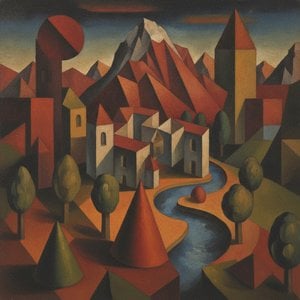
Fernand Léger’s “Two Men”: A Study in Modern Connection
Fernand Léger’s “Two Men” stands as a cornerstone of modernist painting, embodying the spirit of Tubism and capturing a poignant glimpse into the anxieties and aspirations of the early 20th century. This striking black and white photograph doesn't merely depict two figures; it presents an exploration of human connection amidst the burgeoning influence of industrialization – a theme that resonates powerfully even today. The artwork’s subtle gestures and geometric forms invite contemplation on time, presence, and the beauty found in simplicity.
Stylistic Innovation: Tubism & Beyond
Léger revolutionized painting with his development of Tubism, a distinctive offshoot of Cubism that deliberately rejected fragmentation for more streamlined cylindrical shapes. Unlike Picasso and Braque’s fractured perspectives, Léger sought to distill form to its essence, prioritizing solidity and monumentality. “Two Men” exemplifies this approach brilliantly. Notice how the figures are constructed from bold lines and geometric volumes—a deliberate departure from traditional realism—creating a visual language that anticipates elements of Pop Art with its focus on everyday life and industrial aesthetics. The artist’s intention wasn't to represent reality accurately but rather to convey an emotional truth through abstracted shapes.
Historical Context: The Machine Age & Human Connection
Created during the tumultuous period of the Machine Age, “Two Men” reflects Léger’s fascination with technological advancement while simultaneously grappling with its impact on human experience. Léger wasn't simply documenting the changing landscape; he was wrestling with questions about identity and purpose in a world increasingly dominated by machines. The painting subtly communicates this tension—the figures are positioned within a room, defined not just by space but also by their interaction, suggesting that even amidst mechanization, human connection remains paramount. Léger’s artistic vision stemmed from his formative years spent working as an agricultural laborer, providing him with a grounding perspective on the realities of rural life and contrasting it with the dynamism of the industrial future he sought to portray.
Decoding the Symbolism
The symbolism embedded within “Two Men” is multilayered and open to interpretation, enriching its aesthetic impact. The prominent clock hanging above the figures serves as a visual reminder of mortality—a preoccupation common in art during this era—but also hints at the pressure of modern life’s relentless pace. More profoundly, the gesture of one man's hand resting gently on the other’s arm speaks volumes about companionship and support. This quiet moment captures the essence of human connection, conveying tenderness and reassurance amidst a backdrop of geometric abstraction. Léger skillfully utilizes these symbols to elevate the painting beyond mere visual representation, inviting viewers to contemplate deeper themes of existence and relationships.
A Legacy of Bold Vision
Fernand Léger’s “Two Men” remains an enduring testament to his artistic genius—a pioneering work that foreshadowed movements like Pop Art and solidified his place as one of the most influential figures in 20th-century art history. Its simplicity, combined with its masterful use of Tubism's geometric language, continues to inspire artists and collectors alike, ensuring that Léger’s vision of a harmonious blend between human emotion and industrial form endures for generations to come.
Fragen & Antworten
Welche Farbpalette wird in "Zwei Männer" von Fernand Léger verwendet?
Die Farbpalette von "Zwei Männer" von Fernand Léger wird als Neutrale Töne beschrieben. Es handelt sich um eine kompakte Beschreibung der Farben des Werkes.
Welche Stimmung und welche Emotion vermittelt "Zwei Männer" von Fernand Léger?
Die festgehaltene Stimmung von "Zwei Männer" von Fernand Léger ist Zeitgenössisch minimalistisch, und ihr emotionaler Tonfall ist Gelassen.
Kann man "Zwei Männer" von Fernand Léger als Diashow ansehen?
Das Diaporama zu „Zwei Männer“ finden Sie auf der Diashow-Seite des Kunstwerks.



 Vorschau anzeigen
 Zum Druck wechseln
 Versenden
 Teilen
 Details anzeigen
 Leitfaden

 Herunterladen
 Ähnliche Objekte
 Röntgenaufnahme
 Diashow
 Q&A
Q&A Statistiken
 Weiterlesen






































 Die Glasoption ist nur für Größen unter 110 cm verfügbar.