In echtem Maßstab anzeigen In AR an der Wand sehen Zum Druck wechseln Zum digitalen Bild wechseln Versenden als Grußkarte
Details anzeigen Leitfaden öffnen Zu Favoriten hinzufügen Herunterladen Ähnliche Objekte Röntgenaufnahme Diashow Besucherstatistiken

Trouville

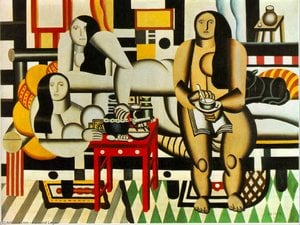
Trouville von Fernand Léger: Ein dynamisches Schwarzweiß-Bild zum Stadtleben im Stil des Kubismus und Expressionismus. Entdecken Sie dieses beeindruckende Kunstwerk auf WikiArt!

Erkunden Sie die Kunst von Fernand Léger (1881-1955), einem Pionier des Kubismus und der 'Tubism'. Entdecken Sie seine mutigen, figurativen Gemälde, die das moderne Leben, Maschinen und die menschliche Form feiern. Ein Vorläufer des Pop Art!

Handgefertigte Ölreproduktion

Handgemaltes Ölgemälde auf Leinwand in Ihrer Wunschgröße und mit Rahmen, auf Bestellung von unseren Künstlern angefertigt. ( Zum Druck wechseln Zum digitalen Bild wechseln)

Corner sample of the P118B picture frame: moulded polystyrene, 5 cm wide and 3 cm thick
P118B 10
Corner sample of the P118H picture frame: moulded polystyrene, 5 cm wide and 3 cm thick
P118H 10
Corner sample of the P118W picture frame: moulded polystyrene, 5 cm wide and 3 cm thick
P118W 10
Corner sample of the P438Z picture frame: moulded polystyrene, 5.5 cm wide and 3.5 cm thick
P438Z 10
Corner sample of the P508JH picture frame: moulded polystyrene, 7 cm wide and 3.5 cm thick
P508JH 12
Corner sample of the P508YH picture frame: moulded polystyrene, 7 cm wide and 3.5 cm thick
P508YH 12
Corner sample of the P805H picture frame: moulded polystyrene, 5 cm wide and 3.5 cm thick
P805H 10
Corner sample of the P805Z picture frame: moulded polystyrene, 5 cm wide and 3.5 cm thick
P805Z 10
Corner sample of the P919BZ picture frame: moulded polystyrene, 7 cm wide and 3.5 cm thick
P919BZ 10
Corner sample of the P919G picture frame: moulded polystyrene, 7 cm wide and 3.5 cm thick
P919G 10
Corner sample of the P919XJ picture frame: moulded polystyrene, 7 cm wide and 3.5 cm thick
P919XJ 10
Corner sample of the P959ZH picture frame: moulded polystyrene, 5 cm wide and 3 cm thick
P959ZH 10
Corner sample of the P968JZ picture frame: moulded polystyrene, 6 cm wide and 4 cm thick
P968JZ 12
Corner sample of the W106C picture frame: solid wood, 5 cm wide and 3 cm thick
W106C 8
Corner sample of the W218G picture frame: solid wood, 5 cm wide and 3 cm thick
W218G 10
Corner sample of the W218JH picture frame: solid wood, 5 cm wide and 3 cm thick
W218JH 8
Corner sample of the W218Y picture frame: solid wood, 5 cm wide and 3 cm thick
W218Y 10
Corner sample of the W307PJ picture frame: solid wood, 6 cm wide and 3 cm thick
W307PJ 10
Corner sample of the W316G picture frame: solid wood, 6 cm wide and 3 cm thick
W316G 10
Corner sample of the W316PJ picture frame: solid wood, 6 cm wide and 3 cm thick
W316PJ 8
Corner sample of the W316Y picture frame: solid wood, 6 cm wide and 3 cm thick
W316Y 10
Corner sample of the W398PJ picture frame: solid wood, 5 cm wide and 3 cm thick
W398PJ 8
Corner sample of the W4111J picture frame: solid wood, 6.5 cm wide and 3.5 cm thick
W4111J 10
Corner sample of the W500HY picture frame: solid wood, 7 cm wide and 5 cm thick
W500HY 15
Corner sample of the W500JH picture frame: solid wood, 7 cm wide and 5 cm thick
W500JH 15
Corner sample of the W692G picture frame: solid wood, 8 cm wide and 4 cm thick
W692G 12
Corner sample of the W849H picture frame: solid wood, 5 cm wide and 3 cm thick
W849H 8
Corner sample of the W940BG picture frame: solid wood, 7.5 cm wide and 4.5 cm thick
W940BG 15
Corner sample of the W953PJ picture frame: solid wood, 6 cm wide and 3.5 cm thick
W953PJ 8

Standardformat
individuell anpassbar
CM
INCH

Wählen Sie aus unseren vordefinierten Formaten, die den ursprünglichen Proportionen des Kunstwerks entsprechen.

Breite
Höhe

Sie können Ihre eigenen Maße eingeben, um einen bestimmten Rahmen oder Platz auszufüllen. Wenn die gewählte Größe nicht den Proportionen des Originalbildes entspricht, werden wir das Kunstwerk entweder beschneiden oder das Gemälde durch zusätzliche, handgemalte Elemente erweitern. Ein digitales Mockup wird Ihnen zur Genehmigung zugesandt, bevor die Produktion beginnt.
Bitte beachten Sie, dass die Bildschirmvorschau nicht die tatsächliche Beschneidung oder Erweiterung widerspiegelt. Nur das Mockup zeigt die endgültige Komposition exakt an.
Obwohl Sondermaße verfügbar sind, empfehlen wir, eine Größe aus der vordefinierten Liste zu wählen, um die ursprünglichen Proportionen beizubehalten.

Beispiele für Anpassungsmöglichkeiten: Gesicht durch Kundenfoto ersetzen; Haustier hinzufügen (z. B. Katze durch Hund ersetzen); eine versteckte Nachricht im Hintergrund einfügen; Hintergrundlandschaft oder -elemente ändern.
Nach der Bestellung wird das WahooArt.com-Team dem Kunden Anweisungen per E-Mail zusenden und eine Mockup-Vorschau bereitstellen.

Weltweiter Versand () in nur 3 bis 4 Wochen statt der üblichen 5 Wochen. (10 Oktober). Keine Kompromisse bei der Qualität.

Kostenloser weltweiter Expressversand
Hochwertige Leinenleinwand
Vollständiger Versicherungsschutz beim Versand
Zollgebühren-Rückerstattungsgarantie
Garantie für exakte Farbtreue
100-tägiges Rückgaberecht (nur bei Mängeln)
100% Geld-zurück-Garantie
Angebot für Mengenrabatt

Gesamtpreis

€ 234

Trouville

Reproduktionsmedium

Format der Reproduktion

-

Gesamtpreis

€ 234

Kurzübersicht

  • Location: Georges Pompidou Center, Paris
  • Subject or theme: Urban landscape
  • Influences: Futurism
  • Medium: Oil on canvas
  • Artistic style: Tubism
  • Title: Trouville
  • Notable elements or techniques: Geometric abstraction; Bold color palette

Kunst-Quiz

Jede Frage hat nur eine richtige Antwort.

Frage 1:
What artistic movement is Fernand Léger’s ‘Trouville’ primarily associated with?
Frage 2:
The painting depicts a scene from which French coastal town?
Frage 3:
What dominant color palette characterizes Léger’s depiction of Trouville?
Frage 4:
Fernand Léger employed a technique known as Tubism, which aimed to represent objects using simplified geometric forms. What was the main purpose of this approach?
Frage 5:
‘Trouville’ reflects Léger's fascination with the influence of industrialization on artistic expression. How does this influence manifest in the painting?

Trouville: A Snapshot of Modern Impressionism

Fernand Léger’s “Trouville” (1949) isn't merely a depiction of a seaside town; it’s a distillation of the spirit of the burgeoning modernist movement, capturing a moment frozen in time with remarkable precision and emotional resonance. Executed in monochrome – a deliberate choice reflecting Léger’s fascination with geometric abstraction – this drawing transcends simple representation to convey a palpable sense of dynamism and urban energy. Léger's signature style, Tubism, prioritizes simplified forms and rhythmic lines, mirroring the influence of Cubism on his artistic vision. The scene unfolds against a backdrop of weathered buildings bathed in muted blues and yellows, colors that subtly evoke the Mediterranean light characteristic of Trouville’s coastal landscape.
  • Style: Tubism – Léger's innovative approach to Cubism championed geometric abstraction while retaining recognizable elements of the subject matter.
  • Medium: Charcoal on paper – The artist favored charcoal for its ability to achieve tonal variations and convey texture, lending an immediacy to the composition.
  • Composition: Léger skillfully employs overlapping planes and intersecting lines to create a sense of depth and movement, mirroring the rhythm of industrial life.
The inclusion of a clock – positioned prominently on the right side – serves as more than just a decorative element; it underscores the passage of time and subtly emphasizes the artwork’s connection to the broader context of the early 20th century. Léger's preoccupation with machinery and industrial forms reflects the anxieties and aspirations of his era, mirroring the transformative impact of technological advancements on society. This piece embodies Léger’s belief that art could communicate complex ideas about the human condition through simplified visual language.
  • Symbolism: The clock symbolizes time and progress – themes central to Léger's exploration of modernity and its relationship to humanity.
  • Historical Context: Created during World War II, “Trouville” reflects Léger’s desire to express optimism and resilience amidst the devastation of conflict.
“Trouville” resonates with viewers today not only for its stylistic brilliance but also for its ability to evoke a feeling of quiet contemplation within a bustling urban environment. It's a testament to Léger’s enduring legacy as one of the most influential artists of his generation, securing his place in art history as a pioneer of geometric abstraction and a champion of the modernist aesthetic. The drawing invites us to consider how art can capture not just what we see but also what we *feel*, presenting Trouville as an emblem of both beauty and intellectual engagement.

Fragen & Antworten

Welche Druckgröße von "Trouville" von Fernand Léger passt in den empfohlenen Raum?

Für einen Wohnbereich ist die empfohlene Druckgröße von "Trouville" von Fernand Léger Großformatig.

Wer hat "Trouville" erschaffen?

"Trouville" wird Fernand Léger zugeschrieben.

In welchem Alter schuf Fernand Léger „Trouville"?

Fernand Léger war 30 Jahre alt, als Trouville im Jahr 1911 geschaffen wurde. Das Alter berechnet sich aus dem Geburtsjahr des Künstlers, 1881.

Was ist das Entstehungsdatum von "Trouville" von Fernand Léger?

"Trouville" von Fernand Léger entstand im Jahr 1911.

Welche Technik und welcher Stil charakterisieren "Trouville" von Fernand Léger?

In "Trouville" trifft die Acryl auf Leinwand-Technik auf die Cubist Style-Strömung.

Sind die Farben von "Trouville" von Fernand Léger gesättigt oder gedämpft?

Die Farben von "Trouville" von Fernand Léger weisen eine Dezente Farben Sättigung auf. Die Sättigung beschreibt, wie lebhaft oder gedämpft die Farben sind.

Welche Leuchtkraft weist "Trouville" von Fernand Léger auf?

Die für "Trouville" von Fernand Léger aufgezeichnete Luminanz beträgt Weicher Schatten.


Biografie des Künstlers

frühes Leben und Ausbildung

Fernand Légér, ein französischer Maler, Bildhauer und Filmemacher, wurde am 4. Februar 1881 in Argentan, Orne, Niedergermanien geboren. Sein Vater züchtete Rinder, und Légér erhielt zunächst eine Ausbildung als Architekt von 1897 bis 1899. Er zog dann im Jahr 1900 nach Paris und unterstützte sich dort als Architektenzeichner.

Künstlerische Entwicklung

Légers frühe Werke wurden vom Impressionismus beeinflusst, wie in Le Jardin de ma Mère (Mein Muttergarten) (1905) zu sehen ist. Nach dem Besuch der Schule für dekorative Künste und der Académie Julian begann er ab seinem 25. Lebensjahr ernsthaft als Maler zu arbeiten. Sein Stil entwickelte sich zu einer persönlichen Form des Kubismus, der von Kritikern als "Tubism" bezeichnet wurde, da er sich auf zylindrische Formen konzentrierte.

Kubismus und die Puteaux-Gruppe

Im Jahr 1910 stellte Légér im Salon d’Automne zusammen mit Jean Metzinger und Henri Le Fauconnier aus. Er schloss sich der Puteaux-Gruppe an, auch bekannt als die Section d’Or (die Goldene Proportion), zusammen mit anderen Künstlern wie Francis Picabia und Marcel Duchamp.

Krieg und seine Auswirkungen auf Légers Werk

Légers Erfahrungen im Ersten Weltkrieg hatten einen erheblichen Einfluss auf sein Werk. Während seiner Zeit an der Front produzierte er Skizzen von Artilleriegeschützen, Flugzeugen und Soldaten. Sein Gemälde Soldat mit Pfeife (1916) spiegelt diese Zeit wider.

Spätere Werke und Vermächtnis

Légers Nachkriegszeitliche Arbeiten, die von glatten, maschinellen Formen geprägt waren, verknüpften ihn mit der Tradition der französischen figurativen Malerei. Seine "animierten Landschaften" von 1921 zeigten Figuren und Tiere in harmonischen, stromlinienförmigen Formen. Schlüsselwerke: Museen, die Légers Werk ausstellen:
Fernand Léger

Fernand Léger

1881 - 1955 , Frankreich

Eckdaten zum Künstler

  • Beeinflusste Kunstrichtungen: ['Pop Art']
  • Beeinflusste Künstler: ['Paul Cézanne']
  • Bemerkenswerte Werke:
    • Die Sitzende Frau
    • Maschinenelement
    • Der Große Umzug
    • Die Stadt
  • Geburtsdatum: 04. Februar 1881
  • Geburtsort: Argentan, Frankreich
  • Künstlerische Richtung: Kubismus, Tubismus
  • Nationalität: Französisch
  • Sterbedatum: 1955
  • Vollständiger Name: Fernand Léger
  • Von Kunstbewegungen Beeinflusst: ['Cézannismus']
  • Von Künstlern Beeinflusst: ['Impressionismus']
Entdecken Sie Kunstwerke, die nach Themen, Stilen und Merkmalen sortiert sind.