Vorschau anzeigen In AR ansehen Zum Druck wechseln Zum digitalen Bild wechseln Versenden
Details anzeigen Leitfaden Zu Favoriten hinzufügen Herunterladen Ähnliche Objekte Röntgenaufnahme Diashow Statistiken

Big Julie

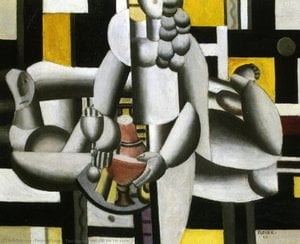
French modernist Fernand Léger’s ‘Big Julie’ captures a dynamic scene featuring a woman holding a wheel amidst industrial influences—a bold exploration of form and movement emblematic of the 1945 era. Immerse yourself in this captivating artwork and bring Léger's vision home.

Erkunden Sie die Kunst von Fernand Léger (1881-1955), einem Pionier des Kubismus und der 'Tubism'. Entdecken Sie seine mutigen, figurativen Gemälde, die das moderne Leben, Maschinen und die menschliche Form feiern. Ein Vorläufer des Pop Art!

Handgefertigte Ölreproduktion

Handgemaltes Ölgemälde auf Leinwand in Ihrer Wunschgröße und mit Rahmen, auf Bestellung von unseren Künstlern angefertigt. ( Zum Druck wechseln Zum digitalen Bild wechseln)

Corner sample of the P118B picture frame: formgepresstes Polystyrol, 5 cm wide and 3 cm thick
P118B €10
Corner sample of the P118H picture frame: formgepresstes Polystyrol, 5 cm wide and 3 cm thick
P118H €10
Corner sample of the P118W picture frame: formgepresstes Polystyrol, 5 cm wide and 3 cm thick
P118W €10
Corner sample of the P438Z picture frame: formgepresstes Polystyrol, 5.5 cm wide and 3.5 cm thick
P438Z €10
Corner sample of the P508JH picture frame: formgepresstes Polystyrol, 7 cm wide and 3.5 cm thick
P508JH €12
Corner sample of the P508YH picture frame: formgepresstes Polystyrol, 7 cm wide and 3.5 cm thick
P508YH €12
Corner sample of the P805H picture frame: formgepresstes Polystyrol, 5 cm wide and 3.5 cm thick
P805H €10
Corner sample of the P805Z picture frame: formgepresstes Polystyrol, 5 cm wide and 3.5 cm thick
P805Z €10
Corner sample of the P919BZ picture frame: formgepresstes Polystyrol, 7 cm wide and 3.5 cm thick
P919BZ €10
Corner sample of the P919G picture frame: formgepresstes Polystyrol, 7 cm wide and 3.5 cm thick
P919G €10
Corner sample of the P919XJ picture frame: formgepresstes Polystyrol, 7 cm wide and 3.5 cm thick
P919XJ €10
Corner sample of the P959ZH picture frame: formgepresstes Polystyrol, 5 cm wide and 3 cm thick
P959ZH €10
Corner sample of the P968JZ picture frame: formgepresstes Polystyrol, 6 cm wide and 4 cm thick
P968JZ €12
Corner sample of the W106C picture frame: Massivholz, 5 cm wide and 3 cm thick
W106C €8
Corner sample of the W218G picture frame: Massivholz, 5 cm wide and 3 cm thick
W218G €10
Corner sample of the W218JH picture frame: Massivholz, 5 cm wide and 3 cm thick
W218JH €8
Corner sample of the W218Y picture frame: Massivholz, 5 cm wide and 3 cm thick
W218Y €10
Corner sample of the W307PJ picture frame: Massivholz, 6 cm wide and 3 cm thick
W307PJ €10
Corner sample of the W316G picture frame: Massivholz, 6 cm wide and 3 cm thick
W316G €10
Corner sample of the W316PJ picture frame: Massivholz, 6 cm wide and 3 cm thick
W316PJ €8
Corner sample of the W316Y picture frame: Massivholz, 6 cm wide and 3 cm thick
W316Y €10
Corner sample of the W398PJ picture frame: Massivholz, 5 cm wide and 3 cm thick
W398PJ €8
Corner sample of the W4111J picture frame: Massivholz, 6.5 cm wide and 3.5 cm thick
W4111J €10
Corner sample of the W500HY picture frame: Massivholz, 7 cm wide and 5 cm thick
W500HY €15
Corner sample of the W500JH picture frame: Massivholz, 7 cm wide and 5 cm thick
W500JH €15
Corner sample of the W692G picture frame: Massivholz, 8 cm wide and 4 cm thick
W692G €12
Corner sample of the W849H picture frame: Massivholz, 5 cm wide and 3 cm thick
W849H €8
Corner sample of the W940BG picture frame: Massivholz, 7.5 cm wide and 4.5 cm thick
W940BG €15
Corner sample of the W953PJ picture frame: Massivholz, 6 cm wide and 3.5 cm thick
W953PJ €8

Standardformat
individuell anpassbar
CM
INCH

Wählen Sie aus unseren vordefinierten Formaten, die den ursprünglichen Proportionen des Kunstwerks entsprechen.

Breite
Höhe

Geben Sie die Breite und die Höhe an, die Sie für Ihren Rahmen oder Ihre Wand benötigen. Da dieses Werk handgemalt ist, kann der Künstler bei einer anderen Form etwas mehr um das Bild herum malen oder etwas abschneiden – Sie entscheiden. Wir senden Ihnen ein digitales Mockup zur Freigabe, bevor mit dem Malen begonnen wird. Das auf dieser Seite gezeigte Bild stellt nicht das tatsächliche Ergebnis dar – dies tut nur das Mockup.

Beispiele für Anpassungsmöglichkeiten: Gesicht durch Kundenfoto ersetzen; Haustier hinzufügen (z. B. Katze durch Hund ersetzen); eine versteckte Nachricht im Hintergrund einfügen; Hintergrundlandschaft oder -elemente ändern.
Nach der Bestellung wird das WahooArt.com-Team dem Kunden Anweisungen per E-Mail zusenden und eine Mockup-Vorschau bereitstellen.

Weltweiter Versand () in nur 3 bis 4 Wochen statt der üblichen 5 Wochen. (27 Oktober). Keine Kompromisse bei der Qualität.

Kostenloser weltweiter Expressversand
Hochwertige Leinenleinwand
Umfassender Versicherungsschutz beim Versand
Zollgebühren-Rückerstattungsgarantie
Garantie für exakte Farbtreue
100 Tage Rückgaberecht (nur bei Mängeln)
100% Geld-zurück-Garantie
Mengenrabatt verfügbar

Gesamtpreis

€ 239

Big Julie

Art der Reproduktion

Format der Reproduktion

-

Endpreis

€ 239

A Bold Embrace of Mechanization: Exploring Fernand Léger’s “Big Julie”

Fernand Léger's "Big Julie," completed in 1945, isn’t merely a depiction of a woman; it’s an audacious declaration that art could simultaneously honor tradition and propel itself into the future. Painted during the tumultuous years following World War II, this monumental canvas embodies the spirit of Surrealism while firmly anchoring itself within Léger's signature geometric abstraction – a stylistic choice that distinguishes him from many of his peers who sought refuge in pure abstraction as an escape from the horrors of conflict. The artwork’s immediate impact is striking: a vibrant yellow dress dominates the composition, radiating warmth against the cool tones of the background, immediately drawing the viewer’s eye. This bold color palette speaks to Léger's fascination with industrial hues and his desire to convey energy and optimism amidst postwar anxieties.
  • Subject Matter: The portrait captures a woman holding a wheel – a deliberate reference to the machinery of industry and, symbolically, perhaps to the cyclical nature of life itself.
  • Style: Léger’s style is undeniably geometric abstraction. Forms are simplified into interlocking planes and cubes, creating a dynamic visual rhythm that rejects naturalistic representation.
The artist meticulously employed a technique characterized by thick impasto – applying paint in heavy layers – which lends the canvas an undeniable tactile quality. This textural approach isn’t simply decorative; it actively contributes to conveying movement and solidity simultaneously. Léger's use of color is equally significant, prioritizing hues derived from industrial pigments like yellow and ochre, reflecting his engagement with the aesthetic language of the machine age. These colors aren’t blended softly but juxtaposed sharply, enhancing the visual drama and reinforcing the artwork’s expressive power.

Historical Context: Surrealism's Unexpected Ally

Despite Léger’s association with Surrealist artists like André Breton, “Big Julie” represents a fascinating divergence from the movement’s preoccupation with dreamlike imagery and subconscious exploration. While Surrealists sought to unlock hidden truths within the unconscious mind, Léger focused on translating the visible world into an abstract form that captured its underlying structure. This decision stemmed partly from Léger's belief that abstraction could offer a more truthful representation of reality than traditional painting – portraying not what we *see*, but what is *there*. The backdrop features elements like a clock and a chair, further emphasizing the interplay between human presence and mechanical influence—a recurring motif in Léger’s oeuvre.

Symbolism Beyond Form: Wheels and Cycles

The prominent wheel serves as more than just an industrial symbol; it embodies concepts of progress, transformation, and continuity. Léger deliberately avoids depicting the woman's face directly, prioritizing instead a stylized representation that prioritizes form over emotion. This stylistic choice underscores Léger’s conviction that abstraction could communicate profound ideas without resorting to sentimentalism. The inclusion of objects like a vase and handbag adds subtle layers of meaning, hinting at domestic life alongside industrial advancement—a visual dialogue reflecting the complexities of postwar society.

Emotional Resonance: Optimistic Futurism

Ultimately, “Big Julie” transcends mere stylistic innovation; it communicates an underlying feeling of optimism and resilience. Léger’s bold geometric forms and vibrant colors convey a sense of dynamism and vitality—a defiant assertion that beauty could flourish even amidst devastation. The artwork invites contemplation on the relationship between humanity and technology, prompting viewers to consider how art can illuminate both our past and envision our future. Reproductions of “Big Julie” offer an exceptional opportunity to bring Léger’s visionary aesthetic into any interior space, capturing a moment of artistic triumph against the backdrop of global upheaval.

Fragen & Antworten

Welcher Kunstrichtung lässt sich "Big Julie" von Fernand Léger zuordnen?

„Big Julie“ ist ein Werk der Geometric Abstraction. Die Stilrichtung gibt die künstlerische Tradition an, der das Werk angehört.

Weist "Big Julie" starke Hell-Dunkel-Kontraste auf?

"Big Julie" von Fernand Léger zeigt einen Aussagekraft Kontrast zwischen hellen und dunklen Bereichen.

Ist "Big Julie" von Fernand Léger gemeinfrei, und warum?

"Big Julie" von Fernand Léger ist gemeinfrei – das Urheberrecht ist abgelaufen. Die Urheberrechtsfristen werden ab dem Todesjahr des Künstlers berechnet, und Fernand Léger verstarb im Jahr 1955.


Künstlerbiografie

frühes Leben und Ausbildung

Fernand Légér, ein französischer Maler, Bildhauer und Filmemacher, wurde am 4. Februar 1881 in Argentan, Orne, Niedergermanien geboren. Sein Vater züchtete Rinder, und Légér erhielt zunächst eine Ausbildung als Architekt von 1897 bis 1899. Er zog dann im Jahr 1900 nach Paris und unterstützte sich dort als Architektenzeichner.

Künstlerische Entwicklung

Légers frühe Werke wurden vom Impressionismus beeinflusst, wie in Le Jardin de ma Mère (Mein Muttergarten) (1905) zu sehen ist. Nach dem Besuch der Schule für dekorative Künste und der Académie Julian begann er ab seinem 25. Lebensjahr ernsthaft als Maler zu arbeiten. Sein Stil entwickelte sich zu einer persönlichen Form des Kubismus, der von Kritikern als "Tubism" bezeichnet wurde, da er sich auf zylindrische Formen konzentrierte.

Kubismus und die Puteaux-Gruppe

Im Jahr 1910 stellte Légér im Salon d’Automne zusammen mit Jean Metzinger und Henri Le Fauconnier aus. Er schloss sich der Puteaux-Gruppe an, auch bekannt als die Section d’Or (die Goldene Proportion), zusammen mit anderen Künstlern wie Francis Picabia und Marcel Duchamp.

Krieg und seine Auswirkungen auf Légers Werk

Légers Erfahrungen im Ersten Weltkrieg hatten einen erheblichen Einfluss auf sein Werk. Während seiner Zeit an der Front produzierte er Skizzen von Artilleriegeschützen, Flugzeugen und Soldaten. Sein Gemälde Soldat mit Pfeife (1916) spiegelt diese Zeit wider.

Spätere Werke und Vermächtnis

Légers Nachkriegszeitliche Arbeiten, die von glatten, maschinellen Formen geprägt waren, verknüpften ihn mit der Tradition der französischen figurativen Malerei. Seine "animierten Landschaften" von 1921 zeigten Figuren und Tiere in harmonischen, stromlinienförmigen Formen. Schlüsselwerke: Museen, die Légers Werk ausstellen:
Fernand Léger

Fernand Léger

1881 - 1955 , Frankreich

Kurzinfos

  • Beeinflusste Kunstrichtungen: ['Pop Art']
  • Beeinflusste Künstler: ['Paul Cézanne']
  • Bemerkenswerte Werke:
    • Die Sitzende Frau
    • Maschinenelement
    • Der Große Umzug
    • Die Stadt
  • Geburtsdatum: 04. Februar 1881
  • Geburtsort: Argentan, Frankreich
  • Künstlerische Richtung: Kubismus, Tubismus
  • Nationalität: Französisch
  • Sterbedatum: 1955
  • Vollständiger Name: Fernand Léger
  • Von Kunstbewegungen Beeinflusst: ['Cézannismus']
  • Von Künstlern Beeinflusst: ['Impressionismus']
Entdecken Sie Kunstwerke, die nach Themen, Stilen und Merkmalen sortiert sind.