In echtem Maßstab anzeigen In AR an der Wand sehen Zum Druck wechseln Zum digitalen Bild wechseln Versenden als Grußkarte
Details anzeigen Leitfaden öffnen Zu Favoriten hinzufügen Herunterladen Ähnliche Objekte Röntgenaufnahme Diashow Besucherstatistiken

Springtime

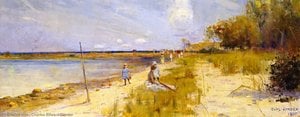
Charles Conder's 'Springtime' captures a serene Australian countryside scene with figures and nature bathed in sunlight. A beautiful example of Heidelberg School art.

Entdecken Sie Charles Edward Conders (1868-1909) faszinierende Landschafts- & Impressionismuswerke! Schlüsselfigur der Heidelberg School – Häfen, Strände & mehr auf WahooArt.

Handgefertigte Ölreproduktion

Handgemaltes Ölgemälde auf Leinwand in Ihrer Wunschgröße und mit Rahmen, auf Bestellung von unseren Künstlern angefertigt. ( Zum Druck wechseln Zum digitalen Bild wechseln)

Corner sample of the P118B picture frame: formgepresstes Polystyrol, 5 cm wide and 3 cm thick
P118B €10
Corner sample of the P118H picture frame: formgepresstes Polystyrol, 5 cm wide and 3 cm thick
P118H €10
Corner sample of the P118W picture frame: formgepresstes Polystyrol, 5 cm wide and 3 cm thick
P118W €10
Corner sample of the P438Z picture frame: formgepresstes Polystyrol, 5.5 cm wide and 3.5 cm thick
P438Z €10
Corner sample of the P508JH picture frame: formgepresstes Polystyrol, 7 cm wide and 3.5 cm thick
P508JH €12
Corner sample of the P508YH picture frame: formgepresstes Polystyrol, 7 cm wide and 3.5 cm thick
P508YH €12
Corner sample of the P805H picture frame: formgepresstes Polystyrol, 5 cm wide and 3.5 cm thick
P805H €10
Corner sample of the P805Z picture frame: formgepresstes Polystyrol, 5 cm wide and 3.5 cm thick
P805Z €10
Corner sample of the P919BZ picture frame: formgepresstes Polystyrol, 7 cm wide and 3.5 cm thick
P919BZ €10
Corner sample of the P919G picture frame: formgepresstes Polystyrol, 7 cm wide and 3.5 cm thick
P919G €10
Corner sample of the P919XJ picture frame: formgepresstes Polystyrol, 7 cm wide and 3.5 cm thick
P919XJ €10
Corner sample of the P959ZH picture frame: formgepresstes Polystyrol, 5 cm wide and 3 cm thick
P959ZH €10
Corner sample of the P968JZ picture frame: formgepresstes Polystyrol, 6 cm wide and 4 cm thick
P968JZ €12
Corner sample of the W106C picture frame: Massivholz, 5 cm wide and 3 cm thick
W106C €8
Corner sample of the W218G picture frame: Massivholz, 5 cm wide and 3 cm thick
W218G €10
Corner sample of the W218JH picture frame: Massivholz, 5 cm wide and 3 cm thick
W218JH €8
Corner sample of the W218Y picture frame: Massivholz, 5 cm wide and 3 cm thick
W218Y €10
Corner sample of the W307PJ picture frame: Massivholz, 6 cm wide and 3 cm thick
W307PJ €10
Corner sample of the W316G picture frame: Massivholz, 6 cm wide and 3 cm thick
W316G €10
Corner sample of the W316PJ picture frame: Massivholz, 6 cm wide and 3 cm thick
W316PJ €8
Corner sample of the W316Y picture frame: Massivholz, 6 cm wide and 3 cm thick
W316Y €10
Corner sample of the W398PJ picture frame: Massivholz, 5 cm wide and 3 cm thick
W398PJ €8
Corner sample of the W4111J picture frame: Massivholz, 6.5 cm wide and 3.5 cm thick
W4111J €10
Corner sample of the W500HY picture frame: Massivholz, 7 cm wide and 5 cm thick
W500HY €15
Corner sample of the W500JH picture frame: Massivholz, 7 cm wide and 5 cm thick
W500JH €15
Corner sample of the W692G picture frame: Massivholz, 8 cm wide and 4 cm thick
W692G €12
Corner sample of the W849H picture frame: Massivholz, 5 cm wide and 3 cm thick
W849H €8
Corner sample of the W940BG picture frame: Massivholz, 7.5 cm wide and 4.5 cm thick
W940BG €15
Corner sample of the W953PJ picture frame: Massivholz, 6 cm wide and 3.5 cm thick
W953PJ €8

Standardformat
individuell anpassbar
CM
INCH

Wählen Sie aus unseren vordefinierten Formaten, die den ursprünglichen Proportionen des Kunstwerks entsprechen.

Breite
Höhe

Geben Sie die Breite und die Höhe an, die Sie für Ihren Rahmen oder Ihre Wand benötigen. Da dieses Werk handgemalt ist, kann der Künstler bei einer anderen Form etwas mehr um das Bild herum malen oder etwas abschneiden – Sie entscheiden. Wir senden Ihnen ein digitales Mockup zur Freigabe, bevor mit dem Malen begonnen wird. Das auf dieser Seite gezeigte Bild stellt nicht das tatsächliche Ergebnis dar – dies tut nur das Mockup.

Beispiele für Anpassungsmöglichkeiten: Gesicht durch Kundenfoto ersetzen; Haustier hinzufügen (z. B. Katze durch Hund ersetzen); eine versteckte Nachricht im Hintergrund einfügen; Hintergrundlandschaft oder -elemente ändern.
Nach der Bestellung wird das WahooArt.com-Team dem Kunden Anweisungen per E-Mail zusenden und eine Mockup-Vorschau bereitstellen.

Weltweiter Versand () in nur 3 bis 4 Wochen statt der üblichen 5 Wochen. (24 Oktober). Keine Kompromisse bei der Qualität.

Kostenloser weltweiter Expressversand
Hochwertige Leinenleinwand
Vollständiger Versicherungsschutz beim Versand
Zollgebühren-Rückerstattungsgarantie
Garantie für exakte Farbtreue
100-tägiges Rückgaberecht (nur bei Mängeln)
100% Geld-zurück-Garantie
Angebot für Mengenrabatt

Gesamtpreis

€ 239

Springtime

Reproduktionsmedium

Format der Reproduktion

-

Gesamtpreis

€ 239

Kurzübersicht

  • Medium: Oil on canvas
  • Title: Springtime
  • Movement: Heidelberg School
  • Location: NGV, Melbourne
  • Artist: Charles Conder

Kunst-Quiz

Jede Frage hat nur eine richtige Antwort.

Frage 1:
What artistic movement is Charles Edward Conder primarily associated with?
Frage 2:
In 'Springtime', what is the primary subject matter depicted?
Frage 3:
What year was 'Springtime' painted?
Frage 4:
Charles Edward Conder was born in which city?
Frage 5:
Which of the following best describes Conder's style as evident in 'Springtime'?

Charles Edward Conder’s “Springtime,” A Window into Heidelberg’s Soul

Charles Edward Conder's "Springtime," painted in 1888, isn’t merely a depiction of a rural scene; it’s a vibrant distillation of the Heidelberg School’s artistic philosophy – a celebration of light, color, and the fleeting beauty of the Australian landscape. This oil on canvas captures a moment of idyllic tranquility nestled within the rolling hills of New South Wales, yet it resonates with a deeper sense of observation and emotional resonance that distinguishes Conder's work from purely topographical representations.

The painting immediately draws the eye to the luminous quality of the light, characteristic of the Heidelberg School’s approach. Conder masterfully employs broken brushstrokes and a palette dominated by greens, blues, and yellows – not in a photographic realism, but rather as an expression of how these colors *feel* under the intense Australian sun. The composition is deceptively simple: a meandering dirt track cuts through a field dotted with grazing sheep and cows, leading towards distant trees that are rendered with a hazy, atmospheric quality. A small group of figures – likely children – are visible in the foreground, adding a touch of human presence to this otherwise serene vista.

The Heidelberg School and its Artistic Roots

To fully appreciate “Springtime,” it’s crucial to understand the context within which Conder was working. The Heidelberg School, emerging in Melbourne during the 1880s, represented a significant shift away from the academic traditions of European art that had previously dominated Australian painting. Artists like Conder, Tom Roberts, and Frederick McCubbin sought inspiration directly from the Australian landscape, rejecting idealized representations in favor of capturing its raw beauty and inherent drama. They embraced *plein air* painting – working outdoors directly from nature – a technique championed by Impressionist painters in Europe.

Conder’s early life, marked by his mother's death in India and subsequent relocation to England before returning to Australia, undoubtedly shaped his artistic sensibility. His experiences as a surveyor instilled a keen eye for detail and an appreciation for the natural world, while his time spent studying art in London exposed him to the burgeoning Impressionist movement. However, Conder ultimately forged his own unique style, blending European influences with a distinctly Australian perspective.

Symbolism and Emotional Resonance

Beyond its picturesque subject matter, “Springtime” is rich in symbolic meaning. The dirt track suggests a journey – perhaps a metaphorical one – while the grazing animals represent the bounty of the land. The figures in the foreground invite us to contemplate our relationship with nature and the simple pleasures of rural life. There’s an underlying sense of nostalgia for a bygone era, a yearning for connection with the earth and its rhythms.

The hazy atmosphere and diffused light contribute significantly to the painting's emotional impact. It evokes a feeling of warmth, tranquility, and perhaps even melancholy – a recognition that such moments of beauty are fleeting and precious. Conder’s use of color is particularly effective in conveying this mood, creating a sense of depth and luminosity that draws the viewer into the scene.

A Legacy of Australian Impressionism

“Springtime” stands as a pivotal work in the development of Australian Impressionism. It exemplifies the Heidelberg School’s commitment to capturing the essence of the Australian landscape with vibrant color, loose brushwork, and an emphasis on light and atmosphere. Conder's ability to imbue his paintings with both visual beauty and emotional depth cemented his place as one of Australia’s most important artists. Reproductions of this captivating work continue to resonate with audiences today, offering a glimpse into the soul of Heidelberg and the enduring appeal of the Australian landscape.

Fragen & Antworten

Wie fügt sich „Springtime“ in die Themen und den Stil von Charles Edward Conder ein?

"Springtime" teilt mit anderen Werken von Charles Edward Conder den Heidelberg School-Stil sowie die wiederkehrenden Themen: heidelberg school realism, australian landscape painting, impressionistic light study, rural life depiction”, “conder’s artistic evolution”.

Zeigt "Springtime" starke Hell-Dunkel-Kontraste?

Der Kontrastwert von "Springtime" von Charles Edward Conder ist Bold.

Welche Größe und Ausrichtung werden für einen Druck von "Springtime" von Charles Edward Conder empfohlen?

Für einen Druck von "Springtime" von Charles Edward Conder wird ein Format von Medium in der Ausrichtung Landscape empfohlen.


Biografie des Künstlers

Frühes Leben und künstlerischer Werdegang

Charles Edward Conder, ein in Großbritannien geborener Maler, Lithograf und Designer, hinterließ einen bleibenden Eindruck auf die Kunstwelt. Geboren am 24. Oktober 1868 in Tottenham, Middlesex, war Conder's frühes Leben von dem Tod seiner Mutter in Indien geprägt, als er gerade vier Jahre alt war.

Künstlerische Karriere in Australien

Im Jahr 1884 zog Conder im Alter von 16 Jahren nach Sydney, Australien, und arbeitete für seinen Onkel als Landvermesser. Er entdeckte jedoch bald seine wahre Leidenschaft im Zeichnen der Landschaft statt in der Vermessung. Bereits 1886 wurde er Künstler für die Illustrated Sydney News, zusammen mit namhaften Künstlern wie Albert Henry Fullwood und Frank Mahony.

Die Heidelberg School und bedeutende Werke

Conders Meisterwerk, Departure of the Orient – Circular Quay (1888), demonstrierte seine neu gewonnene Meisterschaft in Form und Pinselstrich. Diese Hafenszene, die das geschäftige Treiben am Sydney Cove darstellt, wurde schnell von der Art Gallery of New South Wales erworben und wurde damit Conders erstes Werk, das in eine öffentliche Sammlung gelangte.
  • A Holiday at Mentone (1888), ein fröhliches Gemälde, das Männer und Frauen beim Entspannen am Strand zeigt, ist ein weiteres bemerkenswertes Beispiel für Conders Werk.
  • Conders Verbindung mit G. P. Nerli, einem wandernden italienischen Maler, beeinflusste seine künstlerische Entwicklung maßgeblich.
  • Sein Beitrag zur 9 by 5 Impression Exhibition in Melbourne, zusammen mit Tom Roberts und Arthur Streeton, festigte seine Position innerhalb der Heidelberg School Bewegung.

Vermächtnis und spätere Jahre

Conders späte Jahre waren von gesundheitlichen Problemen geplagt, darunter Lähmungen und ein Delirium tremens. Trotzdem malte er weiter und hinterließ ein Vermächtnis als eine Schlüsselfigur der Heidelberg School. Seine Kunst wurde in England besser aufgenommen als in Paris, wobei sein Porträt von Henri de Toulouse-Lautrec im Jahr 1892 gemalt wurde. Betrachten Sie Conders Werke in der Art Gallery of New South Wales oder erkunden Sie mehr über die Heidelberg School auf WahooArts Charles Edward Conder Seite.

Schlussfolgerung

Charles Edward Conders Einfluss auf den australischen Impressionismus ist unbestreitbar. Sein Vermächtnis, das durch seine fesselnden Gemälde und seine Verbindung zur Heidelberg School gekennzeichnet ist, inspiriert weiterhin Kunstliebhaber weltweit.
Charles Edward Conder

Charles Edward Conder

1868 - 1909 , Vereinigtes Königreich

Eckdaten zum Künstler

  • Bemerkenswerte Werke:
    • Departure of the Orient
    • A Holiday at Mentone
  • Geburtsdatum: 24. Oktober 1868
  • Geburtsort (Stadt, Land): Tottenham, Vereinigtes Königreich
  • Künstler, Die Diesen Künstler Beeinflussten: ['G. P. Nerli']
  • Künstlerische Bewegung/Stil: Heidelberg School, Impressionismus
  • Nationalität: Britisch
  • Sterbedatum: 1909
  • Vollständiger Name: Charles Edward Conder
Entdecken Sie Kunstwerke, die nach Themen, Stilen und Merkmalen sortiert sind.