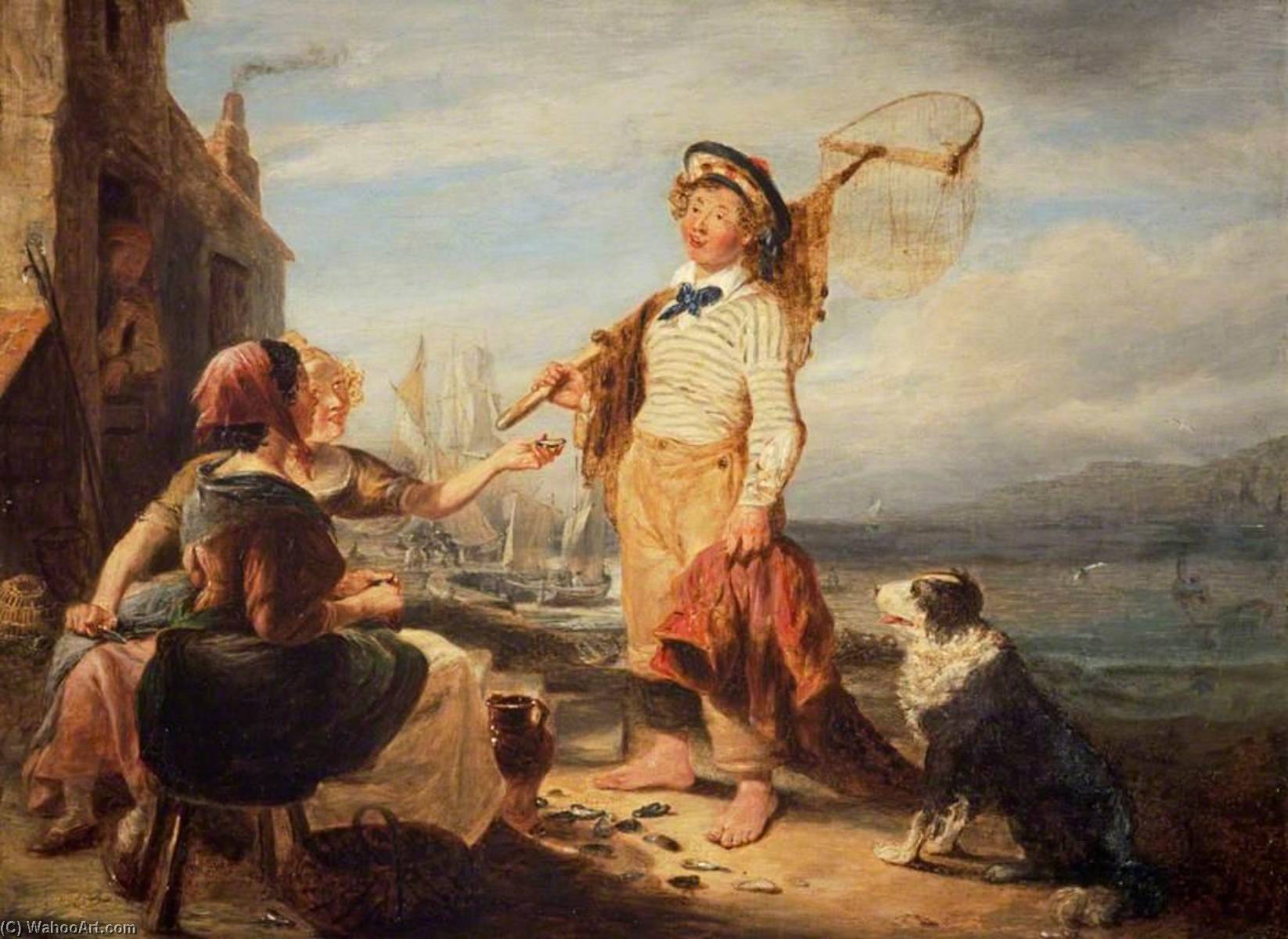
William Kidd, 1790 – 1863

William Kidds malerier: De 18 mest berømte værker, rangeret

William Kidd's mest berømte maleri er Simon and Janet (1860) i The Stirling Smith Art Gallery - Museum, Stirling. Sammen med Old Cottages at Petersfield, Hampshire (1820) og The Fish Stall (1831) udgør de de tre værker, som alle kender. Vores katalog indeholder 23 værker af William Kidd; de 18 nedenfor er dem, som verden ser mest på, hver med årstal, det museum der opbevarer det, og hvorfor det er betydningsfuldt.

Rangordnet efter vores popularitetsscore, som kombinerer søgninger, besøg og ordrer for hvert værk. Opdateret november 2026. Hvert mesterværk på denne side kan bestilles som en håndmalet oliereproduktion i museumskvalitet eller som et kunsttryk i den størrelse, du vælger.

Portræt af William Kidd
William Kidd · 1790 – 1863
Født · død
1790 – 1863, Edinburgh
Værker i vores katalog
23
Mest kendte værker
Simon and Janet (1860)
Flest værker i
Hospitalfield Arts

De 10 mest berømte William Kidd malerier

Simon and Janet (1860) af William Kidd
1

Simon and Janet

1860 · Oil On Canvas · The Stirling Smith Art Gallery - Museum, Stirling

The oil on canvas work titled Simon and Janet is a creation of the artist William Kidd. This piece emerged about 1860, capturing a singular, heavy moment between two figures. It remains part of the collection at The Stirling Smith Art Gallery - Museum in Stirling, United Kingdom.

Håndmalet oliereproduktion fra $199 37 × 27 cm Samme størrelse som originalen $267 64 × 47 cm Bestil i original størrelse →
Old Cottages at Petersfield, Hampshire (1820) af William Kidd
2

Old Cottages at Petersfield, Hampshire

1820 · Oil

Old Cottages at Petersfield, Hampshire is a painting by the artist William Kidd. This work dates to about 1820. The composition focuses on a rural setting containing two houses with chimneys, positioned on the left and right sides of the frame. Several people and a horse are situated within the landscape, appearing alongside the structures.

Håndmalet oliereproduktion fra $199 39 × 25 cm Samme størrelse som originalen $202 39 × 28 cm Bestil i original størrelse →
The Fish Stall (1831) af William Kidd
3

The Fish Stall

1831 · Oil

A woman stands before a wooden table, her hands resting on her hips with a quiet, unyielding determination. She wears a red dress that anchors the composition, a bold splash of color against the utilitarian setting of the market. On the table, the silver scales of fish catch the light, resting near ceramic bowls and a single knife. The scene is a fragment of a busy morning, frozen in a…

Håndmalet oliereproduktion fra $199 29 × 35 cm
Indulging (1832) af William Kidd
4

Indulging

1832 · Oil On Panel · Scottish National Gallery, Edinburgh

In "Indulging" by William Kidd, the oil-on-panel surface holds a scene of quiet, mischievous energy. The artist employs precise brushwork to define the textures of the room, from the heavy folds of an embroidered housecoat to the smooth, reflective surfaces of fine tableware. Every stroke contributes to a sense of immediate, lived-in reality, where the light catches the rim of a wine glass or the curve of an enormous oriental…

Håndmalet oliereproduktion fra $199 28 × 36 cm
The Cottar's Saturday Night (1845) af William Kidd
5

The Cottar's Saturday Night

1845 · Oil On Canvas · The Stirling Smith Art Gallery - Museum, Stirling

The Cottar's Saturday Night is a significant work by the Scottish artist William Kidd. Created in 1845, this oil on canvas painting offers a quiet glimpse into the domestic realities of the mid-19th century. It captures a specific moment of communal life, rendered with the meticulous attention to detail that characterized Kidd's approach to genre painting.

Håndmalet oliereproduktion fra $199 39 × 26 cm Samme størrelse som originalen $336 86 × 59 cm Bestil i original størrelse →
The Navy af William Kidd
6

The Navy

Oil On Canvas · Laing Art Gallery, Newcastle upon Tyne

The oil painting titled "The Navy" by William Kidd presents a realistic scene set within a dimly lit corridor or doorway. The composition is dominated by two elderly men positioned slightly off-center. One man exhibits a prominent facial expression of distress, appearing as though he is choking, while the other man is depicted in the act of assisting him. The scene is characterized by a sense of hardship and suffering,…

Håndmalet oliereproduktion fra $224 27 × 38 cm Samme størrelse som originalen $319 53 × 72 cm Bestil i original størrelse →
John Anderson, My Jo (1848) af William Kidd
7

John Anderson, My Jo

In the gentle embrace of William Kidd’s 1848 masterpiece, John Anderson, My Jo, we are transported to a sun-drenched afternoon in the mid-19th century, where the boundaries between humanity and nature seem to dissolve into a singular, harmonious moment. This evocative portrait is far more than a mere gathering of figures; it is a profound study of companionship and the quiet dignity of rural life. Kidd, an artist renowned for…

Håndmalet oliereproduktion fra $199 36 × 27 cm Samme størrelse som originalen $600 132 × 99 cm Bestil i original størrelse →

William Kidd, malerier 11 til 18

De motiver William Kidd malede mest

De fire motiver, der optræder hyppigst blandt disse mesterværker, med det fineste eksempel på hvert enkelt.

Hvor kan man se William Kidd's malerier

De 7 museer, der rummer flest af malerierne på denne side.

Museum By Værker af William Kidd Malerier fra denne liste
Hospitalfield Arts, ArbroathHospitalfield Arts Arbroath 5 Asleep, The Astrologer, Self Portrait with the Artist's Wife
The Stirling Smith Art Gallery - Museum, StirlingThe Stirling Smith Art Gallery - Museum Stirling 3 Simon and Janet, The Cottar's Saturday Night, John Anderson, My Jo
Scottish National Gallery, EdinburghScottish National Gallery Edinburgh 2 Indulging, Fisher Folk
Laing Art Gallery, Newcastle upon TyneLaing Art Gallery Newcastle upon Tyne 2 The Navy, The Army
Hospitalfield Centre For Art - Culture, ArbroathHospitalfield Centre For Art - Culture Arbroath 1 Jonathan and William
Leeds Art Gallery, LeedsLeeds Art Gallery Leeds 1 The False Parcel
Sheffield City Art Galleries, SheffieldSheffield City Art Galleries Sheffield 1 Interior Scene

William Kidds mest berømte maleri fra hvert årti

  1. 1820s
    Old Cottages at Petersfield, Hampshire (1820) af William Kidd
    Nr. 2 ud af 18

    Old Cottages at Petersfield, Hampshire

    Alder 30 – 39

    Old Cottages at Petersfield, Hampshire is a painting by the artist William Kidd. This work dates to about 1820. The composition focuses on a rural setting containing two…

  2. 1830s
    The Fish Stall (1831) af William Kidd
    Rang 3 ud af 18

    The Fish Stall

    Alder 40 – 49

    A woman stands before a wooden table, her hands resting on her hips with a quiet, unyielding determination. She wears a red dress that anchors the composition, a…

  3. 1840s
    The Cottar's Saturday Night (1845) af William Kidd
    Rang 5 ud af 18

    The Cottar's Saturday Night

    Alder 50 – 59 · The Stirling Smith Art Gallery - Museum

    The Cottar's Saturday Night is a significant work by the Scottish artist William Kidd. Created in 1845, this oil on canvas painting offers a quiet glimpse into the…

  4. 1860s
    Simon and Janet (1860) af William Kidd
    Rang 1 ud af 18

    Simon and Janet

    Alder 70 – 73 · The Stirling Smith Art Gallery - Museum

    The oil on canvas work titled Simon and Janet is a creation of the artist William Kidd. This piece emerged about 1860, capturing a singular, heavy moment between…

Spørgsmål om William Kidds malerier

Hvad er William Kidds mest berømte maleri?Vis svaret

Simon and Janet (1860), The Stirling Smith Art Gallery - Museum, Stirling. Derefter følger Old Cottages at Petersfield, Hampshire (1820) og The Fish Stall (1831).

Hvor gammel var William Kidd, da Simon and Janet blev malet?Vis svaret

70 år gammel: Simon and Janet er fra 1860, og William Kidd blev født i 1790.

Hvad er de 10 bedste malerier af William Kidd?Vis svaret

Simon and Janet, Old Cottages at Petersfield, Hampshire, The Fish Stall, Indulging, The Cottar's Saturday Night, The Navy, John Anderson, My Jo, Fisher Folk, Jonathan and William og Asleep. Ranglisten ovenfor angiver årstallet og museet for hver af dem.

Hvor mange malerier har William Kidd lavet?Vis svaret

Vores katalog indeholder 23 værker af William Kidd, dateret fra 1820 til 1860.

Hvor findes William Kidds mest berømte malerier?Vis svaret

De fleste af dem findes i Hospitalfield Arts (Arbroath), The Stirling Smith Art Gallery - Museum (Stirling) og Scottish National Gallery (Edinburgh). Tabellen ovenfor lister museerne enkeltvis.

Hvornår malede William Kidd sine mest berømte værker?Vis svaret

I 1830s: 2 af de 18 værker på denne side stammer fra denne periode, herunder The Fish Stall.

Hvad er William Kidd's tidligste og seneste berømte malerier?Vis svaret

Det tidligste på denne side er Old Cottages at Petersfield, Hampshire (1820), det seneste Simon and Janet (1860).

Hvad malede William Kidd oftest?Vis svaret

Table (4), Woman (3) og Chair (3), blandt de 18 værker på denne side.

Hvilket medie brugte William Kidd mest?Vis svaret

Oil On Canvas: 3 ud af de 18 værker på denne side.

Hvilke William Kidd-malerier kan jeg se på Hospitalfield Arts?Vis svaret

Asleep, The Astrologer og Self Portrait with the Artist's Wife er blandt de 5 værker på denne side, som er i Hospitalfield Arts, Arbroath's samling.

Kan jeg købe en reproduktion af et maleri af William Kidd?Vis svaret

Ja. Hvert maleri på denne side kan bestilles som en håndmalet oliereproduktion i museums kvalitet eller som et kunstprint i den størrelse, du ønsker, direkte fra maleriets egen side.

Om William Kidd

William Kidd: A Romantic Observer of Everyday Life

William Kidd (1796 – 1863) emerges from the annals of 19th-century British art as a quietly compelling figure, an observer of domesticity and rural life rendered with a charming blend of realism and gentle humor. While not commanding the same immediate fame as his contemporaries like Turner or Constable, Kidd’s prolific output – over 200 paintings – offers a remarkably intimate glimpse into the social fabric of his time, revealing a keen eye for detail and an ability to capture the nuances of human interaction within seemingly ordinary scenes.

Born in Edinburgh in 1796, Kidd's early life remains somewhat shrouded in mystery. He began his artistic training under James Howe, a renowned animal painter, gaining foundational skills that would later inform his approach to depicting figures and settings. This apprenticeship instilled a meticulousness and attention to detail, particularly evident in his rendering of fabrics, furniture, and the subtle expressions on his subjects’ faces. Kidd's career unfolded primarily in London, where he established himself as a successful artist catering to a discerning clientele who appreciated his ability to portray familiar scenes with an air of gentle amusement.

The Style and Themes of a Romantic Observer

Kidd’s artistic style is often categorized within the broader framework of Romanticism, though it possesses distinct characteristics that set him apart. He eschewed the dramatic landscapes favored by some of his contemporaries, instead focusing on scenes of everyday life – cozy interiors, bustling market squares, and quiet moments in rural settings. His paintings are characterized by a warm palette, soft lighting, and an emphasis on domestic tranquility. He frequently depicted scenes of leisure and indulgence, often featuring wealthy gentlemen enjoying their estates or indulging in convivial gatherings.

A recurring theme in Kidd’s work is the contrast between wealth and simple pleasures. He masterfully portrays the opulence of the upper classes – lavish furnishings, exotic fruits, and fine clothing – juxtaposed with scenes of quiet contentment and modest enjoyment. This subtle commentary on social hierarchy and human nature is a hallmark of his artistic sensibility. His illustrations for works by Walter Scott and Robert Burns further cemented his reputation as a skilled draughtsman and interpreter of literary themes.

Influences and Artistic Development

Kidd’s artistic development was undoubtedly shaped by the work of David Wilkie, a Scottish painter known for his scenes of London life. Wilkie's ability to capture fleeting moments of human interaction with remarkable immediacy and realism served as a significant influence on Kidd’s approach to composition and characterization. The influence is particularly evident in works like “Indulgence,” where the languid pose of the elderly gentleman, surrounded by symbols of wealth and comfort, mirrors the relaxed atmosphere depicted in Wilkie's paintings.

Furthermore, Kidd’s meticulous attention to detail and his skillful rendering of fabrics and textures owe a debt to the Dutch Masters, particularly Rembrandt. He meticulously studied their use of light and shadow, employing similar techniques to create depth and volume within his compositions. His work also reflects the influence of English portraiture, with its emphasis on capturing individual character and personality.

Major Works and Legacy

Among Kidd’s most celebrated works are “Indulgence,” a delightful depiction of an elderly gentleman enjoying the fruits of his wealth; “The Shoemaker,” which captures the quiet dignity of a humble craftsman; and numerous illustrations for Walter Scott's novels, including "Ivanhoe" and "Rob Roy." These paintings demonstrate his versatility as an artist, showcasing his ability to render both grand scenes and intimate portraits with equal skill.

Despite not achieving widespread fame during his lifetime, William Kidd’s legacy endures through the sheer volume of his output and the enduring appeal of his charming genre scenes. His work offers a valuable window into the social customs and domestic life of 19th-century Britain, revealing a keen eye for detail and a subtle commentary on human nature. Today, his paintings are treasured in private collections and public galleries alike, testament to their lasting artistic merit.

A Continuing Exploration

Further research into William Kidd’s life and work continues to reveal new insights into this enigmatic artist. His prolific output provides a rich source of material for art historians and scholars seeking to understand the complexities of 19th-century British society. His paintings remain a testament to his skill, observation, and enduring ability to capture the beauty and humor of everyday life.