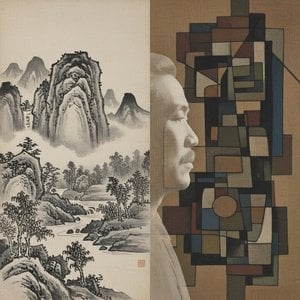
The Legacy of Wang Gai
Wang Gai was a Chinese painter and writer active during the Qing dynasty. He is primarily recognized as the principal author of the famous treatise Jieziyuan Huazhuan (The Method of Painting of the Mustard Seed Garden). This influential manual, which serves as an essential reference for studying pictorial practice, was composed in three parts. The first part was published in 1679, while the remaining two parts followed in 1701. Working alongside his brothers, Wang Shi and Wang Nie, Wang Gai contributed to this work, which provides a methodical approach to painting by analyzing graphic structures and combining elements like rocks, trees, and mountains.
Artistic Contributions and Works
As a landscape painter, Wang Gai's work is characterized by a progressive method of instruction, moving from basic forms to complex compositions. His pedagogical approach is documented through various volumes covering subjects such as landscapes, trees, rocks, and various flora and fauna. Notable works attributed to him in various collections include:
His technical contributions helped establish a standard for academic teaching, offering a comprehensive dictionary of forms and a clear system for initiating students into the art of painting.
Spørgsmål og svar
Kan jeg besøge et virtuelt museum med Wang Gais værker?
3D-galleri for Wang Gai er en side, der fremviser kunstnerens værker i et virtuelt tredimensionelt galleri.
Hvor mange kunstværker af Wang Gai er tilgængelige at gennemse?
Du kan gennemse 10 kunstværker værker af Wang Gai på siden Alle kunstværker.
Hvor kan man finde Wang Gais kunstværker grupperet efter farvepalette?
For at finde værker af Wang Gai i en specifik farvepalette kan du bruge kunstnerens Efter farvepalet side.
Hvor kan jeg se alle værker af Wang Gai?
Se alle værker af Wang Gai på denne hjemmeside på kunstnerens Alle kunstværker-side.