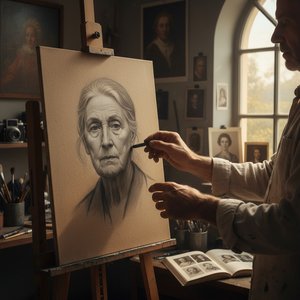
The Life and Art of Samuel Lovett Waldo
Born in Windham, Connecticut, Samuel Lovett Waldo emerged as a distinguished figure in the realm of American portraiture, capturing the essence of a nation in transition. His journey into the world of fine art began in earnest at the age of sixteen when he moved to Hartford to study under the prominent local artist Joseph Steward. This early foundation paved the way for a career defined by meticulous detail and an uncanny ability to render the psychological depth of his subjects. After establishing himself as a portraitist in Hartford and later Litchfield, Waldo’s burgeoning talent caught the attention of influential figures, leading him to South Carolina and eventually across the Atlantic to the prestigious art circles of London.
In London, Waldo sought to refine his craft under the guidance of masters such as Benjamin West and John Singleton Copley. This period of international study was transformative, allowing him to absorb the nuances of the neoclassical tradition and the sophisticated techniques of light and shadow. His time at the Royal Academy, where he exhibited his work, instilled in him a disciplined approach to composition and texture that would become hallmarks of his later studio work in New York City. Upon returning to the United States, Waldo brought with him an air of European refinement that resonated deeply with the American elite, setting the stage for a prolific career as a premier portrait painter.
A Legacy Captured in Portraiture
Waldo’s oeuvre is characterized by its profound ability to transcend mere likeness, offering instead a window into the character and social standing of his sitters. His work often serves as a tableau vivant of American life, documenting the dignity of individuals and the burgeoning wealth of the nineteenth century. One of his most celebrated achievements is his 1819 portrait of General Andrew Jackson, a piece that masterfully balances military authority with human complexity. Through precise rendering of uniform details and a somber, commanding palette, Waldo captured the very spirit of a man destined for the presidency.
Beyond the grand scale of political figures, Waldo excelled in capturing the quiet elegance of domestic life. His portraits, such as those of Mrs. Samuel L. Waldo and The Knapp Children, demonstrate a remarkable command of texture and atmosphere. In these works, he employed techniques like chiaroscuro to create depth, rendering the delicate sheen of silk or the soft glow of skin with breathtaking accuracy. His ability to convey both the outward prosperity and the inward serenity of his subjects ensured his place as a vital chronicler of early American gentility.
Throughout his long career, Waldo maintained a successful studio in New York City, often working in partnership with apprentices and collaborators like William Jewett. His contributions to American art extend beyond individual canvases; he helped establish a standard of excellence in portraiture that reflected the growing sophistication of the American identity. Through his eyes, we see a period marked by:
- The meticulous documentation of historical figures and political leaders.
- The celebration of domestic grace and familial lineage.
- A masterful integration of European neoclassical techniques into an American context.
Spørgsmål og svar
Hvilke kunstværker af Samuel Lovett Waldo har flest visninger?
Se statistik over Samuel Lovett Waldos værker på kunstnerens Statistik side.
Hvor kommer Samuel Lovett Waldo fra?
Samuel Lovett Waldo blev født i USA.
Hvor kan jeg se Samuel Lovett Waldos værker opdelt efter stemning?
Samuel Lovett Waldos værker kan udforskes efter stemning på kunstnerens Stemningsfulde rum-side, hvor kunstværkerne er sorteret efter deres registrerede stemninger.