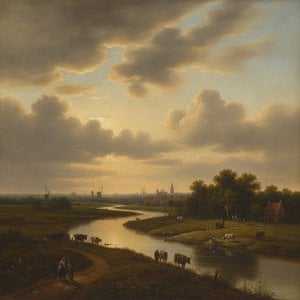
A Life Immersed in Dreams: The Surrealist Visions of Rik Lina
Rik Lina, a Dutch artist born in Valkenburg in 1942, embodies a lifelong dedication to exploring the subconscious realms through vibrant color and dynamic form. His artistic journey began with formal training at the Gerrit Rietveld Academie in Amsterdam between 1960 and 1965, where he cultivated foundational skills in both painting and photography. However, it was his embrace of the Surrealist movement in 1972 that truly ignited his distinctive style, propelling him toward a career defined by dreamlike landscapes and evocative symbolism. Lina’s early life instilled within him a deep connection to nature—a theme that would become inextricably linked with his artistic expression. He heeded the advice of Odilon Redon, choosing to live and work in environments rich with natural beauty, from deserts and mountains to tropical rainforests and coral reefs. This immersion wasn't merely aesthetic; it was a deliberate pursuit of understanding the underlying forces shaping both the inner and outer worlds. A pivotal period followed his emigration to the Dutch Caribbean in 1975, where over a thousand hours spent deep-sea diving profoundly impacted his artistic vision, infusing his work with the poetry and life forms of the oceans and coral reefs.The Cosmopolitan Orientation: Influences and Artistic Development
Lina’s art is not born in isolation but rather from a rich tapestry of influences and collaborations. His early exposure to oriental calligraphy shaped his precision and attention to detail, while his studies at the Rietveld Academie provided a solid technical foundation. The true catalyst for his mature style came with his engagement with the European Surrealist community through publications like Brumes Blondes and Mouvement Phases, collaborating with poets Laurens Vancrevel and Edouard Jaguer respectively. These interactions opened doors to a network of artists pushing the boundaries of perception and reality, profoundly influencing his artistic trajectory. He wasn’t simply adopting Surrealism as a style; he was actively participating in its evolution. This cosmopolitan orientation—a willingness to engage with diverse perspectives and ideas—is evident in his work's dynamic brush technique and bold use of color. Lina’s art doesn’t adhere to a single, rigid interpretation of Surrealism but rather synthesizes various influences into a unique visual language. His lifelong partnership with artist Elizé Bleys further enriched his creative process, fostering a shared exploration of artistic expression that lasted until her passing in 2022. Together they founded the anarchism/surrealist magazine Droomschaar in 1990 and participated in numerous international collaborations including CAPA (Collective Automatic Painting Amsterdam) and the Cabo Mondego Section of Portuguese Surrealism, demonstrating a commitment to collective creativity and cross-cultural exchange.Nature, Mythology, and the Subconscious Landscape
The core of Rik Lina’s artistic vision lies in his ability to seamlessly blend nature, mythology, and the subconscious mind. His paintings are not literal representations of landscapes but rather evocative interpretations that invite viewers to explore their own inner worlds. Bright colors serve as a conduit for emotion, while dynamic brushwork creates a sense of movement and energy. Recurring motifs—elements of nature such as lush vegetation, exotic animals, and marine life—are often juxtaposed with mythological figures and symbols, creating dreamlike scenes that defy easy categorization. PSYCHALIA POLIS 2007, for example, exemplifies this approach, showcasing a vibrant composition teeming with symbolic imagery. Lina’s work isn't about deciphering hidden meanings but rather about evoking a feeling—a sense of wonder, mystery, or unease. He often incorporates elements of the oceans and coral reefs into his paintings, reflecting his extensive diving experience and fascination with the hidden depths of the natural world. This exploration extends beyond the visual realm; Lina’s art delves into the psychological landscapes of dreams, memories, and archetypes, inviting viewers to confront their own subconscious desires and fears.Major Achievements and Historical Significance
Rik Lina's contributions to contemporary painting have been recognized through numerous exhibitions and inclusions in prestigious collections. His work has been showcased at the Fundación Eugenio Granell in Santiago de Compostela, Spain, on multiple occasions, and is held in the permanent collections of the Boymans van Beuningen Museum in Rotterdam and the Rijksmuseum in Amsterdam. His retrospective exhibition at the Centro Portugues do Surrealismo in Famalicao, Portugal, in 2010 solidified his position as a significant figure within the international Surrealist community. Beyond individual exhibitions, Lina’s collaborative projects—such as “The Reverse of the Look – Surrealism Today” and “In the Light of Glazed Castles – Surrealist Collages”—have played a crucial role in fostering dialogue and exchange between artists across borders. His work has also been featured in scholarly publications like Caleidoscopio surrealista by Miguel Pérez Corrales and the International Encyclopedia of Surrealism, further cementing his historical significance within the movement. Lina’s art represents a unique synthesis of personal experience, artistic innovation, and intellectual engagement. He doesn't simply replicate existing styles but rather pushes the boundaries of Surrealism, creating a visual language that is both deeply personal and universally resonant. His ongoing exploration of nature, mythology, and the subconscious mind continues to inspire and challenge viewers, ensuring his lasting legacy as a visionary artist.Continuing Exploration: A Legacy in Progress
Currently residing between Amsterdam and Portugal, Rik Lina remains actively engaged in artistic creation and collaboration. His work with Portuguese artist friends within the Cabo Mondego Section of Portuguese Surrealism demonstrates his ongoing commitment to collective creativity and cross-cultural exchange. He continues to explore new techniques and themes, pushing the boundaries of his visual language while remaining true to his core principles—a deep connection to nature, a fascination with mythology, and an unwavering dedication to exploring the subconscious mind. His recent publications through Empty Mirror Books showcase his ongoing engagement with literary and artistic communities, further solidifying his position as a multifaceted artist. Lina’s legacy is not simply defined by past achievements but rather by a continuous process of exploration and innovation. He embodies a rare combination of technical skill, intellectual curiosity, and emotional depth—qualities that ensure his lasting impact on the world of contemporary art.Spørgsmål & svar
Hvor kommer Rik Lina fra?
Rik Lina blev født i Netherlands.
Hvor kan jeg se farveprofilen i Rik Linas værker?
Rik Linas farvebrug på tværs af de værker, der er listet på denne hjemmeside, kan studeres på kunstnerens Farvepalettens genom-side.
Kan jeg gennemse Rik Linas værker efter stemning?
Kunstnerens Stemningsrum side viser Rik Linas værker arrangeret efter deres atmosfære.