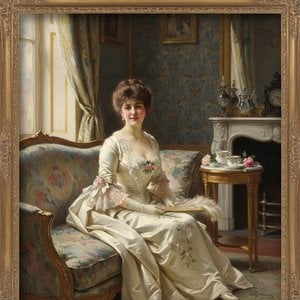
The Luminous World of Richard Edward Miller
Born in the vibrant city of St. Louis, Missouri, Richard Edward Miller emerged as a defining figure of American Impressionism, weaving a visual tapestry that captured the delicate essence of light and leisure. His artistic journey began in his native home, where he honed his skills at the local School of Fine Arts. This foundational period, characterized by rigorous training in drawing, modeling, and anatomy, prepared him for the transformative years he would spend in Europe. Seeking to expand his horizons, Miller traveled to Paris, immersing himself in the prestigious Académie Julian. Under the guidance of masters such as Jean-Paul Laurens and Jean-Joseph Benjamin-Constant, he absorbed the sophisticated techniques of the French tradition, a period of study that would forever inform his approach to color and composition.
The heart of Miller's creative evolution lay in his deep connection to the Giverny Colony. As a member of this illustrious group of American Impressionists, he lived and worked alongside contemporaries like Frederick Frieseke, often finding inspiration in the sun-d'renched landscapes near Claude Monet’s home. His work from this era is celebrated for its decorative impressionism, a style that prioritized the conveyance of pleasant optical sensations over heavy narrative. He possessed a unique ability to paint wistful maidens relaxing in gardens dappled with sunlight, using broken brushstrokes and a luminous palette to create scenes of profound tranquility. His canvases often featured a rhythmic use of diagonals—arranging figures and furniture in a way that guided the eye through an intimate, introspective space.
A Legacy of Beauty and Domesticity
Miller’s artistic philosophy was rooted in the idea that art should serve a decorative and comforting purpose. He famously stated that his intention was not to create works for the staid environments of museums, but rather for the comfortable intimacy of people's homes. This sentiment is reflected in his mastery of subject matter, which frequently focused on women posing languidly in elegant interiors or serene outdoor settings. Whether capturing the quiet introspection of Sewing By Lamplight or the delicate allure of Girl With Jewels, his paintings evoke a sense of domestic peace and refined grace.
Throughout his distinguished career, Miller achieved significant recognition both in America and abroad. His accolades included:
- Chevalier de La Legion D'honneur, a prestigious honor from France.
- Silver Medal at the Paris Salon in 1904.
- Silver Medal at the St. Louis World's Fair in 1904.
- Bronze Medal at the Pan-American Exposition in 1901.
- Membership in the National Academy of Design in New York.
After his time in France, Miller’s travels took him through Pasadena, California, where he influenced the emerging impressionist movement there, before he eventually settled in the art colony of Provincetown, Massachusetts. He remained in this coastal community for the rest of his life, leaving behind a body of work that continues to enchant viewers with its soft light, elegant figures, and timeless sense of serenity. His contribution to American Impressionism remains a testament to the power of art to provide lasting pleasure through beauty and light.
Spørgsmål og svar
Hvilke andre navne eller pseudonymer bruger Richard Edward Miller?
Richard Edward Miller optræder under de alternative navne Richard E. Miller.
Hvor kan man finde Richard Edward Millers kunstværker grupperet efter nøgleord?
Siden Efter nøgleord for Richard Edward Miller grupperer kunstnerens værker efter nøgleord.
Hvor kan jeg se farveprofilen i Richard Edward Millers værker?
Farvepalettens DNA for Richard Edward Miller er en side, der præsenterer farveprofilen i kunstnerens samlede værk.