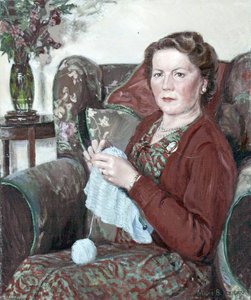
Mavis Blackburn: A Painter of Gentle Landscapes and Quiet Moments
Mavis Blackburn (1923-2005) wasn’t a name that dominated the art world, yet her quietly evocative paintings possess a remarkable charm. She was a British artist who dedicated her life to capturing the serene beauty of the English countryside – particularly the Wirral Peninsula and surrounding areas – with an understated grace and a deep appreciation for light and color. Blackburn's work isn’t about grand pronouncements or dramatic scenes; instead, she offers intimate glimpses into idyllic landscapes and still lifes brimming with subtle detail and a profound sense of peace.
Born in Wallasey, Cheshire, in 1923, Mavis Blackburn’s artistic journey began with formal training at Liverpool College of Art. Her early influences were shaped by prominent instructors like Will C. Penn, Martin Bell, and Alfred Wiffen, who instilled in her a solid foundation in technique while encouraging experimentation. She initially explored abstraction during the 1960s and 70s, finding inspiration in the bold movements of artists such as Bridget Riley, but ultimately returned to a naturalistic style, drawn to the familiar comforts of British landscapes. Blackburn’s artistic practice was deeply rooted in her local environment; she spent much of her life residing in West Kirby, Wirral, providing her with constant access to the subjects that would define her oeuvre.
The Palette and Technique of Pastoral Scenes
Blackburn's paintings are characterized by a delicate balance between realism and impressionism. She rarely employed harsh brushstrokes or overly vibrant colors; instead, she favored muted tones – soft blues, greens, ochres, and pinks – to create a sense of atmospheric depth and tranquility. Her technique involved layering thin washes of paint, building up color gradually to achieve luminous effects. A key element of her style is the meticulous rendering of detail, particularly in depicting flowers—often Dutch tulips, reflecting a deep appreciation for their beauty and historical significance. These still lifes are not merely botanical studies; they’re imbued with a quiet dignity and a sense of timelessness.
Her landscapes frequently feature red brick cottages nestled amongst rolling hills, evocative waterways, and the ever-present presence of the sea. Works like “Building Site, West Kirby, Wirral” capture the transformation of the landscape during construction, yet retain an underlying sense of harmony and beauty. Similarly, "Rooftops, Holmfirth, West Yorkshire" presents a charming view of rural Yorkshire, showcasing the simple pleasures of village life. These scenes aren’t dramatic or heroic; they are intimate portraits of everyday existence, rendered with remarkable sensitivity.
Notable Works and Recognition
Blackburn's work has been exhibited at various venues throughout her career, including the Royal Academy, the Royal British Institute, and the Williamson Art Gallery in Birkenhead, where a retrospective exhibition was held in 1992. The gallery holds several of her paintings in its permanent collection, testament to their enduring quality and appeal. Her auction records indicate that her work has sold for prices ranging from approximately £500 to over £3,000, demonstrating a growing appreciation for her unique artistic vision.
Beyond the gallery walls, Blackburn’s paintings have found homes in private collections across the United Kingdom. Her art is often associated with the Wirral Peninsula and its distinctive character, reflecting a deep connection to her local community. She was also a member of several artist organizations, including the Royal Camberwell Artists' Association and the Wirral Society of Art.
Legacy and Influence
Mavis Blackburn’s legacy lies not in grand pronouncements or revolutionary techniques, but in her quiet dedication to capturing the beauty of the everyday. Her paintings offer a welcome respite from the frenetic pace of modern life, inviting viewers to slow down, appreciate the simple pleasures, and find solace in the natural world. While she may not be as widely recognized as some of her contemporaries, Mavis Blackburn’s work continues to resonate with those who value understated elegance, meticulous detail, and a profound sense of peace.
Her influence can be seen in the continued popularity of idyllic British landscape painting, demonstrating the enduring appeal of scenes that evoke nostalgia, tranquility, and a deep connection to place. Further research into her life and work reveals an artist deeply committed to her craft and profoundly connected to the landscapes she so lovingly depicted.