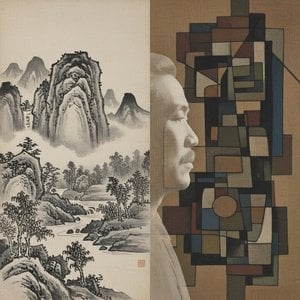
The Cinematic Soul of a Visual Storyteller
Kim Jong-Hak, born in 1951 in the scenic region of Jecheon, South Korea, was an artist whose creative essence transcended the boundaries between the moving image and the static canvas. While history often remembers him as a titan of South Korean television, his spirit was that of a true multidisciplinary visionary. His journey began not with a brush, but with the rhythmic pulse of narrative structure, honed during his formative years at Kyung Hee University. As a student of journalism, he developed an acute sensitivity to the human condition, a trait that would later define both his directorial masterpieces and his evocative visual expressions. His early life was marked by a profound connection to storytelling, evidenced by his early accolades in theater competitions, which laid the groundwork for a career dedicated to capturing the ephemeral beauty of emotion and the weight of historical memory.
The trajectory of Kim’s career is inseparable from the evolution of Korean media itself. Joining the Korean Broadcasting Corporation (MBC) in 1977, he entered an era of immense technological and cultural transition. As color broadcasting and new camera technologies emerged, Kim mastered the art of the visual frame, learning to use light and composition to evoke deep-seated psychological truths. His early work as an assistant director under legendary mentors allowed him to absorb the nuances of historical drama, or sageuk, where he learned to weave the grandeur of the past with the intimate struggles of the individual. This period was a crucible of development, transforming a young journalist into a sophisticated visual architect capable of directing complex, multi-layered narratives that resonated far beyond the television screen.
Mastery of Emotion and the Weight of History
Kim Jong-Hak’s true legacy lies in his ability to transform historical trauma into universal human experiences. His breakthrough works, most notably Eyes of Dawn (1991) and Sandglass (1995), are not merely television programs but cinematic landmarks that captured the collective psyche of a nation navigating its turbulent post-war identity. Through his lens, themes of grief, reconciliation, and the relentless passage of time were rendered with a painterly sensitivity. He possessed a rare gift for utilizing the frame to mirror the internal landscapes of his characters; a sudden shift in shadow or a lingering shot on a desolate landscape could communicate more than any dialogue. His work functioned as a bridge, connecting the heavy, often painful history of Korea to a modern, searching audience, much like how a painter uses texture to convey the scars of time.
In his later years, Kim continued to push the boundaries of scale and ambition. The establishment of Kim Jong Hak Production in 1999 signaled his commitment to large-scale, high-concept storytelling, including fantasy epics like The Legend and Faith. Even as he navigated the immense financial and logistical pressures of big-budget production, his fundamental artistic impulse remained focused on the evocative power of the image. His work during this period reflected a fascination with the mythic and the monumental, attempting to capture the sublime through grand visual compositions. Though his life came to a tragic end in 2013 amidst the shadows of professional struggle, the brilliance of his creative output remains undimmed, leaving behind a body of work that serves as a profound testament to the power of visual storytelling to confront, endure, and ultimately transcend human suffering.
Spørgsmål og svar
Hvilke andre navne er Kim Jong-Hak kendt under?
Kim Jong-Hak optræder under de alternative navne Kim Jonghak.
Hvor kan jeg se farveprofilen i Kim Jong-Haks værker?
Farvepalettens DNA for Kim Jong-Hak er en side, der præsenterer farveprofilen i kunstnerens samlede værk.
Hvor populære er Kim Jong-Haks kunstværker?
Siden Statistik for Kim Jong-Hak præsenterer statistikker beregnet ud fra kunstnerens værker, som er listet på denne hjemmeside.
Findes der en komplet liste over Kim Jong-Haks værker?
Se alle værker af Kim Jong-Hak på denne hjemmeside på kunstnerens Alle kunstværker-side.