A Life Woven in Color and Memory
Born in Edinburgh, United Kingdom, Joyce W. Cairns has emerged as one of the most significant voices in contemporary Scottish art. Her journey through the world of fine art is a deeply personal odyssey, shaped by her formative years in North East Scotland and an academic path that led her from the prestigious Gray's School of Art in Aberdeen to the Royal College of Art in London. This rich educational foundation, which included a fellowship at Gloucestershire College of Art and Design and further studies at Goldsmiths' College, provided the technical rigor necessary to support her profound expressive power. As a painter and printmaker, Cairns does not merely depict scenes; she captures the very essence of human experience, weaving together the threads of autobiography and psychological depth.
Her artistic evolution is marked by a transition from the mythological explorations of the 1970s to more visceral, grounded themes. For many years, her work was intimately tied to the small fishing village of Footdee at the mouth of Aberdeen harbour. The presence of large boats passing her home and the industrial landscape of the harbour became recurring motifs, serving as a backdrop for much of her evocative figurative painting. In these works, the boundary between the external world and internal memory begins to blur, creating a space where the past and present coexist in a hauntingly beautiful tension.
Themes of War, Family, and Identity
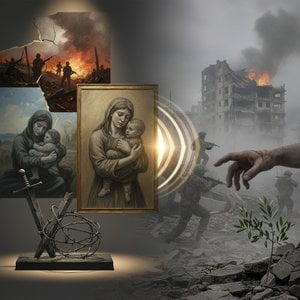
The heart of Cairns’ oeuvre lies in its ability to communicate complex emotional landscapes through a powerful expressionist style. She is widely recognized for her ability to tackle heavy, monumental themes such as war, family, and memory. One of her most significant achievements was the development of the War Tourist project, a body of work that recounted the horrors of conflict through the lens of personal family history. By approaching war not as a distant political event but as a personal, lived experience, she achieved a level of intimacy that resonated deeply with audiences, notably during her major exhibition at the Aberdeen Art Gallery.
Her paintings often feature characters that feel both monumental and fragile, reflecting the psychological weight of her subject matter. Whether exploring the domesticity of TV Dinners or the rugged landscapes of her Scottish roots, there is a consistent sense of humanity in her brushwork. This focus on the human condition has allowed her work to remain relevant in an ever-changing world, as she continues to use the canvas to navigate the complexities of identity and the persistence of memory.
Legacy and Institutional Recognition
Throughout her illustrious career, Joyce W. Cairns has achieved remarkable distinction within the art community. Her leadership and influence were formally recognized when she was elected President of the Royal Scottish Academy (RSA) in 2018, making history as the first woman to hold this prestigious position. This milestone is a testament to her standing as an influential educator and a pillar of the Scottish art establishment.
Her contributions to the arts are reflected in numerous accolades and her presence in significant collections:
- President of the Royal Scottish Academy
- First female president of the Aberdeen Artist’s Society
- Member of the Royal Scottish Academy (RSA)
- Work held in numerous private and public collections across the United Kingdom and abroad
From her early days as a lecturer at Gray’s School of Art to her current residence near the River Tay in Dundee, Cairns has remained dedicated to a practice that is both deeply local and universally resonant. Her legacy is one of courage—the courage to confront difficult histories and the courage to find beauty within the fragments of the past.
Spørgsmål og svar
Hvilken by og hvilket land er Joyce W Cairns født i?
Joyce W Cairns blev født i Edinburgh, i United Kingdom.
Hvor kan jeg finde statistik om Joyce W Cairnss værker?
Siden Statistik for Joyce W Cairns præsenterer statistikker beregnet ud fra kunstnerens værker, som er listet på denne hjemmeside.
Hvor kan jeg se alle værker af Joyce W Cairns?
Se alle værker af Joyce W Cairns på denne hjemmeside på kunstnerens Alle kunstværker-side.