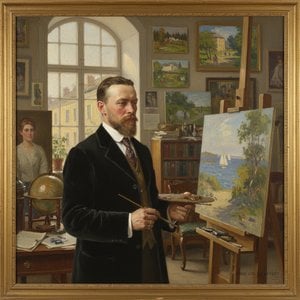
Early Life, Family and Training
Jonas de Barros was born in 1875 in the town of Itu, located in the state of São Paulo, Brazil. He was the son of Abrahão Lincoln de Barros and Maria Clarinha de Barros. The family lived in Itu until 1895, a period that shaped the early years of the painter before his life moved toward the larger urban centers of the country.
His path as an artist began through direct mentorship. He studied under the painter Almeida Júnior, a connection that provided him with a foundation in the technical demands of his craft. This early guidance helped prepare him for more formal academic pursuits. He eventually became a student at the Academia de Belas Artes, where he refined his skills and developed the approach he would use throughout his career.
As he matured, his interests turned toward the observation of the world around him. He found his calling in painting landscapes and scenes of customs, focusing on the quiet details of daily life and the natural environment. This dedication to capturing specific moments and settings became a defining characteristic of his work as he transitioned from a student to a professional painter.
Patrons, Workshop and Commissions
Barros found significant professional footing through his connection to the Museu Paulista. He was among the painters selected by the institution's former director, Afonso d'Escragnolle Taunay, to undertake a specific and demanding task. His commission involved portraying the history of São Paulo, capturing the city's evolution through various eras. This work required him to look closely at historical records to ensure his depictions remained grounded in reality.
To achieve this historical accuracy, he relied heavily on photographic sources. He frequently studied the images captured by the photographer Militão Augusto de Azevedo, using these visual documents as the foundation for his compositions. By translating these photographs into oil paintings, he helped document the changing face of the city for the museum's collection. His approach allowed him to bridge the gap between the stillness of a photograph and the lived atmosphere of a painted scene.
Key Works and Exhibitions
The public life of Jonas de Barros was marked by a steady presence in the galleries of São Paulo. In 1901, he brought his painting Rinha de Galos to the Casa Garraux, marking an early moment of recognition. This was followed by a significant showing in 1902, when he presented thirty different works at the Galeria Castelões. His reach extended through several years of collective displays, including his participation in the Iª Exposição Brasileira de Belas-Artes during 1911 and 1912.
Much of his legacy remains held within the Ipiranga Museum in São Paulo. Among the pieces preserved there is Quiosque no Cambucí, 1822, a work that captures a specific sense of place and time. The museum also holds his Retrato de Campos Sales, a piece that reflects the portraiture and historical interests that defined much of his output. These works offer a glimpse into the scenes of customs and landscapes he spent his life observing.
Spørgsmål og svar
Kan jeg udforske Jonas de Barross værker efter emne?
Siden Emneoversigt kortlægger Jonas de Barross kunstværker efter motiv.
Hvor kan jeg se alle værker af Jonas de Barros?
Se alle værker af Jonas de Barros på denne hjemmeside på kunstnerens Alle kunstværker-side.
Kan jeg studere Jonas de Barross farvebrug på tværs af alle værker?
Farveprofilen for Jonas de Barross værker kan ses på kunstnerens Farvepalettens DNA-side.
Hvordan finder jeg værker af Jonas de Barros inden for et specifikt tema?
Siden Efter nøgleord for Jonas de Barros grupperer kunstnerens værker efter nøgleord.