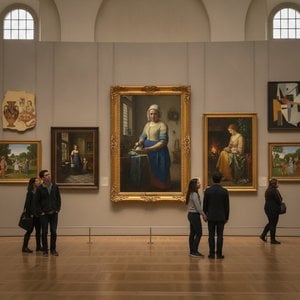
The Dutch Hand in London
Born in the bustling streets of Haarlem, Netherlands, Jan van der Vaart began his life's work under the watchful eye of Thomas Wijck. This early training laid the foundation for a career that would eventually find its true home across the sea. By 1674, he had established himself in London, moving within the circles of Dutch immigrants who shaped the English art scene. He spent much of his time in the workshop of Willem Wissing, a man who had once been a pupil of the great Sir Peter Lely. In those shared spaces, Van der Vaart learned the delicate art of painting draperies and landscapes, contributing his skill to the larger portraits that defined the era.
His life was one of constant movement and adaptation. After Wissing passed away in 1687, Van der Vaart took up the mantle of the workshop, continuing the legacy of his mentor. He was a man of many talents, moving between the roles of painter, draughtsman, and restorer. His hands were as skilled at the precise work of mezzotint as they were at the broad strokes of a landscape. He even found time to act as a collector, gathering works that reflected his own refined eye.
A Versatile Hand
The breadth of his output was remarkable, as he refused to be confined to a single subject. He moved through the genres with a quiet confidence, applying his technique to various forms of visual storytelling. His work often focused on the following:
- Portraits that captured the likeness of his contemporaries.
- Landscapes that brought the natural world into the domestic sphere.
- Trompe-l'œil still lives, including a notable depiction of a violin on a door at Chatsworth House.
- Flower still lifes and religious compositions.
- Mezzotint prints produced after the works of prominent portraitists.
This versatility allowed him to navigate the shifting demands of the London art market. He was an early practitioner of the mezzotint technique in England, helping to introduce a new way of seeing through print. His influence extended even to the next generation, as he likely served as a teacher to the engraver John Smith.
The Quiet Years of Restoration
As the years passed, the physical toll of his craft began to manifest. The very eyesight required to capture the minute details of a flower or the texture of a fabric began to fail him. By 1713, having sold his collection and established a house in Covent Garden, he made a significant change in his life's work. He set aside the brush and the engraving tool to focus on the careful restoration of paintings. This transition allowed him to remain connected to the art he loved, even as his ability to create new worlds diminished. He lived out his days in London, leaving behind a legacy of technical skill and a business that his nephew Arnold would continue to manage.
Spørgsmål og svar
I hvilke kunstretninger arbejdede Jan van der Vaart?
De kunstretninger, som Jan van der Vaart arbejdede inden for, kan findes på kunstnerens Alle kunstretninger-side, hvor værkerne er grupperet efter kunstretning.
Hvor kan jeg se Jan van der Vaarts værker opdelt efter stemning?
På kunstnerens Stemningsfulde rum side kan du finde Jan van der Vaarts værker sorteret efter stemning.
Hvor kan man finde Jan van der Vaarts kunstværker grupperet efter nøgleord?
For at finde værker af Jan van der Vaart inden for et specifikt tema kan du bruge kunstnerens Efter nøgleord-side, som grupperer værkerne efter nøgleord.